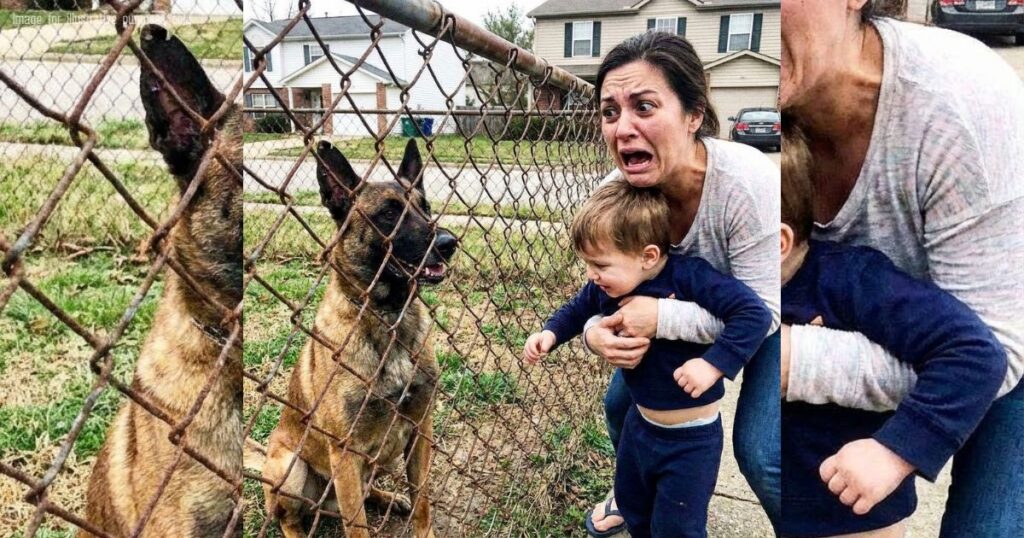
If you think dragging a half-frozen kid out of a pond earns a dog a quiet retirement, you don’t understand cul-de-sacs in 2025. Three weeks after I kept Toby breathing in the snow, the neighborhood decided to put me on trial—with Wi-Fi, lawn chairs, and store-bought cookies.
They didn’t call it a trial, of course.
They called it “A Community Safety Listening Session.”
Humans like soft words for hard things.
It started with a video.
Not Elena’s. Not Mac’s. Some teenager two houses down had filmed the rescue from an upstairs window—the blue and red lights, the screaming, the moment the flashlight found me wrapped around Toby like a furry shield.
They posted it to the neighborhood app with a caption:
“That ‘dangerous’ dog just saved the Vance kid’s life. Maybe the real liability isn’t the one with four legs 🤔”
The video left out the part where my hip nearly froze solid. It left out the smell of Toby’s skin turning too cold, too fast. But it showed enough: my scarred body blocking the wind, Mac shouting at the officer not to draw his gun, Elena collapsing around her son.
It was up for thirteen minutes before it spread.
Thirteen minutes before the comments turned my street into a battlefield.
I don’t understand screens the way humans do, but I understand adrenaline. I understand the way Mac’s heartbeat doubled as he scrolled, thumb jerking, jaw tight.
He sat on the couch, phone glowing in his hand, while I lay with my head on his boot. I could hear every tiny tick of his tendons.
“Listen to this,” he said finally, voice flat. He started reading out loud.
“‘This dog is a hero. We don’t deserve animals like this.’”
His hand drifted down, fingers tangling in the fur of my neck.
Then his voice changed.
“‘Actually, this is exactly why these types of dogs don’t belong near kids. Trained to attack, high prey drive, one wrong move and we’re planning a funeral.’”
His pulse spiked. I flicked an ear.
Another comment.
“‘So we’re just okay with a military attack dog running around breaking down doors now? What if he’d gone after another child instead?’”
Mac exhaled through his nose in that sharp way that means angry.
Elena texted him a screenshot. I could smell the stress chemicals even through the glass of her kitchen window. Her message popped up big and bright:
We need to talk. They’re bringing this to the HOA board. Tonight.
The board met in the “multi-purpose room” of the clubhouse, which smelled like folding tables, lemon cleaner, and old coffee.
The last time I’d sat in a room with this many chairs, it had been a briefing tent outside Kandahar.
Back then, we talked about routes, blast radiuses, and who might not come home.
Tonight, they talked about me.
I lay at Mac’s feet, service harness snug across my shoulders, my ID tags a small jungle of metal clinks whenever I shifted. Every time his leg bounced, my shoulder brushed his shin. We were tethered even without a leash.
Elena sat in the front row with Toby. He wore headphones and clutched a small rubber dinosaur in one hand, my old chew toy in the other. He kept glancing at me, rocking gently, the way he did at the fence before the night of the storm.
The HOA president cleared his throat. He wore a crisp polo shirt and the nervous scent of a man who likes control and is losing it.
“Thank you, everyone, for coming,” he began. “We’re here to discuss concerns regarding community safety, recent events involving a resident’s dog, and our liability as a neighborhood.”
There it was again. Liability.
Humans love labels. They put them on dogs, on kids, on each other, on anything that makes them uncomfortable. A label feels like a shield, but sometimes it’s just a blindfold.
A woman in the second row—short hair, bright sneakers, smell of citrus soap and judgment—shot her hand up immediately.
“Can we just be honest?” she said. “If that video hadn’t gone around, we’d still be trying to get rid of this dog. One lucky night doesn’t erase a whole file of ‘incidents.’ He broke a door. He escaped his yard. He—”
“He broke a door to pull my son out of a frozen pond,” Elena snapped, louder than she meant to. Heads turned. Toby flinched, but his eyes stayed on me.
The citrus woman folded her arms. “I’m glad your son is okay. Truly. But I also know a family whose child was mauled by a ‘good dog’ that ‘never hurt anyone.’ Everyone always says that line… until it’s too late.”
Murmurs in the crowd. Nods. Tight lips. A few people wouldn’t meet my eyes at all.
I’d seen that look before, in another country, on the faces of villagers who didn’t know if the dog at the gate was trained to sniff out bombs or to send a message.
Fear doesn’t need facts. It just needs a story that feels close enough.
They brought in an “expert witness.”
She smelled like other dogs and calm authority—a trainer, or maybe a behaviorist. She sat in front of me, knees relaxed, hands still, eyes soft. It was good handling.
“Atlas,” she said, voice low. “Hey, buddy.”
I watched her hands first. Always the hands.
She extended her palm, letting me lean in to scent her. Dry skin, chicken treats, faint whiff of shelter disinfectant. She knew her job.
“This dog is not feral,” she said, turning to the room while still keeping me in her peripheral vision. “He is focused, responsive, and has a history of high-level training.”
“You say ‘focused,’” citrus woman scoffed. “I say ‘fixated.’ Same difference when your child is on the other end.”
The trainer didn’t flinch.
“Look,” she said, “I won’t pretend there’s zero risk. There is always risk with any animal, especially one this powerful and this experienced. But there’s also risk in not understanding what animals like Atlas can do for families like the MacAllisters, and frankly, for kids like Toby.”
Elena’s fingers tightened on her son’s shoulders. “What is that supposed to mean?” Citrus woman demanded. “Are you saying the rest of us don’t care about our kids?”
“I’m saying,” the trainer replied carefully, “that neurodivergent kids often connect with animals in ways they can’t with people. I did a home visit this week. Toby approached this dog, initiated contact, and—”
“He what?” someone whispered.
Elena’s eyes shone. “He said his name,” she said softly. “He hasn’t spoken in months. He touched Atlas’s ear and he whispered it. I heard it. His therapist heard it. It wasn’t loud, but it was there.”
The room rustled like a field in the wind. Surprise. Skepticism. Hope.
Toby rocked a little faster but didn’t look away from me. His lips moved around a sound no one else could hear.
I heard it.
Atlas.
That word is my call sign, my anchor. I would’ve crawled through fire for it in the desert. I would crawl through HOA bylaws for it here.
Then came the part that turned the meeting into something bigger—and messier—than a dog dispute.
The board lawyer stood. Gray suit, briefcase, the heavy smell of paper and worry.
“Our insurance adjuster has flagged this situation,” he said. “If we are aware of a ‘high-risk animal’ and do not take action consistent with our own regulations, we could be held responsible in the event of… another incident.”
“Another incident?” Mac repeated, leaning forward. “You mean the one where my dog saved a child’s life and your rulebook nearly killed him because we were supposed to keep him behind a fence?”
The lawyer shifted. “I’m simply outlining our exposure. We have to think about the community as a whole, not just—”
“Not just the veteran you want to exile and the kid you call a file number at the insurance office,” Mac snapped.
The air crackled. I nudged his hand with my nose, a gentle bump: Easy. Breathe. Check your flank.
He inhaled, long and shaky.
The board president tried to smooth it over. “No one is talking about exile,” he said. “We’re exploring options. Perhaps mandatory muzzling outside, a reinforced enclosure, higher premiums—”
“You already tried that,” Elena cut in. “You tried to build a taller wall instead of a safer community.”
“Mrs. Vance,” the president said carefully, “with all due respect, you were the one who filed the original complaint.”
The room went very quiet.
All eyes swung to her.
Even Toby paused his rocking.
Elena’s face flushed. Shame. Fear. Determination. Humans are complicated; they can bleed three emotions at once.
“I did,” she said, voice barely above a whisper. “Because I looked at Atlas and saw every headline that ever terrified me. I saw power I couldn’t control and scars I didn’t understand. I saw a threat when what I was really seeing… was my own fear.”
She turned to face the rows of folding chairs.
“And I need you all to hear this,” she said, louder now. “My fear almost killed my son.”
A murmur.
“I was so busy trying to make my life look safe that I forgot to let it be safe,” she went on. “I trusted rules and apps and group chats more than the actual living beings in front of me. I wanted a neighborhood that looked perfect on a brochure, instead of one where a disabled veteran and his retired working dog could live with dignity.”
“Are you saying we don’t care about dignity?” Citrus woman snapped. “We care about not getting sued because someone’s ‘good boy’ snaps—”
Click the button below to read the next part of the story.⏬⏬