I signed the petition to have him put down on a Tuesday. By Thursday night, that “vicious beast” was the only thing keeping my heart beating in the freezing snow.
We live in Oak Creek Estates, one of those modern American suburbs where the grass is measured with a ruler and the Homeowners Association (HOA) rules are treated like scripture. It’s a place where “safety” is a status symbol and ring doorbell cameras watch every sidewalk.
Then, Mr. Henderson moved into the corner lot—the one with the peeling paint.
He didn’t hire a moving company. He just pulled up in a rusted sedan that looked like it had survived a war zone. And he brought The Dog.
He wasn’t a Golden Retriever or a fluffy “Doodle” like everyone else owns here. He was a Belgian Malinois. Lean, muscular, with a black mask and eyes that tracked movement like a weapon system. His name was Ranger.
To the neighborhood group chat, Ranger looked like a ticking time bomb.
He didn’t bark at squirrels. He didn’t play. He just paced the fence line with a terrifying, silent intensity.
“It’s reckless,” I typed into the neighborhood app one evening, watching Mr. Henderson limp as he carried cheap grocery bags into his house. “That fence is rotting. There are kids riding e-bikes right past there. We need to call Animal Control before a tragedy happens.”
The “likes” poured in. We felt righteous. We were protecting our property values. We were protecting our children.
My judgment solidified when I saw Mr. Henderson at the local pharmacy. I was picking up premium vitamins; he was at the counter, counting out crumpled bills for a bottle of generic human-grade ibuprofen. He looked tired, wearing a faded green field jacket.
He can’t even afford to take care of himself, I thought, judging him from my heated SUV. How is he controlling a predator like that?
Two days later, I filed the official report. I cited “aggressive behavior” and “inadequate containment.” I felt a twinge of guilt, but I told myself I was being a responsible mother.
Then came the storm.
That Thursday, a “Bomb Cyclone” hit the East Coast. Temperatures dropped to single digits within hours. The roads turned into sheets of black ice. My husband was stuck in Atlanta on business, and my teenagers were gaming in the basement with headsets on.
Around 10:00 PM, I realized the garage door was stuck open. I threw on a silk robe and slippers, thinking I’d be out for ten seconds to manually close it.
I stepped onto the driveway and vanished.
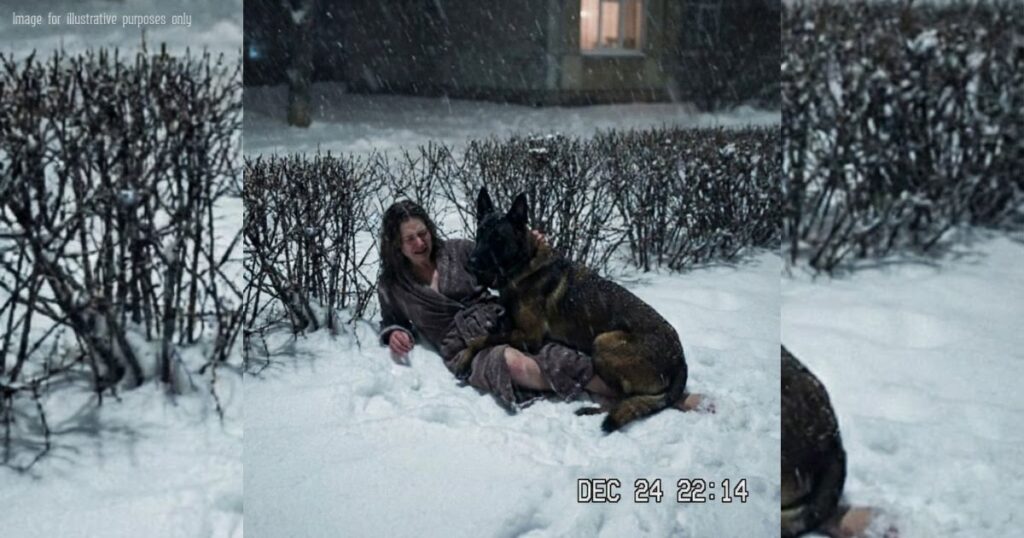
I hit a patch of black ice so slick it felt like the earth had been yanked away. My feet went up, and my head cracked against the concrete. The world went white, then dark gray. I slid down the sloped driveway, tumbling behind the dense hedges, completely invisible from the street and the house.
I tried to stand, but my leg crumbled. A compound fracture. The pain was blinding, making me vomit bile into the snow. I reached for my pocket, but my phone was sitting on the kitchen island.
I screamed. The wind roared back, swallowing my voice. The street was empty. The neighborhood was silent, everyone tucked inside their warm, “safe” homes.
Twenty minutes passed. The cold wasn’t just cold anymore; it was a physical weight, crushing my lungs. My shaking slowed down. I knew what that meant. Hypothermia was setting in. I closed my eyes, thinking about my kids, realizing I was going to die in a bathrobe ten yards from my front door because of a garage door sensor.
Then, I heard it.
Snap. Crunch.
Wood splintering.
I flinched, expecting a coyote. Through my freezing eyelashes, I saw a shadow clear the fence between our yards in a single, massive leap.
Ranger.
He hit the ground running. I curled into a ball, covering my neck, waiting for the bite I had predicted for weeks.
But there was no bite.
I felt a heavy weight slam onto my chest. Ranger lay directly on top of me. He wasn’t attacking; he was banking me. He curled his muscular body around my torso, acting as a living blanket, pressing his furnace-like heat against my failing heart.
He let out a sound I’d never heard—not a growl, but a rhythmic, piercing bark.
Bark… pause… Bark… pause.
It was mechanical. Relentless. A distress beacon.
He licked my face, his rough tongue scraping against my numbing skin, forcing me to stay awake. Every time my eyes drifted shut, he nudged my jaw hard with his wet nose.
He’s working, a sluggish part of my brain realized. He’s on duty.
I don’t know how long we lay there, the “monster” saving the woman who tried to kill him. Eventually, I heard a command cut through the wind.
“RANGER! HOLD!”
Mr. Henderson came moving through the deep snow. He wasn’t limping now. He moved with a speed and focus that betrayed his age. He knelt beside me, his hands checking my pulse and pupil dilation with practiced efficiency.
“Ma’am, stay with me,” he commanded. His voice wasn’t the quiet mumble of a shut-in; it was the steel voice of a Sergeant. He stripped off his own jacket, wrapped it around me, and dialed 9-1-1.
Ranger didn’t move an inch until the paramedics loaded me onto the stretcher. As they wheeled me away, I saw the old man clip a leash onto the dog. Ranger looked at me one last time, his eyes soft, intelligent, and worried.
Three days later, discharged with a cast and a concussion, I had my son drive me to the corner lot.
I hobbled to the door with a basket of muffins, feeling smaller than I ever had in my life.
Mr. Henderson opened the door. The house was freezing inside—colder than the outside air. He was wearing two sweaters.
“I came to thank you,” I stammered, fighting back tears. “And Ranger. He saved my life.”
Mr. Henderson looked at the floor, embarrassed. “He did what he was trained to do, ma’am. He was a Multi-Purpose Canine in Afghanistan. He sniffed out IEDs. He saved a lot of Marines back then. He… he still thinks he’s on patrol.”
He invited me in, reluctantly. There were no family photos. Just a folded American flag in a case and a photo of a younger Mr. Henderson with a dog that looked just like Ranger.
“He has bad hips now,” Mr. Henderson said softly, rubbing Ranger’s ears as the dog sat stoically by his wheelchair. “That jump over the fence… it hurt him bad. But he heard your heart rate drop from across the yard. He hears things we can’t.”
I looked around the sparse living room. I saw the bottle of generic ibuprofen on the table—the ones I saw him buy.
I suddenly realized they weren’t for him. They were for the dog. Veterinary medicine has become so expensive that he was splitting human pills to manage the dog’s pain.
Then, I saw the letter on the coffee table. It was bright orange. A citation from the City Code Enforcement.
NOTICE OF ANIMAL SEIZURE. Due to multiple complaints of aggression and inadequate containment… owner has 7 days to surrender the animal or prove compliance with new fencing regulations.
My digital signature was on the complaint referenced in the file.
I felt like I was going to be sick.
“I don’t know what I’m doing,” Mr. Henderson said, his voice finally cracking. “Inflation… my pension check just doesn’t cover the new vinyl fence the HOA wants. And the vet bills. I tried to keep him quiet. I really did.”
He looked at me, tears welling in his tired eyes. “He’s not a pet, ma’am. He’s my partner. When the nightmares come at 3:00 AM, he wakes me up. If they take him, they might as well take me too.”
I started crying. I cried for my arrogance. I cried for the way I let my fear of the “other” blind me to the hero living next door. I judged a man for his unpainted fence while he was choosing between heating his home and relieving his partner’s pain.
“They aren’t taking him,” I said, grabbing the orange paper.
“Ma’am?”
“I wrote this,” I confessed, my voice shaking. “And I’m going to fix it.”
I didn’t just withdraw the complaint. I went back to that neighborhood group chat. I typed out the longest post of my life.
I told them about the ice. I told them about the “monster” that used his own body heat to keep a stranger alive while his own hips were screaming in pain. I told them that while we were worried about “curb appeal,” a decorated veteran was freezing in his living room to keep his service dog mobile.
The post didn’t just get likes. It got action.
This is America. We argue about everything, but when we see the truth, we show up.
Within two hours, a neighbor who owns a fencing company was at Mr. Henderson’s door with a crew. They tore down the rotting wood and put up the finest fence in the county—free of charge.
The local vet saw the post and commented immediately: Free hydrotherapy and pain management for Ranger. For life.
By evening, the porch that I had once called an “eyesore” was stacked so high with firewood, dog food, and grocery gift cards that you couldn’t see the front door.
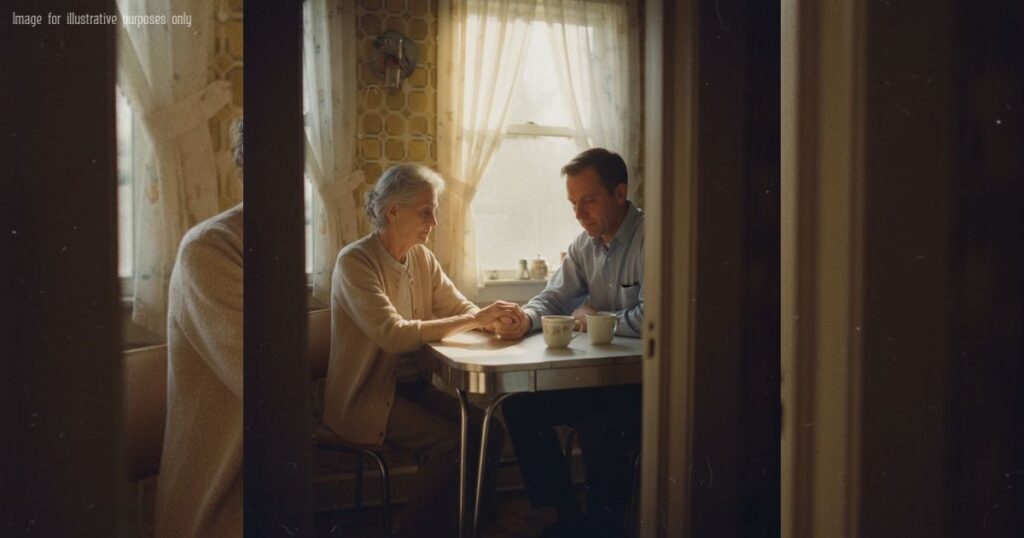
We sat in his living room a week later. It was warm. The fire was crackling. Ranger was sleeping on a new orthopedic memory-foam bed, his legs twitching as he dreamed of chasing balls instead of bombs.
“You know,” Mr. Henderson said, sipping coffee, “I thought everyone out here hated us. I thought we didn’t belong in a neighborhood like this.”
“You belong here more than anyone,” I said.
I looked at Ranger. He wasn’t a weapon. He was a mirror. He showed us that our fear is often just a lack of understanding, and that the strongest hearts often beat behind the most ragged fences.
In a world where we are trained to scroll past, to judge, and to cancel—sometimes the most radical thing you can do is walk across the street and say hello.
We are all fighting battles our neighbors know nothing about. Be the one who breaks the ice, before the cold takes over.
—
🧩 PART 2: The Fence Didn’t Fix the Fear
The fence went up in a day.
The backlash took less than an hour.
By the next morning, my phone buzzed like an angry beehive—notifications stacking on my screen until the words blurred. Some people were still praising Ranger, calling him a hero.
But the other comments?
They were sharp. Suspicious. Hungry.
Click the button below to read the next part of the story.⏬⏬