Who gets saved.
My throat tightened.
Because part of me understood what they meant.
And part of me hated that it took a near-death experience to make me see how quickly we measure each other’s worth.
When it was my turn, I stood up slowly.
Every eye in that room turned toward me like I’d become a symbol instead of a person.
“I agree with one thing,” I said, voice shaking but steadying as I spoke. “Safety matters.”
A few people seemed surprised I didn’t come out swinging.
I held up the binder.
“This is a behavioral evaluation from a certified trainer. These are vet records. These are compliance documents for the fence. This is proof—real proof—that Ranger has training and containment.”
I paused, letting the silence do its job.
“But here’s what I need you to hear,” I continued. “Ranger is not the only thing being judged here.”
I looked across the room, searching for faces I recognized.
“We saw an old man with a peeling fence and we decided he didn’t belong. We saw a working dog and we decided it was a threat. And the scariest part is how normal that felt.”
Someone scoffed.
I didn’t flinch.
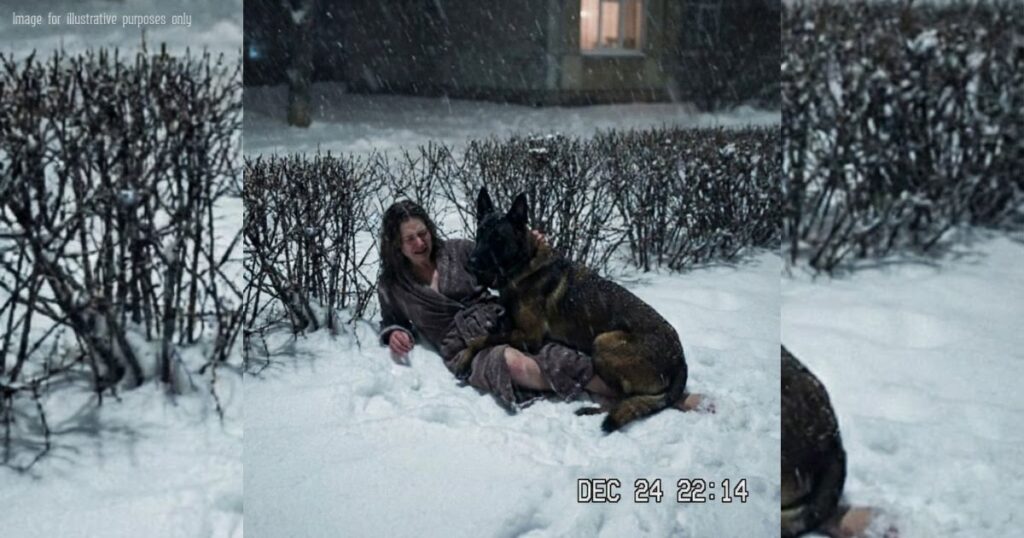
“Last week,” I said, “I lay in the snow with a broken leg and hypothermia setting in while my family was ten yards away inside the house.”
A hush fell.
“Ranger jumped a fence with bad hips and used his body heat to keep me alive. He barked until Mr. Henderson found me. That dog did not ‘snap.’ That dog worked.”
I let my eyes move to the parents in the room.
“If you want to protect your children,” I said softly, “teach them what a warning bark means. Teach them not to throw snowballs at animals. Teach them that fear doesn’t give you the right to destroy someone else’s life.”
The room shifted—some uncomfortable, some defensive.
And then Mr. Henderson stood up.
He didn’t look like a hero.
He looked like a man who’d been forced into a spotlight he never asked for.
He didn’t raise his voice.
That’s why everyone heard him.
“I don’t want your pity,” he said. “I don’t want to be your project.”
He glanced down at his hands—hands that had probably carried more weight than any of us could imagine.
“I just want to keep my partner.”
His voice cracked on the last word.
Not like weakness.
Like exhaustion.
“When the nightmares hit,” he continued, “he wakes me up. When I stop breathing right, he nudges me until I sit up. When I forget where I am, he brings me back.”
He looked around the room.
“If you take him,” he said, “you’re not removing a danger. You’re removing the one thing that keeps me from disappearing.”
Silence swallowed the fluorescent hum.
Even the HOA President blinked too hard, like she had to fight to stay “professional.”
A woman in the back stood up.
“I’m scared of dogs,” she admitted. “I am. I’ve had bad experiences. But…”
She hesitated, then exhaled.
“But I’m more scared of becoming the kind of person who can hear that man talk and still choose rules over humanity.”
That’s when the room broke.
Not into chaos.
Into reality.
People started offering solutions instead of opinions.
A group proposed a neighborhood training day—education for kids and adults about dog behavior and safe boundaries.
Someone suggested creating a hardship waiver process for fence requirements, so older residents weren’t crushed by sudden rule changes.
And then, one of the loudest critics spoke again—voice quieter this time.
“If we’re going to help him,” he said, “we should build something fair. A community fund for emergency vet care, not just one dog.”
A few heads nodded.
Controversial, sure.
But it shifted the argument from who deserves help to how we help without turning it into a popularity contest.
It was the first time that night that Oak Creek Estates sounded like a community instead of a comment section.
Two days later, the city inspector came.
Mr. Henderson sat in his chair, spine straight.
Ranger lay at his feet, calm, eyes scanning like a sentry who trusted the perimeter.
The inspector checked the fence. Read the binder. Observed the dog’s response to basic commands.
Finally, he cleared his throat.
“Based on compliance and evaluation,” he said, “no seizure will take place at this time.”
My knees almost gave out from relief.
But then he added, carefully:
“This remains conditional. Any further complaints will trigger review.”
He didn’t say it like a threat.
He said it like a fact.
Because the system doesn’t do grace.
It does procedures.
That night, I walked outside alone.
The snow had hardened into glittering crust under the streetlights. Doorbell cameras blinked quietly on porches, watching like little electronic judges.
Across the street, Mr. Henderson’s house glowed warm for the first time since he’d moved in.
I saw Ranger through the window—curled on his bed, finally resting.
Not on patrol.
Just… a dog.
I stood there longer than I meant to.
Because here’s the part nobody wants to admit out loud:
It’s easy to be kind when the story is simple.
Hero dog saves woman. Neighborhood rallies. Happy ending.
But real life doesn’t end when the post stops trending.
Real life is the follow-up emails.
The suspicious comments.
The uncomfortable questions about fairness and fear and who gets help when everything costs too much.
And it’s what you do when the attention fades.
I went back inside, opened the neighborhood app, and typed one last message.
Not a dramatic speech.
Not a guilt trip.
Just a sentence I needed to believe myself:
“If we want a safer neighborhood, we can’t just build fences. We have to build people who don’t treat each other like threats.”
Then I turned off my phone.
And for the first time in a long time, I slept—knowing that the next storm wouldn’t just test our roofs and roads.
It would test whether we’d learned anything at all.
Thank you so much for reading this story!
I’d really love to hear your comments and thoughts about this story — your feedback is truly valuable and helps us a lot.
Please leave a comment and share this Facebook post to support the author. Every reaction and review makes a big difference!
This story is a work of fiction created for entertainment and inspirational purposes. While it may draw on real-world themes, all characters, names, and events are imagined. Any resemblance to actual people or situations is purely coincidenta