If you think the story ended with the little girl walking out of my bakery carrying the stars, you’re wrong.
That moment was just the part that makes people cry. What came next is the part that makes people argue.
The next morning, I came in before dawn like always.
The bakery is quiet at 4:30 AM. Just the hum of the refrigerators and the soft thump of dough on the table as I stretch and fold it. The neon sign outside still flickers, so the light in the window looks like a heartbeat trying to decide if it wants to keep going.
Marco shuffled in twenty minutes late, hair messed up, still half-asleep.
“Sorry, boss,” he yawned. “My alarm…”
“It’s fine,” I said. “We survived.”
He washed his hands and glanced over at the prep list.
“Hey, what happened to the Galaxy Cake?” he asked. “Did it sell?”
I hesitated for half a second. “Yeah,” I said. “It’s gone.”
He grinned. “Told you someone would pay for your art.”
I didn’t correct him. Not then.
The morning rush hit—commuters, teachers, construction guys, a couple of cops, a nurse or two in scrubs. People complained about the weather, about traffic, about the cost of gas. Nobody knew I had given away an $85 cake the day before. Nobody knew I had written “Damaged. Total Loss.” in the ledger and felt weirdly proud of myself.
I thought it would stay that way.
For exactly twenty-four hours, the whole thing was just between me, a tired nurse named Sarah, and a little girl who got to eat the stars.
Then the internet found out.
It started with a notification ping on my phone during the lunch lull. I run our bakery’s social media myself—it’s just photos of croissants and occasional dad jokes about carbs—so my phone sits on a shelf behind the register.
20 new notifications.
We’re not that kind of place. We don’t “go viral.” Our biggest post ever was a picture of a cinnamon roll shaped like a heart that got shared on a local dog rescue page by accident.
I wiped my hands and picked up the phone.
The first thing I saw was a screenshot of our front door. The Daily Crust. The little bell above it. My crooked “Fresh Bread Daily” sign in the window.
Above the photo, a long block of text.
It was from a community group page called Maplewood Moms & Neighbors. Someone had tagged the bakery’s profile, so it showed up in our notifications.
The post was written by Sarah.
She hadn’t used my name. She hadn’t even used the bakery’s name at first. She’d just said:
“I want to tell you about what happened yesterday at a small local bakery…”
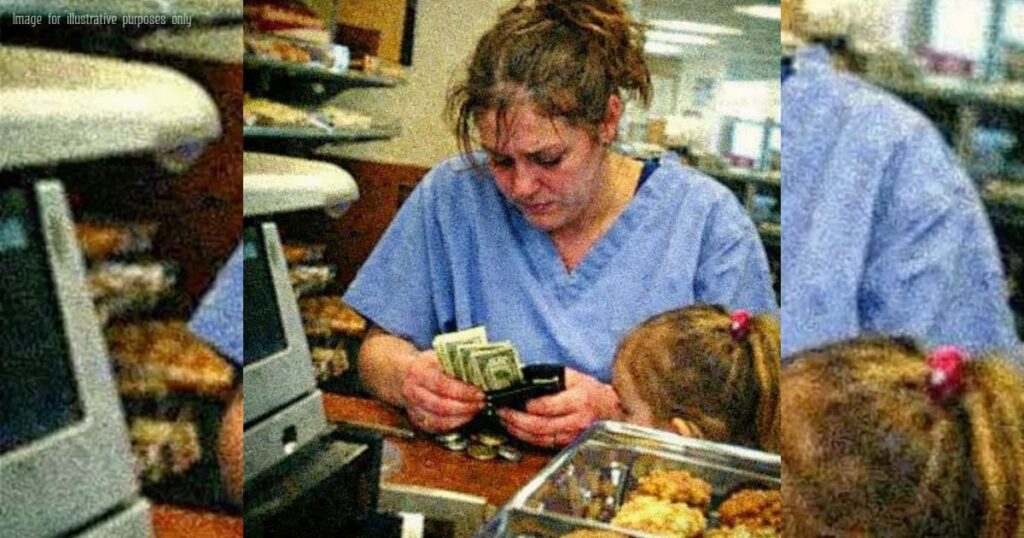
She wrote about the Galaxy Cake. About counting her ones and coins. About telling her daughter the cake was plastic because she couldn’t afford it. She wrote about my lie—the “Miller order” that never existed, the health code story, the whole improvised script.
She ended with:
“My daughter thinks we were just in the right place at the right time. I know a stranger chose to be kind instead of looking away. If you can, support little places like this. They’re keeping people like us afloat in more ways than one.”
Then someone in the comments recognized the front door and tagged us.
And then everything exploded.
By 2:00 PM, there was a line out the door.
People came in looking at me differently. Not like I was just the guy who knew how to proof dough and fix a broken espresso machine with a rubber band. They looked at me like I was some sort of local hero and also a curiosity.
“Are you the cake guy?” a woman in a yellow raincoat asked, eyes shining.
“I… bake cakes, yeah,” I said cautiously.
“I read the story,” she said. “That was beautiful. I just wanted to say thank you.”
She paid for her coffee and left a twenty in the tip jar. Our usual tips are singles and quarters. The jar started to look like a fundraiser.
Next, a man in a polo shirt came in with his two kids. He ordered four cupcakes and then said, a little too loudly, “And I’d like to pay for a cake for the next family that can’t afford it.”
He slapped his card on the counter like he was buying a car.
“Uh,” I said, glancing at the kids, who were watching this like TV. “You can just leave credit on the account, if you’d like. Quietly is fine.”
He laughed. “No, no, tell them it’s from us. The Parkers.” He turned to his kids. “We help people, right?”
The boy nodded enthusiastically. The girl looked embarrassed.
By closing time, three different people had offered to “sponsor” future cakes. A woman tried to give me a check for $500 to start a “Galaxy Fund” for kids’ birthdays. A teacher asked if I could come speak to her class about kindness and “community leadership,” which made me want to crawl under the oven.
I should have seen it coming. I’ve lived long enough to know that once something hits the internet, it stops belonging to the people it actually happened to. It becomes a story that anyone can pick up, shake, and rewrite until it sounds like what they already believe.
By the next morning, the post had moved out of the local group and into bigger “feel-good” pages. Some of them left our name on. Some didn’t. They called me “the kind baker,” “the galaxy cake hero,” “the man who refused to let a child’s birthday be ruined by capitalism.”
And, right on schedule, the arguments started.
I saw the first nasty comment before my second cup of coffee.
“Cool story, but this is just poverty porn.”
Then:
“Why is everyone praising this guy for doing what a functioning system should be doing? We shouldn’t need random bakers to fix the fact that people can’t afford cakes.”
Then:
“Small business owners are struggling too. What about his electric bill? Is he supposed to give away free stuff until he goes under?”
Someone else replied:
“He doesn’t have to do anything. That’s the point. He chose compassion. That matters.”
And then:
“If he can afford to give away $85 cakes, maybe his prices are too high.”
The thread turned into a spiral. People argued about wages, rent, healthcare, taxes, tipping, and whether or not poor kids “need” fancy cakes. Some accused Sarah of exaggerating to get attention. Others accused me of staging the whole thing.
One comment said:
“If this really happened, the baker is just virtue signaling. Why tell the story unless you want applause?”
Joke’s on them. I hadn’t told the story at all.
I was in the kitchen elbow-deep in brioche dough while strangers debated my motives like I was a character in a movie instead of a guy trying to keep yeast alive and pay for flour.
At 11:00 AM, my niece, Lily, stormed into the bakery, phone in hand.
“Uncle Dan,” she said, “you’re trending.”
“That’s not a medical condition, is it?” I asked.
She rolled her eyes. “Seriously. People are posting videos about you. Reaction videos. Stitching the story. Commentating. There’s a guy with a channel called ‘Honest Takes’ who did a three-minute breakdown about whether you were manipulating the mom.”
I stared at her. “I gave away a cake. I didn’t start a war.”
She snorted. “Online, everything is a war.”
The first real hit came from someone I actually knew.
Around lunch, Mrs. Harper walked in. She’s been a regular for years. Retired teacher, tight gray bun, cardigan collection that could fill a museum. She buys the same thing every Tuesday and Thursday: black coffee, one bran muffin, sliced in half, warmed.
She stepped up to the counter, eyes narrowed a little.
“Coffee and bran muffin?” I asked, already reaching for it.
“Please,” she said. Her voice was cooler than usual.
I poured her coffee and slid the muffin across. She took it but didn’t move.
“Daniel,” she said. “I saw that story online.”
I braced myself. “Yeah, it seems to have taken off a bit.”
She pressed her lips together. “I’ve been coming here for fifteen years. I’ve paid full price, even when my pension got cut. I never asked for a discount. And now I read you’re giving away expensive cakes?”
My stomach dropped. “Mrs. Harper, that was a specific situation. A little girl—”
“I know,” she said sharply. “I read the whole thing. Twice.” Her eyes softened for a second. “It was kind. Truly. But you have to understand how it looks.”
“How it looks?”
“Like you have favorites,” she said. “Like some people are ‘deserving poor’ and the rest of us just quietly making do don’t count. I’m not angry. I’m… disappointed.”
Disappointed. The word landed heavier than any online comment could.
“That’s not what it is,” I said quietly. “It’s not a program. It’s not a policy. It was one moment. One decision.”
She sighed. “I know. But people are going to walk in here now expecting something. Expecting you to be the ‘hero’ from the internet. And when you can’t do that, they won’t blame the economy, or the cost of eggs. They’ll blame you.”
She picked up her coffee.
“Be careful, Daniel,” she said. “Kindness is good. But people like to put saints on pedestals so they can knock them down when they disappoint them.”
Then she left.
The bell above the door chimed, sounding, for the first time, like a warning.
The controversy peaked three days later when a local reporter showed up.
He was young, with a neat beard and a notebook he didn’t really need because I could see the recorder running on his phone.
“I’m doing a piece for The Maplewood Chronicle,” he said. “Human interest.”
I wiped my hands and nodded. “All right.”
He asked the usual questions: how long I’d had the bakery, why I did what I did, what I thought about all the attention.
I told the truth. Mostly.
“I didn’t plan any of this,” I said. “I just didn’t want a kid thinking the stars were fake.”
He smiled. “That’s a great line.”
Then he asked, “Did you really have to throw the cake away for health reasons if it didn’t get picked up?”
I hesitated. “Technically, we could have repurposed it in some ways. But not as a custom item. I… exaggerated a little in the moment. To make it easier for the mom to accept.”
“So you lied?” he asked, pen hovering.
“Yes,” I said. “I lied. Twice, actually. Once to the girl, about the ‘Miller’ order. Once about the ‘health code’ thing. I’m not proud of lying. But I’m not ashamed of the reason.”
He wrote that down. I watched him, knowing exactly what would happen.
Online, the nuance would disappear. They would quote “I lied” without the rest.
Sure enough, when the article went live, the headline was:
LOCAL BAKER ADMITS HE LIED ABOUT “VIRAL CAKE” STORY – BUT SAYS HE’D DO IT AGAIN
And the comments poured in.
Click the button below to read the next part of the story.⏬⏬