“So he manipulated a struggling mom just to make himself feel better.”
“Actually, this is what dignity looks like. He gave her a way to say yes without feeling like a charity case.”
“If he’s lying about that, what else is he lying about? Bet the whole story is fake.”
“Guys, it’s a cake, not a political platform.”
People weren’t arguing about me anymore. They were arguing about kindness itself. Whether it should be conditional. Whether it should be anonymous. Whether it should be private. Whether it even counts if anyone finds out.
They debated if Sarah should have posted the story at all.
“Sharing this publicly puts her kid’s hardship on display.”
“No, sharing stories like this reminds people that we’re all connected.”
“This is emotional manipulation to get business for the bakery.”
“He didn’t even post it. She did. Maybe she just wanted to say thank you.”
Meanwhile, I still had to pay the flour invoice.
Here’s the part that probably won’t make it into any inspirational quote graphics:
I regretted it, for a minute.
Not the cake. Not the candles. Not the look on Maya’s face.
I regretted that the thing that had felt so simple in the moment had been turned into a spectacle I couldn’t control. I regretted that Sarah was probably reading strangers’ opinions about whether she was a good mother or a “bad with money” cliché. I regretted that my staff was getting side-eyed by customers who came in filming on their phones, waiting to catch the next “moment.”
One afternoon, a woman marched in with her camera already recording and said to the person in line ahead of her, loud enough for the mic to catch:
“Don’t you just love seeing real kindness?”
The customer blinked. “I’m just here for a latte.”
And that, right there, is what bothered me most.
We’ve gotten used to treating kindness like a performance. Like content. If you’re not filming it, did it even happen?
The night I gave away that cake, there were no cameras. Just rain outside, flour dust in the air, and a tired woman trying to protect her daughter’s heart.
If someone had been standing there with a phone, I’m not sure I would have done the same thing. Not because I’m less kind, but because the whole energy changes when you know an audience is watching. It becomes a show.
The internet loves a hero, but heroes are just regular people on a good day. And regular people have bad days. They get tired. They miscount change. They get irritated when someone complains about the price of a muffin for the fifth time before noon.
The problem with turning one decent decision into a viral story is that we start expecting perfection from the person in it. And the second they trip, we feel entitled to tear them down.
We do this to strangers. To celebrities. To teachers. To nurses. To each other.
And then we wonder why everyone is so exhausted all the time.
A week after the article ran, the bell above the door chimed again, hesitantly.
It was Sarah.
She wasn’t in scrubs this time. Just jeans and a sweater. Maya skipped in beside her, wearing a galaxy-patterned backpack that looked like it had seen better days.
“Hi,” I said, suddenly nervous.
“Hi,” she replied. She gave a small, apologetic smile. “We came to pay our bill.”
“Your what?”
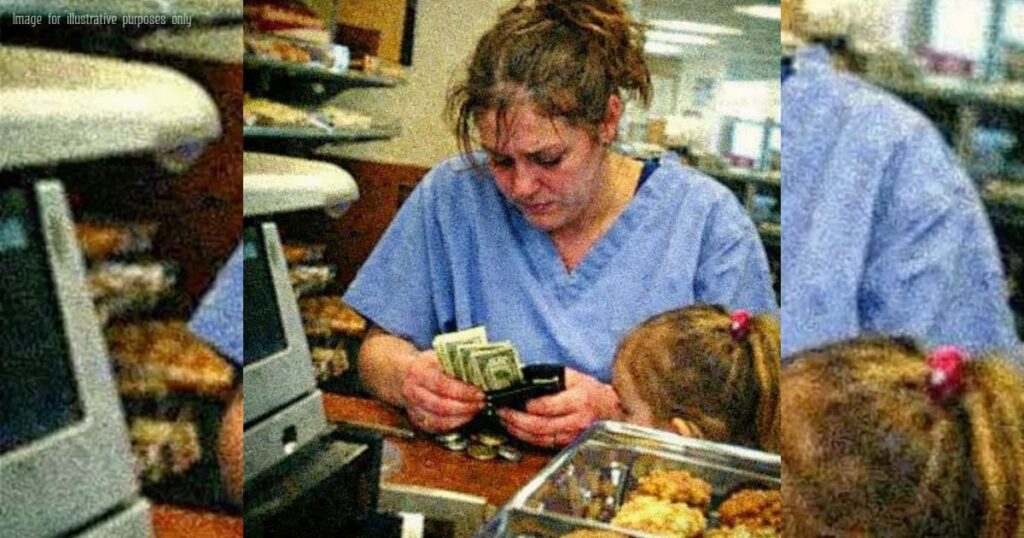
She reached into her purse and pulled out an envelope. It was stuffed, not with big bills, but with small ones. Fives, ones, a lot of coins taped into rolls.
“I’ve been picking up extra shifts,” she said. “And doing some housecleaning on the side. People from the post… they sent us some money. Not a lot, but enough that I didn’t feel right just… keeping it.”
She slid the envelope toward me.
“I know you said it was a loss,” she said. “But I also know that cake wasn’t really ‘damaged.’ You did us a favor. Let me do one back.”
I opened my mouth. Closed it.
Maya tugged on my apron.
“Mr. Dan,” she said. “The cake was real, right? Not plastic?”
“It was very real,” I said. “Was it good?”
She nodded solemnly. “It tasted like nighttime.”
I swallowed a lump in my throat.
I pushed the envelope back toward Sarah.
“Tell you what,” I said. “If you really want to pay something, buy yourself a coffee. And buy her a cookie. And if there’s anything left after that, put it toward whatever bill makes your stomach hurt the most.”
Her eyes glistened. “You don’t have to—”
“I know,” I said. “Neither did you, when you wrote that post. But you chose gratitude. I can choose this.”
She hesitated, then took the envelope back and let out a breath that sounded like she’d been holding it for a week.
“People have said some things online,” she murmured.
“I know,” I said.
“I didn’t mean to… make trouble.”
“You didn’t,” I said calmly. “The trouble was already there. High rents. Low wages. Kids wanting more than their parents can afford. You just told the truth about one afternoon.”
She looked at me for a long moment.
“I’m glad you lied,” she said softly. “About the cake. About the health code. I know some people are mad about it, but… you gave me a way to say yes without feeling small in front of my kid. That matters more to me than what people in the comments think.”
Then she smiled, a real smile this time.
Maya picked out a sprinkle cookie. I rang them up and only charged for that.
When they left, the bell chimed again. It sounded… normal.
Not like a miracle. Not like a movie cue. Just like what it is: a bell on a door that opens and closes hundreds of times a week, for hundreds of quiet, ordinary, unfilmed moments.
If you’re reading this because you saw the viral version, here’s the part that won’t fit neatly into a caption:
Yes, I lied to a crying mother. Twice. I broke the story in half so she could carry the lighter part.
Yes, I gave away an $85 cake in a time when eggs cost more than most of us want to admit. I did the math. It didn’t make sense on paper. I did it anyway.
Yes, the internet argued about it. People took that moment and turned it into a battlefield for whatever they already believed about money, responsibility, generosity, and what “good people” should do.
Here’s what I learned watching strangers dissect a memory that belonged to three people in a bakery on a rainy afternoon:
You will never do kindness pure enough to escape criticism.
If you do it quietly, people will say you’re not doing enough.
If someone finds out, they’ll say you did it for attention.
If you help one person, they’ll ask why you didn’t help five.
If you lie to protect someone’s dignity, they’ll call you dishonest.
If you tell the truth, they’ll tell you you’re naive.
Do it anyway.
Not for the comments. Not for the cameras. Not for the headlines in local papers or the “faith in humanity restored” compilations.
Do it because for one night, a little girl gets to eat the stars.
Do it because for one month, a mother’s chest loosens just enough for her to sleep.
Do it because you remember what it feels like to stand in front of a glass case wanting something you know you can’t afford.
You don’t have to own a bakery. You don’t have to give away cakes. You don’t have to be a “hero.”
You just have to look up from your own ledger—of money, of time, of grudges—and notice who is counting coins at the counter next to you.
And when it’s your turn to choose between protecting your margins and protecting someone’s dignity, you’ll know which loss is worth taking.
Thank you so much for reading this story!
I’d really love to hear your comments and thoughts about this story — your feedback is truly valuable and helps us a lot.
Please leave a comment and share this Facebook post to support the author. Every reaction and review makes a big difference!
This story is a work of fiction created for entertainment and inspirational purposes. While it may draw on real-world themes, all characters, names, and events are imagined. Any resemblance to actual people or situations is purely coincidenta