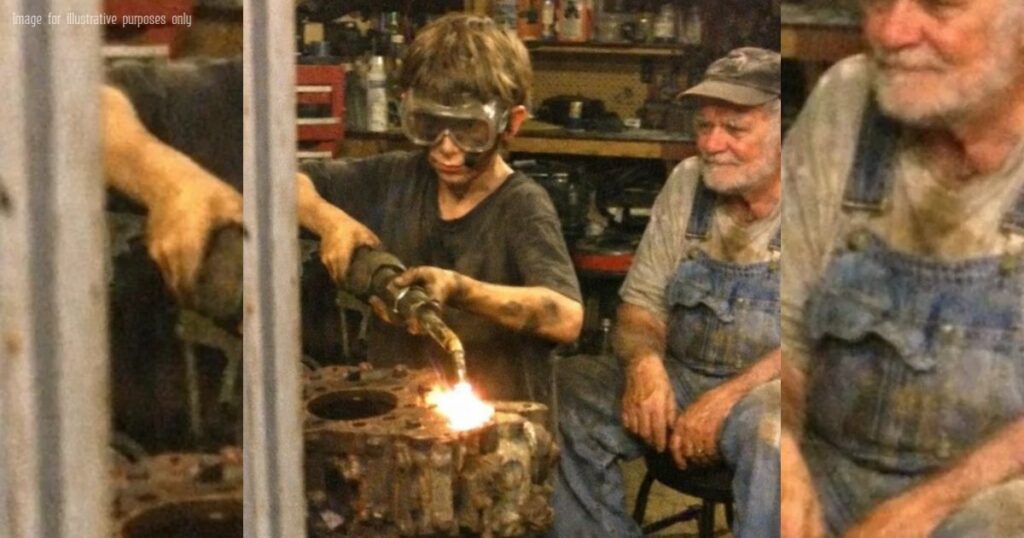
I was ready to call the police on my neighbor for running an illegal business in his garage. Then I saw my twelve-year-old son holding the blowtorch, and my heart stopped.
We live in one of those neighborhoods where the grass is measured with a ruler and the trash cans are hidden behind beige lattice fences. It’s a place of silence, of high-speed fiber optics, and of relentless, exhausting perfection. I fit right in. I’m a senior analyst for a logistics firm, which means I spend twelve hours a day staring at three monitors, moving digital boxes from one side of the world to the other, terrified that one wrong click will crash the global supply chain.
Then there was Mr. Henderson.
He was the glitch in our matrix. He lived in the only house on the cul-de-sac that hadn’t been renovated since 1990. His driveway had oil stains. His lawn had dandelions. And his garage door was always open, spilling out the sounds of grinding metal and classic rock into our sterilized air.
My son, Leo, had been disappearing every afternoon for two weeks. Leo is a “complicated” kid. That’s what the school counselors call him. He has anxiety, ADHD, and a sensory processing disorder. If the Wi-Fi cuts out, he melts down. If his routine changes, he panics. We’ve spent a fortune on therapists, noise-canceling headphones, and tablets to keep him calm.
So, when the Homeowners Association (HOA) sent me a “Notice of Violation regarding Unsanctioned Commercial Activity and Noise” pointing directly at Henderson’s house, and I realized Leo wasn’t in his room, I saw red.
I marched across the street, the notice crumpled in my fist. I was ready to threaten a lawsuit. I was ready to scream about property values and child endangerment. I was a modern parent protecting my fragile child from a dirty, chaotic old man.
I stomped up the driveway, dodging a rusted engine block. The smell hit me first—gasoline, sawdust, and old coffee. It was the smell of a time before the internet.
“Henderson!” I shouted, rounding the corner into the garage. “I’ve told you to stay away from my—”
The words died in my throat.
The garage wasn’t a chop shop. It was a cathedral of junk. Walls lined with pegboards holding thousands of tools, shelves stacked with radios, carburetors, and lamps. And in the center, under a single hanging yellow bulb, stood three boys.
One was the neighbor’s kid, who had been suspended for fighting. Another was a quiet boy from down the block who never looked anyone in the eye.
And there was Leo.
My son, who couldn’t handle the texture of mashed potatoes, was covered in grease up to his elbows. He was holding a heavy wrench, clamped onto a bolt of a lawnmower engine that looked like it had been dredged from a swamp.
He wasn’t crying. He wasn’t looking at a screen. He was biting his lip, his eyes narrowed in a focus I had never seen before.
Mr. Henderson was sitting on a rolling stool, wiping his hands on a rag. He didn’t look up at me. He looked at Leo.
“Easy now,” Henderson said. His voice was gravelly, like tires on a dirt road. “Don’t force it, Leo. If you force it, you strip the head. You gotta feel the metal giving way. Listen to it.”
Leo took a breath. He closed his eyes for a second, then applied slow, steady pressure.
Creak. Snap.
The bolt turned.
“I got it!” Leo gasped, his face lighting up with a smile that broke my heart. “Mr. Henderson, I got it!”
“Good job, kid,” Henderson grunted. “Now, check the gasket. If it’s cracked, we make a new one. We don’t buy, we build.”
I stood there, paralyzed, holding the threatening letter like a weapon I didn’t know how to use. The noise in the garage wasn’t chaos. It was the rhythm of work. The kind of work we don’t do anymore.
Henderson finally looked at me. He had eyes that had seen wars and recessions and grief. He saw the anger drain out of me, replaced by confusion.
“You here to take him?” Henderson asked. He didn’t sound scared of me or the HOA. He sounded tired.
“I… I got a letter,” I stammered. “The Association says you’re running a business.”
Henderson chuckled, a dry, rattling sound. “Business? I haven’t made a dime in twenty years. These boys brought me their broken junk. I’m just showing them how to fix it.”
He stood up and walked over to me, wiping his hand on his coveralls before offering it. I hesitated, then took it. His grip was rough, calloused, and real.
“Your boy,” Henderson said, lowering his voice so Leo wouldn’t hear. “He isn’t broken, you know. He’s just bored. His brain is moving a hundred miles an hour, and you got him sitting in a stagnant room. He needs to see that his hands can change the world. He needs to know that if something breaks, he doesn’t have to throw it away and buy a new one. He can heal it.”
I looked at Leo. He was laughing with the suspended kid, comparing grease stains. For years, I had been trying to “fix” Leo with medication and silence. I wanted him to fit into the box.
Henderson gave him a wrench.
“We live in a throwaway world,” Henderson said, looking out at the pristine, identical houses on our street. “We throw away toasters, we throw away cars, and eventually, we start thinking we can throw away people when they don’t work right. But nothing is unfixable. Not if you have the patience.”
I looked down at the HOA notice in my hand. It cited “visual nuisance” and “unauthorized gathering.”
I walked over to the trash can in the corner of the garage—a metal drum filled with scrap—and dropped the paper inside.
“Do you…” I cleared my throat, feeling ridiculous in my tailored suit. “Do you think the carburetor on my ’68 Mustang is salvageable? It’s been sitting under a tarp for ten years.”
Henderson grinned. It changed his whole face. “Bring it over. But you’re sanding the rust off yourself. I’m not a maid.”
I stayed for two hours. I ruined my Italian loafers. I got oil on my white shirt. And for the first time in a decade, I didn’t check my email.
When we walked home, Leo didn’t ask for his iPad. He walked with a swagger, his hands black with honest dirt.
“Dad?” he asked. “Mr. Henderson said that tomorrow we’re going to fix the suspended kid’s bike. He said the chain is shot, but we can re-link it.”
“That sounds great, bud,” I said.
“Dad?”
“Yeah?”
“I’m not scared when I’m there. My chest doesn’t hurt.”
I put my arm around his shoulder, ignoring the grease that transferred to my jacket.
We have built a world of incredible convenience. We can order dinner with a thumbprint and attend meetings in our pajamas. But in our rush to make everything “smart” and “clean,” we forgot the healing power of grit. We forgot that human beings were built to create, to mend, and to struggle with physical things.
We are raising a generation terrified of failure because they’ve never been taught that failure is just a stripped bolt—something you back out, lubricate, and try again.
The HOA sent another letter yesterday. They want to know if the “gatherings” have ceased.
I wrote back: It’s not a gathering. It’s a classroom.
And this weekend, I’m buying a toolkit. Not for the house. For me. Because I think I’m the one who needs fixing the most.
—
Part 2
The next morning, I woke up with the phantom weight of that HOA letter still in my hand—like I’d dropped it in Henderson’s trash can, but it had followed me home anyway.
Leo was already dressed.
Not the usual pajama pants and oversized hoodie that made him look like he was trying to disappear into fabric. Jeans. Sneakers. Hair brushed without me asking. He stood at the kitchen counter eating cereal with both feet planted like he had someplace to be.
“You’re up early,” I said.
He didn’t look at me. He didn’t have to. His voice held a new kind of certainty—quiet, but locked in.
“Mr. Henderson said be there at three. He said people who are late… break bolts.”
I almost laughed. Almost.
Then my phone buzzed on the counter, lighting up the kitchen like an accusation. Another email from the HOA. Subject line in all caps, because of course it was:
FINAL REMINDER: COMMUNITY STANDARDS COMPLIANCE
Click the button below to read the next part of the story.⏬⏬