Part 2
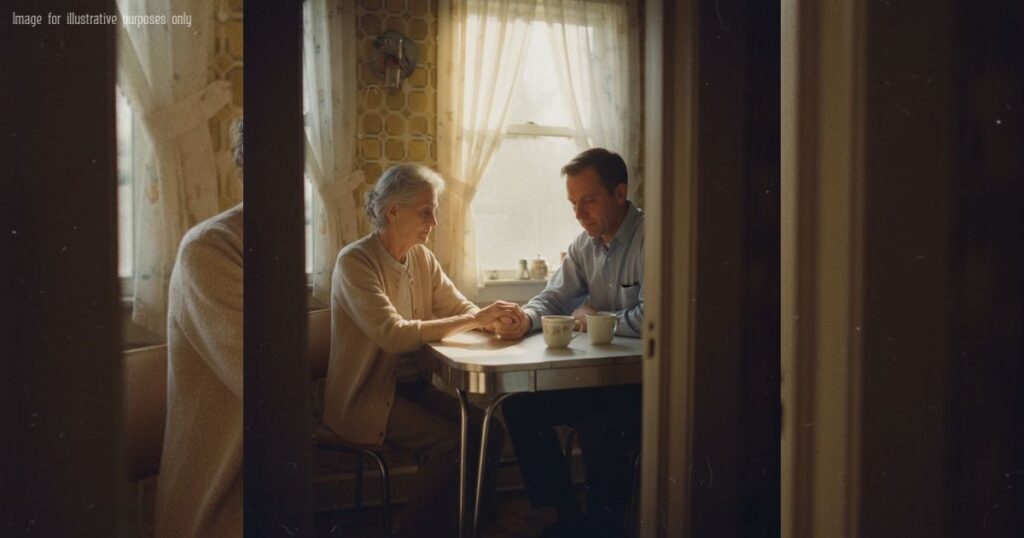
The next morning, I woke up with the phantom weight of that HOA letter still in my hand—like I’d dropped it in Henderson’s trash can, but it had followed me home anyway.
Leo was already dressed.
Not the usual pajama pants and oversized hoodie that made him look like he was trying to disappear into fabric. Jeans. Sneakers. Hair brushed without me asking. He stood at the kitchen counter eating cereal with both feet planted like he had someplace to be.
“You’re up early,” I said.
He didn’t look at me. He didn’t have to. His voice held a new kind of certainty—quiet, but locked in.
“Mr. Henderson said be there at three. He said people who are late… break bolts.”
I almost laughed. Almost.
Then my phone buzzed on the counter, lighting up the kitchen like an accusation. Another email from the HOA. Subject line in all caps, because of course it was:
FINAL REMINDER: COMMUNITY STANDARDS COMPLIANCE
I didn’t open it. I watched my son eat cereal like it was fuel.
And I felt something I hadn’t felt in a long time.
Not fear.
Not control.
Hope—with teeth.
By three o’clock, Henderson’s garage had become a magnet.
The same three boys were there, plus two more I recognized from the bus stop. One of them was a girl from down the street who always wore headphones bigger than her head. She stood near the doorway like she might bolt at any second, hands shoved in her jacket pockets, eyes taking inventory of every sound.
Henderson didn’t treat her like she was fragile.
He just nodded once and said, “You’re here. That’s enough.”
Leo spotted me and lifted his chin like, See? I told you.
The “suspended kid” wheeled in his bike like it was a wounded animal. The chain hung limp, greasy and snapped, the back wheel wobbling like a loose tooth.
“I tried to fix it,” the kid muttered, trying to sound tough and failing. “I made it worse.”
Henderson grunted. “Good. Now you’re ready to learn.”
He rolled a metal stool toward the bike, then looked at all of them—the kids, and me, and the whole messy circle forming in a place our neighborhood had tried to shame into silence.
“This is the rule,” he said. “Nothing gets touched until we look. Eyes first. Brains second. Hands last.”
The kids nodded like soldiers.
I stood there in my button-down shirt, suddenly aware of how clean I looked compared to the honest grime in that garage.
Henderson handed Leo a pair of thick gloves.
Leo froze.
For years, gloves were a problem. Seams. Texture. Pressure. The kind of thing that could spiral him into a panic that lasted hours.
But Leo didn’t flinch.
He slid them on slowly, fingers flexing like he was testing a new skin.
Then he looked up at Henderson and asked, “Is it okay if I take them off if it feels… wrong?”
Henderson didn’t sigh. Didn’t roll his eyes. Didn’t tell him to toughen up.
He just said, “That’s called listening to your body. Smart people do it.”
Leo’s shoulders dropped like someone had finally lowered the volume of the world.
And I—God help me—I realized I’d spent years trying to teach my son how to ignore himself.
They didn’t start with a blowtorch.
They started with a rag.
Henderson made the “suspended kid” wipe the chain with slow, deliberate motions, like he was polishing something important instead of cleaning off grime.
“You don’t fix what you don’t respect,” Henderson said. “Most people don’t respect anything once it gets ugly.”
That line hit me harder than it should have.
Because it wasn’t really about bikes.
It was about kids who didn’t fit into classrooms built for silence and stillness.
It was about older men in oil-stained driveways.
It was about marriages that got “efficient” until nobody remembered how to touch.
It was about me.
Leo leaned close, eyes narrowed, fully present. He wasn’t twitching. He wasn’t scanning for an escape.
He was here.
Then Henderson reached under the workbench and pulled out the blowtorch.
My heart did that same horrible stop-start thing.
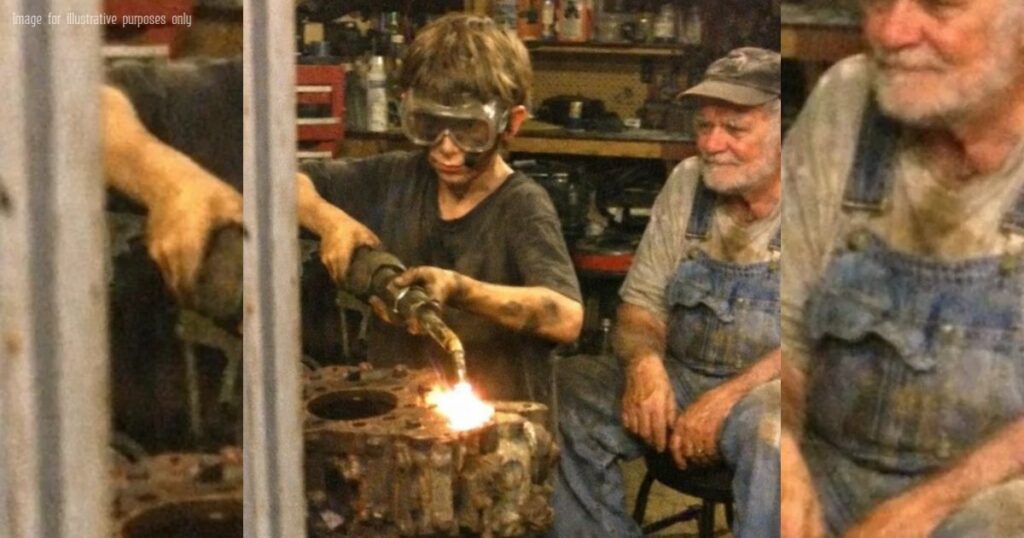
The image from yesterday flashed in my head like a warning label: my twelve-year-old holding fire.
But Henderson didn’t toss it to him like some macho rite of passage.
He set it down on the bench like it was a loaded weapon.
He pointed at the wall behind it, where a red fire extinguisher hung like a promise.
He pointed to a metal tray.
He pointed to a bucket of sand.
“Fire is a tool,” he said. “Not a toy. And it doesn’t care if you’re a good kid.”
Everyone went silent.
Leo stared at the torch, mouth slightly open—not with fear, but with awe.
Henderson looked at him. “You ever been told you’re too much?”
Leo blinked. “Yeah.”
“You ever been told you’re too sensitive?”
Leo nodded.
Henderson’s voice softened, just enough. “Good. That means you notice things. That means you can be taught.”
Then—only then—did he let Leo touch it.
Not the flame.
The handle.
With Henderson’s big, steady hand covering Leo’s smaller one like a shield.
Leo’s breathing got shallow.
I saw the moment his nervous system tried to revolt.
And I saw him do something that made my throat tighten:
He paused.
He swallowed.
He whispered, “Okay. Slow.”
Like Henderson had taught him.
Like nobody else had.
At four o’clock, a woman appeared at the end of Henderson’s driveway.
Perfect hair. Perfect athleisure. Perfect smile that didn’t reach her eyes.
She didn’t come closer. She didn’t have to. She held her phone up like it was a badge.
I recognized her: one of the HOA board members. The kind of person who treated the neighborhood like a curated feed.
She filmed for ten seconds.
Then she turned and walked away.
No greeting.
No concern.
Just content.
My stomach sank because I knew what happens in neighborhoods like ours: problems don’t get solved. They get posted.
That evening, the neighborhood message board lit up like a bonfire.
“UNSAFE ACTIVITY ON CEDAR RIDGE COURT.”
“CHILDREN AROUND OPEN FLAMES?”
“IS THIS LEGAL?”
“PROPERTY VALUES???”
Someone posted a blurry screenshot—Henderson’s garage, kids clustered, my son’s head visible in the corner, Henderson’s back hunched like a shadow, the torch on the bench.
The comments came fast.
Half the neighborhood sounded like a courtroom.
The other half sounded like a mob.
And tucked between the outrage and the cheering were the sentences that made my skin crawl:
“Kids these days are coddled.”
“No wonder they’re anxious.”
“Let them learn.”
“This is negligent.”
“This is the kind of man you shouldn’t trust around children.”
That last one made my hands go cold.
They didn’t know Henderson.
They didn’t know the way he spoke to Leo like he was capable.
They didn’t know the way he built boundaries stronger than any “community guideline.”
They didn’t know anything.
But they had opinions anyway.
And I realized something ugly and true:
We live in a world where people will call the police faster than they’ll knock on a door.
The HOA scheduled an “emergency meeting” for the next night.
In our neighborhood, that’s what passes for a crisis: not hunger, not loneliness, not a kid dissolving in panic in a bathroom stall at school.
Noise.
Mess.
A garage with life in it.
I almost didn’t go.
I wanted to protect Leo from the spectacle of adults arguing about him like he wasn’t a human being.
But Leo surprised me.
“I want to go,” he said.
“Why?” I asked carefully.
He stared at the floor. His fingers worried the hem of his shirt—old habit, familiar anxiety trying to return.
Then he looked up.
“Because they’re talking about us like we’re… bad. And I’m not bad. Mr. Henderson says I’m not broken.”
I felt something in me crack open.
“Okay,” I said. “We’ll go.”
The meeting took place in the community clubhouse—the cleanest building in the neighborhood. Beige walls. Beige carpet. Beige chairs lined in perfect rows like we were waiting to be processed.
The HOA president stood at the front with a clipboard and the tight smile of someone who enjoys power because it makes them feel safe.
“Thank you for coming,” she began. “We are here to address concerns about unauthorized activity and potential safety hazards.”
“Henderson,” someone muttered behind me like it was a curse.
Click the button below to read the next part of the story.⏬⏬