Leo sat beside me, knees bouncing, hands clasped tight. I could feel the heat of his anxiety like a second body in the chair.
And then Henderson walked in.
He didn’t look embarrassed.
He didn’t look angry.
He looked… older than yesterday. Tired in a way that had nothing to do with the meeting and everything to do with carrying a life no one asked about.
He took a seat in the back like he wasn’t there to fight.
Like he was there to listen.
That made my chest burn.
Because everybody else came to win.
They went on about liability.
About insurance.
About “unauthorized gatherings.”
About fire risk.
About “strangers” walking into a garage that had been open to kids who needed somewhere to be.
A man in the front row stood and said, “I didn’t work my whole life to live next to a junkyard.”
Someone else added, “If those kids get hurt, we’ll all pay.”
A woman behind me whispered, “My son has nightmares. Seeing that… mess… makes him anxious.”
And there it was.
The truth nobody wanted to say out loud.
In our neighborhood, we pretend we care about children.
But what we really care about… is not being inconvenienced by them.
Leo’s breathing sped up. I watched him fold inward, his shoulders creeping toward his ears.
I leaned close and whispered, “Look at me.”
He did.
“Slow,” I said. “Just like the bolt.”
His eyes watered—then he nodded, shaky but holding.
Then the HOA president said, “Mr. Henderson, do you have anything to say for yourself?”
The room turned toward him like a spotlight.
Henderson stood slowly. His knees popped loud enough to make a few people laugh under their breath.
He didn’t raise his voice.
He didn’t perform.
He just spoke like a man who had been ignored long enough to stop begging to be understood.
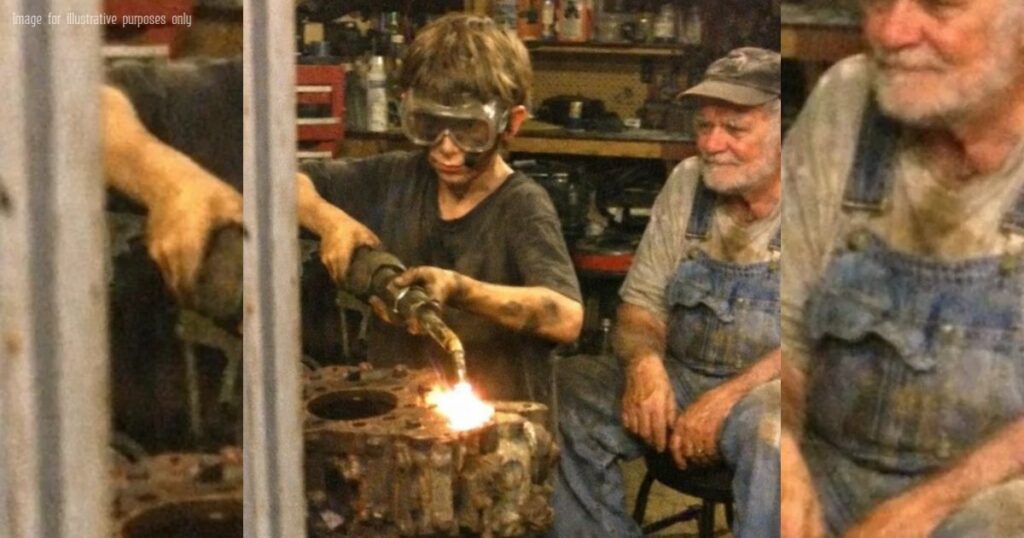
“I’m not running a business,” he said. “I’m running a place where kids learn they’re useful.”
Someone scoffed. “That’s what schools are for.”
Henderson’s eyes flicked up, sharp as a nail. “Then why are so many kids falling apart?”
Silence.
Not polite silence. Not respectful silence.
The kind that happens when the truth walks into a room and everyone pretends they didn’t see it.
Henderson continued. “These kids come to my garage because it doesn’t ask them to be perfect. It asks them to be present.”
A woman stood. “With a blowtorch?”
Henderson nodded once. “With supervision. With rules. With safety. With respect.”
He glanced at Leo.
Then he said the sentence that turned my stomach because I knew it would split the room in half:
“Most of you are more afraid of a tool than you are of what screens are doing to your children.”
The room erupted.
People talking over each other. Angry laughter. Defensive shouting.
Someone yelled, “That’s ridiculous!”
Someone else snapped, “You don’t get to judge our parenting!”
And then, like a spark in dry grass, the controversy took off—because it wasn’t about blowtorches.
It was about guilt.
It was about fear.
It was about the fact that deep down, a lot of parents know their kids are lonely… and they don’t know how to fix it.
Leo’s hands trembled. I could feel him teetering.
Then he did something I will remember for the rest of my life.
He raised his hand.
The room quieted, confused. Adults don’t expect children to speak in places like this.
The HOA president hesitated. “Yes… Leo?”
My son stood up. His voice shook, but it came out.
“When I’m in Mr. Henderson’s garage,” he said, “my chest doesn’t hurt.”
A few people shifted uncomfortably.
Leo swallowed and kept going.
“In my room, it hurts. At school, it hurts. Even when everyone is being ‘nice,’ it hurts. In the garage… I feel… normal.”
He looked around the room, eyes wet, face red, imperfect and brave.
“I’m not doing anything bad,” he said. “I’m learning how to fix things. And… it makes me feel like I can fix myself.”
The room went quiet in a way it hadn’t been all night.
Not because they agreed.
Because they didn’t know what to do with a kid telling the truth.
After the meeting, people clustered in little groups, whispering like gossip was oxygen.
Some avoided me.
Some came up and said, “That was… powerful,” in voices that sounded like they were trying to stay neutral.
A man I barely knew shook his head and said, “Kids need discipline, not therapy.”
Another woman snapped back, “Kids need support, not shame.”
And just like that, the comments section had come alive in real life.
Two Americas, arguing over a twelve-year-old’s nervous system.
Henderson walked past me toward the door.
I stopped him. “Thank you,” I said, and my voice broke on the second word.
He nodded once. “Don’t thank me. Keep him coming.”
I glanced down at Leo. He looked drained—like he’d run a marathon in his own body.
But he also looked… taller.
Like he’d taken up space and survived it.
That night, another email arrived from the HOA.
Not a letter this time.
A “proposal.”
They wanted Henderson to stop “all youth activity” immediately unless he obtained “approved certification” and “submitted a formal program outline.”
In other words: make it sterile, make it bureaucratic, make it impossible.
I stared at the screen until my eyes blurred.
And then I heard Leo in his room.
Not the usual silence.
Not the soft tapping of a tablet.
A sound like metal on metal.
I walked in.
He was sitting on the floor with an old screwdriver and a broken desk lamp he’d pulled from the garage scrap bin.
He looked up, startled.
“I’m not taking it apart to break it,” he said quickly, fear flaring—the old reflex of expecting punishment.
I sat down on the carpet beside him.
“I know,” I said. “You’re taking it apart to understand it.”
He blinked hard, like his eyes were burning.
Then he handed me the screwdriver.
“Can you hold the base?” he asked.
My hands—hands that spent twelve hours a day moving digital boxes—wrapped around cheap plastic and cold metal.
And I realized the real fight wasn’t with the HOA.
The real fight was with a culture that treats discomfort like danger.
That mistakes mess for failure.
That would rather medicate a child’s panic than give them a place to put it.
A world that can’t tolerate anything it can’t control.
I looked at my son, bent over the lamp with fierce concentration, lips moving as he counted screws under his breath like a prayer.
And I made a quiet decision—one that would absolutely set people off, because it asks the question nobody wants to answer:
What if our kids aren’t fragile glass…
What if they’re steel?
And what if the reason so many of them are breaking…
is because we never let them be forged?
Outside, the neighborhood stayed pristine.
Inside, on my living room floor, my son and I got our hands dirty.
And for the first time, I didn’t feel like I was losing control.
I felt like I was finally learning how to be a father.
Thank you so much for reading this story!
I’d really love to hear your comments and thoughts about this story — your feedback is truly valuable and helps us a lot.
Please leave a comment and share this Facebook post to support the author. Every reaction and review makes a big difference!
This story is a work of fiction created for entertainment and inspirational purposes. While it may draw on real-world themes, all characters, names, and events are imagined. Any resemblance to actual people or situations is purely coincidenta