PART 2 — The Week After the Diner
The next morning, I walked into the feed store like I always do—same bell over the door, same smell of molasses and rubber boots—except it didn’t feel the same anymore.
Heads turned.
Not the friendly kind. The measuring kind.
Like I’d walked in wearing someone else’s skin.
I nodded at Earl behind the counter. He nodded back, but his eyes slid past me to the door, like he expected Mateo to walk in behind me with mud on his jeans and the whole town’s fear on his shoulders.
He didn’t.
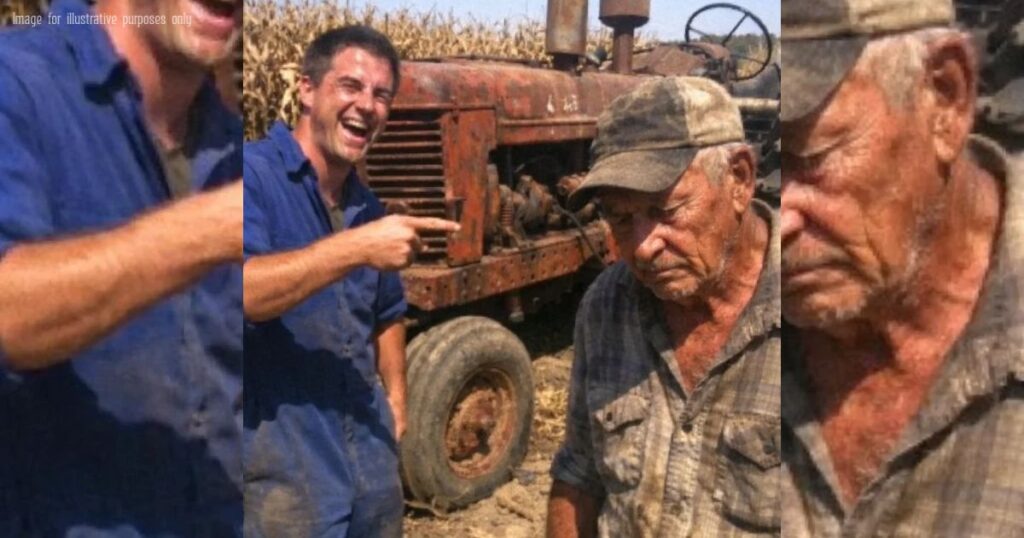
Mateo was out at the farm already, wiping last night’s dew off the harvester windshield with a rag that used to be one of my wife’s dish towels. He didn’t know what was waiting in town for him. He was still living in that simple world where a machine either runs or it doesn’t, and a man either shows up or he doesn’t.
I envied him for that.
By noon, the story had grown legs.
By supper, it had grown horns.
A guy in a cap—one of those caps with a slogan stitched across the front like it’s a personality—told me my “little speech” at the diner was “making things worse.” Another man said I was “virtue signaling,” whatever that means in a place where we still signal with our truck lights.
I didn’t raise my voice. I didn’t have to.
I just asked, “Did you offer to fix my harvester?”
He stared at me like I’d spoken in Spanish.
“I got my own problems,” he muttered.
So did Mateo. So did I.
The difference was we didn’t make our problems everybody else’s excuse.
That week, we harvested like men running from winter.
The old machine roared through rows of corn like it had something to prove. Every time it coughed, my heart seized. Every time it steadied again, I felt twenty years younger and twice as stubborn.
Mateo learned my hand signals faster than my own son ever did.
A raised fist meant stop.
Two fingers meant check the chain.
A slap on the hood meant I was too proud to say thank you out loud.
He didn’t complain about the heat. He didn’t complain about the aching. He didn’t complain about me, even when I snapped.
And I did snap.
More than once.
Because when you’re old and tired and scared, you start snapping at whatever is closest.
And for the first time in a long time, someone was close.
On Wednesday, a pickup truck crawled past our field at walking speed. Then it did it again. Then again.
On the third pass, the window rolled down.
A phone held out like a weapon.
Mateo froze mid-step, a wrench in his hand. His shoulders went tight, like he’d been hit with an invisible rope around the chest.
I waved them off. Not a rude wave. Not a friendly one either.
Just the wave you give a fly you’re done arguing with.
The truck sped off, tires spitting gravel.
Mateo stared after it.
“They… take picture,” he said quietly.
“Let ’em,” I told him, even though my stomach twisted. “Pictures don’t pull corn.”
But pictures can pull something else.
They can pull a crowd.
That night, my phone—an old one, cracked screen, more dust than apps—kept buzzing like it was angry at me. I don’t know half the features on that thing. I mostly use it to talk to my son on holidays and to check the weather when the sky lies.
This time it was messages.
A neighbor’s niece had posted a photo of Mateo leaning into the open engine bay, his hands black with grease, my harvester behind him like an old animal finally standing again.
The caption said something like: “Old farmer hires immigrant. He fixes what the town called scrap.”
It was meant to be sweet, I think.
But the comments…
Mercy.
People I’d never met, from places I’d never been, argued like they were fighting over the last loaf of bread.
Some said Mateo was the kind of person this country needs.
Some said the “rules are rules.”
Some called me a hero. Some called me worse things than I’ll repeat.
And the strangest part?
Most of the people yelling the loudest didn’t know a thing about harvest.
They didn’t know what it means to watch the frost forecast drop like a guillotine.
They didn’t know what it feels like to stand in a field you love and realize your body can’t keep up with it anymore.
They were arguing about an idea.
Mateo was a man.
By Thursday morning, the diner waitress called me.
“Elias,” she said, voice low. “Just… be careful, okay?”
“Careful of what?”
She hesitated. “People are talking. Not just talking. Making calls.”
My hand tightened around the receiver.
“To who?”
“I don’t know,” she whispered. “Just… be careful.”
When I hung up, my house felt too quiet. The kind of quiet that happens right before bad news arrives.
I tried calling my son.
He answered on the third ring, breathless like he’d been running from his own life.
“Dad? Everything okay?”
I wanted to say yes.
I wanted to be the kind of father who never brings trouble to his child’s door.
But I wasn’t that father.
Not anymore.
“People are stirring up a mess,” I said. “Over Mateo.”
There was a pause, then a sigh I recognized—half concern, half calculation.
“Dad,” he said carefully, “you can’t just… put yourself in the middle of that.”
“It’s my farm.”
“It’s a national argument,” he corrected. “And you’re going viral. You know what that means? People will dig. They’ll show up. They’ll try to make you a symbol.”
“A symbol?” I barked a humorless laugh. “I’m a man with a dying tractor and a mortgage.”
“Exactly,” he said, like that proved his point. “You’re vulnerable.”
The word hit me like a slap.
Vulnerable.
Like I was some cracked cup waiting to be knocked over.
“Mateo is the vulnerable one,” I said.
More silence.
Then my son’s voice softened, just a little. “Do you know his situation? Like… officially?”
I stared out the kitchen window at my fields. The corn stood like soldiers, tall and quiet and indifferent to human paperwork.
“I know he works,” I said.
“Dad—”
“I know he shows up,” I continued. “I know he doesn’t steal. He doesn’t drink. He doesn’t mouth off. He doesn’t hide when the work gets hard.”
“That’s not what I—”
“And I know,” I said, my throat tightening, “that everyone who’s suddenly an expert didn’t lift a finger when I needed help.”
My son didn’t argue after that. He just sounded tired.
“Please be careful,” he said again, quieter this time. “People can be cruel when they think they’re righteous.”
After we hung up, I walked out to the barn without my hat. The sun hit my scalp like a scolding.
Mateo was under the harvester, wrenching on something I couldn’t even see. He slid out when he heard my boots.
“You okay, Señor?” he asked.
I studied him.
The smudges on his cheek. The bruises blooming on his forearms. The way he stood like he was ready to apologize for breathing.
And I realized something ugly.
He’d lived his whole life practicing that posture.
Making himself smaller so others could feel bigger.
“No,” I said honestly. “I’m not.”
He nodded like he understood more than my words.
Then he reached into his pocket and pulled out a folded piece of paper.
Not fancy. Not official-looking. Just a worn, creased sheet like it had been held and reread too many times.
“My sister,” he said, tapping the paper. “She in Texas. She say… you must keep copy. Always.”
He didn’t hand it to me.
He didn’t ask me to read it.
He just held it like a man holding a life raft.
“I don’t want trouble,” he said.
There it was.
The truth under all the arguing.
Not politics. Not slogans. Not comment sections.
Just a man trying to live without being hunted by rumor.
I swallowed hard.
“You didn’t come here to be trouble,” I said.
He looked down. “Trouble find.”
Before I could answer, a vehicle crunched up the gravel driveway.
Not a truck from town.
Not a neighbor.
A plain car.
Click the button below to read the next part of the story.⏬⏬