Dust-colored.
Practical.
The kind of car that doesn’t want to be remembered.
Mateo’s face changed instantly. The color drained from it. His eyes flicked to the barn like he was calculating distance, exits, hiding places.
I hated that I saw a man do that.
I hated that my land—my land—could make someone feel cornered.
Two people got out. Not aggressive. Not shouting. No dramatic slamming doors.
One man, one woman. Clipboards. Calm shoes.
They didn’t look like villains. They looked like people who’d filled out a thousand forms before breakfast.
The woman lifted a hand politely. “Mr. Elias Harper?”
“That’s me,” I said, stepping forward so I was between them and Mateo without thinking.
She smiled—professional, not unkind. “We’re here because we received a report. We need to ask a few questions.”
Mateo’s breathing turned shallow.
I kept my voice steady. “A report about what?”
The man glanced at his clipboard. “Employment verification.”
My jaw tightened.
Of course.
Not about the vandal who dumps trash in the ditch every month.
Not about the guy who drives drunk home from the bar.
Not about the scammers who call old people and drain their savings.
No.
About the quiet man fixing a dead machine.
Because it’s always safer to police the person with the least power.
I felt heat rise in my chest.
But I didn’t explode.
Exploding only feeds the story people already want to tell.
So I did the hardest thing I’ve learned to do in my old age.
I spoke like a human.
“We’re harvesting,” I said. “Frost is coming.”
The woman nodded, like she’d heard that a hundred times from men like me. “We understand. This won’t take long.”
Mateo stared at the ground so hard I thought he might sink into it.
I turned slightly, just enough that only he could hear me.
“Look at me,” I said.
He didn’t.
“Mateo,” I said again, firmer. “Look at me.”
Slowly, he lifted his eyes.
They were wet.
Not tears falling yet. Just the shine of them, like a storm gathering.
“You are not a criminal for working,” I said, low and clear. “Do you hear me?”
His lips trembled. “In my country,” he whispered, “they take you for less.”
“Well,” I said, swallowing the lump in my throat, “this isn’t your country anymore.”
Then, because I’m a stubborn old man who still believes words matter, I added:
“And if it is—if this land is going to claim your sweat—then it can’t pretend you don’t exist.”
The man with the clipboard cleared his throat politely.
“Mr. Harper,” he said, “we’re not here to argue. We just need to document. We need to ask—”
“I know what you need,” I said, cutting him off, not unkindly, but with a steel I didn’t know I still had. “And I know what I need. I need to bring this harvest in. I need to keep my farm.”
The woman’s eyes flicked to the field, then back to me.
Her expression shifted—just a hair.
Like she wasn’t just seeing a report anymore. Like she was seeing rows of corn that didn’t care about paperwork.
“Can we speak inside?” she asked.
I nodded once. “Yes. But he stays. And he stays in sight.”
The man hesitated.
Then he nodded too.
We walked into the barn office—if you can call a dusty corner with an old chair and a calendar from three years ago an office.
While they asked their questions, I realized something that made my stomach drop.
I’d been so focused on keeping my harvester alive… I hadn’t noticed the other thing dying.
My bank account.
The stack of envelopes on my kitchen table.
The red-stamped notice I’d shoved under the salt shaker because I wasn’t ready to look at it again.
Late fees.
Past due.
Final warning.
The bank didn’t care that I’d found help.
It didn’t care that my wife was gone.
It didn’t care that my son lived a thousand miles away and that my bones ached like old wood.
It cared about numbers.
And the numbers were winning.
When the questions finally ended, the woman set her clipboard down and looked at me like a person again.
“Mr. Harper,” she said carefully, “I know this feels… personal. But it’s procedure.”
“Procedure,” I repeated, tasting the word like something bitter.
She nodded. “I’m not here to make your life harder.”
I wanted to believe her.
I almost did.
Then my phone buzzed again.
Another message.
Another comment thread.
Another stranger yelling from behind a screen.
And standing there in my barn, I finally understood the real fight.
It wasn’t old versus new.
It wasn’t local versus outsider.
It wasn’t even politics, not really.
It was empathy versus ego.
It was whether you judge a man by his hands… or by whatever story you need him to fit.
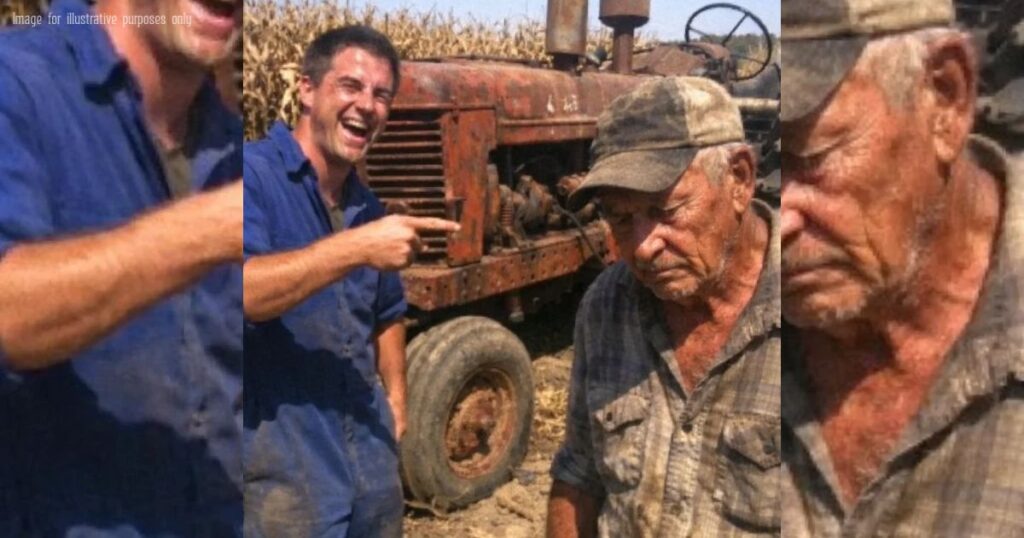
That night, after they left, Mateo sat on an overturned bucket behind the barn, staring out at the fields like he was memorizing them in case he never saw them again.
I sat beside him, my joints protesting the way they do now.
We didn’t talk for a long time.
Crickets sang.
The old harvester ticked as it cooled, like a heartbeat settling down.
Finally, Mateo spoke.
“In diner,” he said softly, “you say… ‘American.’”
I nodded.
He swallowed. “I don’t want word. I want… peace.”
I stared out at my corn. At my dirt. At the land that has taken everything from me and still feels like home.
“I want that too,” I said.
Then I looked at him—really looked at him—and asked the question that I knew would split the world into comment sections all over again.
“Mateo,” I said, voice rough, “if the town tells you to leave… will you?”
His eyes flickered.
And in that flicker was every mile he’d ever walked, every door that had ever shut, every hand that had ever pointed instead of helped.
He didn’t answer right away.
Instead, he asked me something back—something so simple it felt like a knife.
“And you, Señor,” he whispered. “If they tell you to sell… will you?”
I didn’t have an answer either.
Because the truth is, we were both standing on the same edge.
Two men from two different worlds, holding up the same broken machine, trying to keep a life from getting repossessed by fear.
And if you’re reading this, you already know the real question isn’t what the law says, or what the comments say, or what the loudest people at the diner say.
The real question is:
When someone shows up with calloused hands to fix what everyone else abandoned—do you call that a threat…
Or do you call it a blessing?
Because the frost is coming.
And some of us are still arguing about who deserves to stand in the field when it hits.t
Thank you so much for reading this story!
I’d really love to hear your comments and thoughts about this story — your feedback is truly valuable and helps us a lot.
Please leave a comment and share this Facebook post to support the author. Every reaction and review makes a big difference!
This story is a work of fiction created for entertainment and inspirational purposes. While it may draw on real-world themes, all characters, names, and events are imagined. Any resemblance to actual people or situations is purely coincidenta