They told me I was leaving my wallet on the highway. They said the meth heads or the bored teenagers would strip me clean before noon. They were wrong.
My name is Silas, and I’ve been farming this same patch of dirt in the Midwest since a handshake meant more than a contract. I’m seventy-two years old. My knuckles look like walnut shells and my back hurts when it rains, which means it hurts most days. I don’t recognize my country lately. I turn on the TV, and it sounds like a family reunion where everyone’s been drinking too much whiskey and nobody likes each other anymore.
We’re angry. We’re broke. We’re suspicious.
But the moment that broke me wasn’t the news. It happened last Tuesday at the “Mega-Mart” in town. I hate that place—it smells like floor wax and desperation—but the local general store closed five years ago, so there I was.
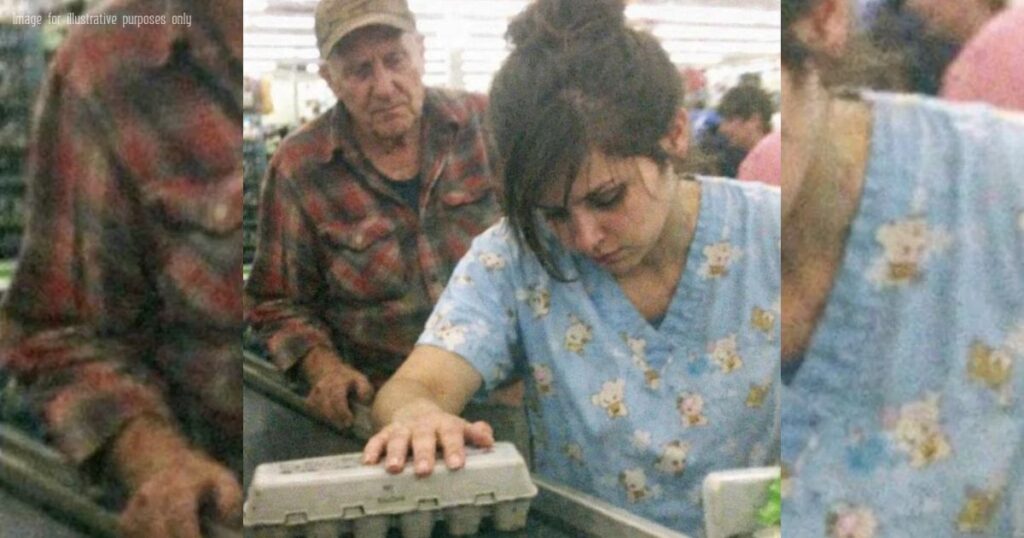
I was standing behind a young woman in the checkout line. She was wearing scrubs, the kind with little cartoon bears on them. She looked exhausted, shifting her weight from one foot to the other. On the conveyor belt, she had a loaf of store-brand bread, a jar of peanut butter, and a carton of eggs.
The cashier scanned the eggs. The price flashed on the screen: $8.49.
The young woman flinched. It was a small movement, just a tightening of her shoulders. She looked at the total, then at the cash in her hand. She looked back at the eggs.
“I’m sorry,” she whispered, her face going pink. “Can you take the eggs off? I… I don’t need them.”
She needed them. I could see the dark circles under her eyes. She probably worked twelve-hour shifts cleaning up messes nobody else wanted to touch, and she couldn’t afford a scrambled egg for breakfast.
I wanted to step in and pay for it. But I saw the way she held her chin up—that stiff, fragile pride we all carry out here. If I offered charity, she’d crumble. So I stayed quiet. I watched her walk away with just the bread and peanut butter.
That night, I sat on my porch looking at my fields. The harvest was good this year. Too good. The corporate buyers were offering me pennies for my produce, barely enough to cover the diesel for the tractor. I had bushels of tomatoes, sweet corn, and squash rotting in the barn because it cost more to ship them than they were worth. And I had forty chickens laying eggs faster than I could eat them.
We are starving in the middle of a feast, I thought.
The next morning, I did something my neighbor, Miller, called “senile.”
I dragged an old picnic table down to the end of my gravel driveway, right next to the county road. I loaded it up. Pyramids of red tomatoes, baskets of green beans, sacks of sweet corn, and a cooler filled with cartons of eggs.
I took an old metal biscuit tin, cut a slot in the lid, and nailed it to the table. Then I painted a sign on a piece of plywood. I didn’t use fancy words.
THE HONOR STAND Take what you need. Pay what you can. If you can’t pay, do something kind for someone else.
Miller stopped by in his truck as I was hammering the sign. He leaned out the window, chewing on a toothpick.
“Silas, you old fool,” he laughed, shaking his head. “By sunset, the teenagers will smash the eggs, and the junkies will steal the tin. You’re inviting the wolves to dinner.”
“Maybe,” I said, wiping sweat from my neck. “Or maybe I’m tired of treating everyone like a wolf.”
I went back to the house and sat by the window. I forced myself not to go down there. The rule of the Honor Stand was privacy. Nobody wants to look a man in the eye when they’re counting out nickels for dinner.
The first car slowed down around 10:00 AM. A rusted sedan. A guy got out, looked around nervously, and grabbed a bag of corn. He didn’t put anything in the box.
Miller was right, I thought. A bitter taste rose in my throat.
Then a minivan stopped. A mother with three kids. They loaded up on tomatoes and peppers. She put something in the tin.
By 6:00 PM, the table was bare. Not a single tomato left.
I walked down the driveway, my heart thumping a slow, heavy rhythm. I expected the tin to be ripped off, or empty. But when I lifted it, it rattled. It was heavy.
I took it back to the kitchen and dumped it out on the table.
There were dollar bills—wrinkled, soft ones that had been in pockets for a long time. There was a handful of quarters. But it was the other things that made me stop breathing.
There was a folded piece of notebook paper. Inside was a crisp five-dollar bill and a note written in shaky cursive: “Thank you. I haven’t had a fresh tomato in two years. – Mrs. H.”
There was an IOU scrawled on the back of a gas station receipt: “Get paid Friday. Will drop off $10. Promise.”
And there was something wrapped in a napkin. I unfolded it to reveal a silver military challenge coin. It wasn’t money. It was a memory. Someone had traded a piece of their history for breakfast. I sat there for a long time, rubbing my thumb over the metal coin.
The next day, I restocked the stand. I put the challenge coin back in the box with a note taped to the lid: “Your credit is good here. Keep your medal. Thank you for your service.”
By the end of the week, the coin was gone. In its place was a twenty-dollar bill.
But the real magic didn’t happen in the box. It happened around it.
On Thursday, I walked down to check the stock and found that someone else had been there. I hadn’t put out any zucchini, but there was a pile of them on the end of the table with a sticky note: “My garden went crazy. Free to a good home.”
On Friday, I found a jar of wildflower honey that wasn’t mine.
On Saturday, I woke up to find that the wobbly leg on the picnic table—the one I’d been meaning to fix for three years—had been braced with a new piece of two-by-four. No note. Just fixed.
The “Pay what you can” part wasn’t just about money. People were paying with labor. They were paying with pride.
One afternoon, I saw a pickup truck with a bumper sticker supporting the political candidate I can’t stand. The driver was a big guy, bearded, wearing a hat that screamed his political allegiance. He stopped at the stand.
At the same time, a Prius pulled up. The driver had bumper stickers supporting the other side—the side the pickup driver probably hated.
I tensed up, watching from my porch. This is it, I thought. The argument. The shouting match.
The guy in the pickup reached for the last carton of eggs. The woman from the Prius reached for it at the same time. They froze.
I saw the guy say something. He gestured to the eggs, then to her. He stepped back. He let her take them. She smiled and handed him a bag of the zucchini someone else had left. They stood there for five minutes, just talking. Not about the election. Not about policies. They were pointing at the corn, talking about the rain.
They were just two neighbors figuring out dinner.
Two weeks later, the young nurse came back. I was restocking the table when she pulled over. She looked different. Less grey. She walked up to me, and her eyes were wet.
“I left five dollars last week,” she said quietly. “But I took way more than that in vegetables. I felt guilty.”
” The sign says pay what you can,” I reminded her.
“I know,” she said. She reached into her car and pulled out a stethoscope. “I don’t have much money until my next shift. But… I see you rubbing your shoulder. I’m a physical therapist assistant. If you sit down, I can show you a stretch that will help that rotator cuff.”
I sat on the bumper of her car. Right there on the side of County Road 9, a stranger worked the knot out of my shoulder for twenty minutes. It hurt like hell, and then, for the first time in a decade, the pain vanished.
“That,” I told her, testing my arm, “is worth a hell of a lot more than a carton of eggs.”
She smiled. A real smile this time.
Miller doesn’t call me a fool anymore. Yesterday, he dropped off a crate of apples from his orchard. “Too many for the wife to can,” he grumbled, refusing to make eye contact. “Put ’em on the table.”
We are told every day that this country is broken. We are told that we are enemies, that we are selfish, that we are too far gone to save. We are told to hoard what we have and build fences to keep the others out.
But out here, at the end of my driveway, I learned the truth.
The box is never empty.
Sometimes the payment is cash. Sometimes it’s a fixed table leg. Sometimes it’s a jar of jam from a stranger’s pantry. Sometimes, it’s just the knowledge that you aren’t the only one struggling to keep the lights on.
We don’t need more politicians telling us who to blame for the cold. We just need to remember how to build a fire together.
We aren’t enemies. We’re just hungry neighbors waiting for an invitation to be good again.
So, if you’re driving down County Road 9 and you see a beat-up picnic table, stop by. Take a tomato if you’re hungry. Leave a dollar if you’re flush.
And if you can’t pay? That’s alright. Just fix the fence on your way out.
—
Part 2 — The Day My Honor Stand Went Viral, the Town Tried to Kill It
The fence did get fixed.
I walked down County Road 9 Monday morning with a mug of coffee warming my hands, expecting to see the same sagging wire I’d been meaning to repair since my knees were young.
Instead, the posts were straight. The bottom strand was tightened. Somebody had even replaced a busted staple with a proper metal brace.
No note. No signature. Just a quiet act of “I saw it, so I handled it.”
I stood there a long time, listening to my chickens fuss in the distance and the wind comb through the dead corn stalks like fingers through old hair.
Then my phone rang.
It was the county office.
A woman with a voice like laminated paper said, “Mr. Silas Hart? We received a complaint about an unpermitted roadside stand. We’re required to follow up.”
Click the button below to read the next part of the story.⏬⏬