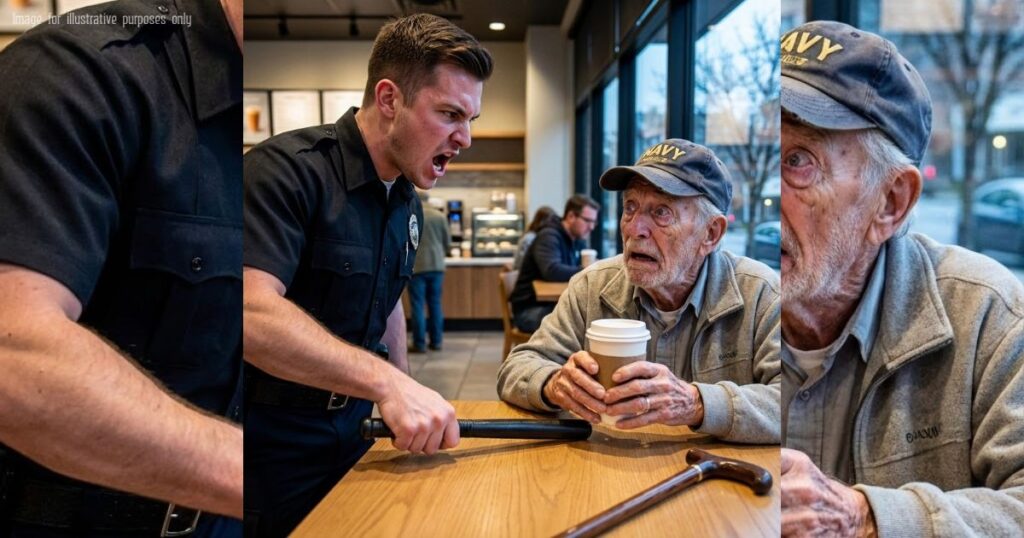
“Get out. You’re making the customers uncomfortable.”
That’s exactly what the security guard barked. Not at a rowdy teenager. Not at someone causing a scene.
He was yelling at a man who looked like he was made of parchment paper and trembling bones. A man wearing a faded Navy cap, clutching a cold cup of coffee like it was a lifeline.
My phone was in my hand, thumb hovering over TikTok, but I froze.
I’m Leo. I’m twenty. I live off energy drinks and DoorDash gigs, and I spend my afternoons in the downtown public library because my apartment’s Wi-Fi is garbage and the heating bill is terrifying.
The library is supposed to be the last free place in America. But lately? It feels like a VIP lounge. Glass walls, a fancy café in the lobby, and “No Loitering” signs everywhere.
And then there was The Corner.
That’s where they sat. The “Invisibles.” Four or five seniors who came in every single day when the doors opened at 9 AM. They didn’t have MacBooks. They didn’t have lattes. They just had time.
One lady, Mrs. Gable, knitted scarves that never seemed to get longer. Another guy just stared out the window at the construction cranes, tapping his finger. They were quiet. They were clean. But in a fast-paced city obsessed with youth and productivity, they were treated like furniture that needed to be moved to the basement.
That Tuesday, the temperature outside was five degrees below zero.
Mr. Henderson—the man in the Navy cap—had dozed off. His head dipped onto his chest.
The security guard, a guy barely older than me with a puffed-up chest, marched over. He tapped the table with a baton. Hard.
“Wake up, Sir! No sleeping. This is a workspace for active patrons. If you aren’t reading or working, you have to leave.”
Mr. Henderson jolted awake, terrified. His cane clattered to the floor with a sound that echoed like a gunshot.
“I… I’m sorry,” he stammered, his voice thick with sleep. “My heating is out at the apartment. I just needed to warm up before the bus comes.”
“Policy is policy,” the guard said, crossing his arms. “You’re taking up a four-top table. We have students looking for seats.”
The library was dead silent. A group of high schoolers near the 3D printer were snickering. One girl held up her iPhone, recording. “Boomer mode: Deactivated,” she whispered, giggling.
My stomach turned. It felt like swallowing hot coals.
I looked at Mr. Henderson. He was reaching for his cane, his hands shaking so bad he couldn’t grip it. He looked ashamed. Not angry—ashamed. As if existing in public was a crime he had committed.
I stood up. My chair scraped loudly against the floor.
“He is working,” I said. My voice cracked, but I kept walking.
The guard spun around. “Excuse me?”
I walked right up to the table, tossed my backpack onto the empty chair next to Mr. Henderson, and sat down.
“He’s working with me,” I lied. My heart was hammering against my ribs like a trapped bird. “We’re… discussing history. For my project.”
The guard narrowed his eyes. “He was asleep.”
“He was thinking,” I shot back. “And last I checked, this building was paid for by the taxes he’s been paying since the 1950s. He owns this chair more than you do.”
The guard hesitated. He looked at the camera phone the girl was still holding. He didn’t want a viral lawsuit. He grunted, “Keep it awake,” and walked away.
The silence that followed was heavy.
Mr. Henderson looked at me with watery, milky blue eyes. “You didn’t have to do that, son. I don’t want to be a bother.”
“You’re not a bother,” I said, opening my laptop so it looked legit. “I’m Leo.”
“Arthur,” he whispered. He reached out a hand that felt like rough sandpaper. “Arthur Henderson.”
I didn’t have much money, but I went to the fancy café in the lobby. I bought two large hot chocolates. I gave one to Arthur.
He took a sip and closed his eyes. “I haven’t had cocoa in ten years,” he said softly.
For the next hour, I didn’t study. I listened.
Arthur wasn’t just an “old guy.” He was an ironworker. He pointed a crooked finger at the window, toward the tallest skyscraper in the city skyline.
“See that beam? The cross-brace on the 40th floor?” he asked. “I riveted that in 1978. Wind was blowing sixty miles an hour. My best friend slipped on that girder. I caught him by his belt loop.”
I looked at the building. I walk past it every day. I never thought about the hands that put it there.
The next day, I came back. Arthur was there. So was Mrs. Gable. I brought a box of donut holes. I sat down.
“Mrs. Gable,” I asked. “What are you knitting?”
She looked up, startled that someone under thirty was speaking to her. “It’s nothing, dear. Just… keeping my hands moving so the arthritis doesn’t freeze them.”
I learned she used to teach advanced calculus. She saw my screen—I was failing my statistics class—and she pulled a pencil out of her purse. In ten minutes, she explained what my professor couldn’t explain in ten weeks.
A weird thing happened.
The video the high school girl took? It got posted. But it didn’t go the way she thought. The caption was mocking, but the comments were a war zone.
“Why are Boomers taking up all the space?” one comment read. “Go to a nursing home.”
But then others chimed in. “That man is a Vet. Show some respect.” “We are discarding our elders like trash in this country. It’s sick.”
People started recognizing the library.
By Friday, the “Old Folks Table” wasn’t empty. Two other college students were sitting there. One was showing Arthur how to use FaceTime to call his granddaughter in Oregon. Another was listening to Mrs. Gable talk about the Civil Rights protests she marched in down Main Street.
It wasn’t a charity case. It was an exchange.
We gave them relevance. They gave us perspective. In a world of AI and algorithms, they were the only real thing in the room.
But the real gut punch came yesterday.
Arthur slid a small, terrifyingly old photo across the table. It was black and white, showing a group of young men, shirtless and sweating, standing in a muddy trench. They were laying the massive pipes for the city’s sewage and water system.
“That’s me,” Arthur pointed to a grinning kid covered in mud. “We dug this trench by hand so this city could flush its toilets.”
He looked at me, dead serious.
“Leo, people talk about the ‘generation gap.’ They say you kids are soft, and you say we’re selfish. But here’s the truth.”
He tapped the photo.
“You are walking on the roads we paved. You are drinking water from the pipes we laid. And one day, if you’re lucky, you’ll be the old man in the chair, hoping someone remembers that you mattered.”
He leaned in.
“We aren’t the past, son. We’re your foundation. If you kick out the foundation, the house falls down.”
I taped a copy of that photo to my laptop.
We live in a brutal, fast-moving America. We fight on Twitter about who had it harder—Gen Z with our student loans, or Boomers with their housing market. We count every dollar. We judge every stranger.
But in that library, I realized something.
Nobody is a “Non-Player Character.” Nobody is just “overhead.”
Every trembling hand you see once held a baby, or a rifle, or a hammer that built the roof over your head.
So, here is my challenge to you.
Next time you see a senior sitting alone—at a coffee shop, on a park bench, or in a library—don’t look through them. Don’t scroll past them.
Sit down. Buy the coffee. Ask: “What did you build?”
Because sooner than you think, the world will belong to someone else, and you’ll be the one hoping for a warm seat and a little bit of grace.
—
Part 2 — The Week the “Old Folks Table” Stopped Being Invisible
If you saw the clip of the security guard trying to kick Arthur out, you probably think the story ends with a warm cocoa and a wholesome lesson.
It didn’t.
That video didn’t fix anything.
It lit a match in a room full of gasoline, and then everyone argued about who should be blamed for the fire.
By Monday morning, the downtown library felt different the second I walked in.
Not louder.
Click the button below to read the next part of the story.⏬⏬