“We need to speak with you privately,” she said. “There have been additional complaints.”
Complaints.
Like he was a noise violation.
I stood up so fast my chair screeched.
“What complaints?” I snapped.
Ms. Caldwell didn’t look at me.
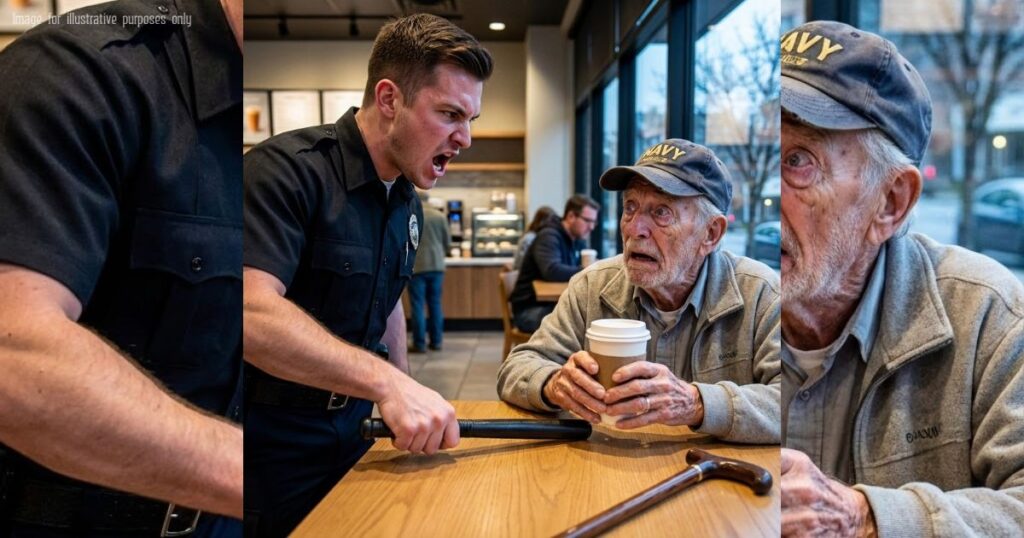
“Sir,” she said to Arthur, “we’ve been made aware that you may be using the facility as a substitute for… other accommodations. That isn’t what this space is designed for.”
Arthur’s mouth opened.
No sound came out.
I felt something cold crawl up my spine.
Because I understood what she was really saying.
Not sleeping.
Not loitering.
Not seating.
They thought he didn’t belong here.
Not because of behavior.
Because of status.
Arthur swallowed. “My heat is out,” he said again, like the truth should be enough. “I’m waiting for my landlord to fix it.”
Ms. Caldwell nodded in a way that looked sympathetic but wasn’t.
“We can provide you with a list of warming centers,” she said, as if she were offering a menu.
“A list?” I repeated. “So you’re kicking him out and handing him paper.”
“That’s not what I said,” she replied. “We’re simply redirecting.”
Redirecting.
Like he was a pop-up ad.
Arthur’s hand shook so badly his coffee sloshed over the rim.
And then he did something I’ll never forget.
He reached into his jacket and pulled out a folded envelope, worn soft from being opened too many times.
He held it out.
It was a notice.
Not dramatic.
Not cinematic.
Just a piece of reality with black ink.
FINAL NOTICE — HEAT CODE VIOLATION DOCUMENTED.
TENANT ADVISED TO SEEK ALTERNATIVE SHELTER IF CONDITIONS PERSIST.
His voice barely existed when he spoke.
“I called,” he said. “I called everyone. They said they’re short-staffed. They said they’re backed up. They said—”
He stopped, embarrassed by his own desperation.
“I’m not trying to make this your problem,” he whispered to Ms. Caldwell. “I’m trying not to die in my apartment.”
The air in the library turned thick.
People nearby stopped typing.
A chair creaked.
Someone coughed like they didn’t know where to put the sound of that sentence.
Ms. Caldwell’s face flickered for half a second.
There was a human in there.
But then her shoulders lifted back into policy-position.
“I’m sorry,” she said. “But we are not equipped to handle housing situations.”
Arthur nodded.
That nod broke me.
Because it was the nod of someone who had spent his life being told, Not our job.
Not our job to keep you warm.
Not our job to keep you safe.
Not our job to remember you’re human.
He started to stand, slow and painful.
I stepped forward.
“No,” I said. “If he goes, I go.”
Ms. Caldwell finally met my eyes. “Young man, don’t make this into a scene.”
“I’m not making it a scene,” I said, voice shaking. “You are. You’re doing it quietly so it doesn’t look cruel.”
One of the guards shifted, ready.
Mrs. Gable stood up too, needles still in her hands like tiny swords.
“And if you remove him,” she said calmly, “you’ll be removing me.”
Her voice carried.
More heads turned.
A college kid in headphones slid one ear off.
A middle-aged woman with a tote bag whispered, “Oh my God.”
And then, from the other side of the reading room, someone stood.
A guy I’d never seen before.
Maybe late twenties.
Tired eyes.
He lifted his laptop and walked over.
“If you’re banning people for being cold,” he said, “ban me too.”
Then a young mom stood up, baby in a stroller.
“I come here because my apartment is loud and small,” she said. “If the library starts deciding who ‘deserves’ quiet and warmth, it won’t stop with him.”
A teen with a backpack raised his hand like we were in class.
“My grandma watches my little brother while my mom works,” he said. “If you treat her like a problem when she needs somewhere to sit, then what are we even doing as a city?”
It spread like a chain reaction.
Not everyone joined.
Some people rolled their eyes.
Some looked annoyed, like we were ruining their day.
But enough people stood that Ms. Caldwell’s clipboard looked suddenly tiny.
And that’s when she made the decision that changed everything.
She nodded to the guards.
“Arthur Henderson,” she said, voice firmer, “you are being issued a seven-day ban for repeated policy violations.”
Arthur’s face went white.
My stomach dropped through the floor.
A ban.
For trying not to freeze.
The room erupted—not screaming, not chaos.
Something worse.
A wave of voices.
Arguments.
Questions.
Someone shouted, “This is ridiculous!”
Someone else snapped back, “Rules are rules!”
A guy near the printers muttered, “He’s probably faking.”
And another person shot, “Why would anyone fake being cold?”
The debate didn’t feel like a debate.
It felt like the country in miniature.
Half the room saying, Compassion isn’t optional.
Half the room saying, Order matters more than feelings.
And right in the middle?
An old man with a cane, shrinking into himself because the world had turned him into a comment section.
Arthur looked at me.
His eyes were wet.
But his voice was steady.
“Leo,” he said quietly, “don’t you dare get banned too.”
I clenched my jaw.
“You built this city,” I whispered. “You dug the trenches. You laid the pipes. And now they’re telling you you’re not allowed to sit at a table.”
Arthur’s mouth trembled.
Then he did something I didn’t expect.
He put his hand on my wrist.
Firm.
Heavy with meaning.
“Listen,” he said, “I want you to remember something.”
I leaned in.
He spoke so low only I could hear.
“People will argue about whether I deserve help,” he said. “They’ll ask if I worked hard enough, saved enough, voted right, lived right, aged right.”
He swallowed.
“But nobody should have to audition for warmth.”
I felt my eyes burn.
He squeezed my wrist once.
Then he turned toward Ms. Caldwell and the guards.
“I’ll go,” he said, voice clear enough for everyone to hear. “Not because you’re right. Because I’m tired.”
He picked up his cane.
Slow.
Dignified.
Like he refused to give them the satisfaction of seeing him break.
As he took his first step away, I saw the laminated sign on our table again.
ONE HOUR LIMIT WHEN BUSY.
I thought of all the hours Arthur had spent building things that would outlast him.
And how quickly a city can forget its builders when they stop being useful.
I grabbed my phone—not to film Arthur.
Not to turn him into content.
I opened my notes app instead, hands shaking, and typed a sentence that felt like a dare aimed at everyone watching.
If public spaces only welcome you when you look “productive,” then they were never public. They were rented.
Arthur reached the doors.
The cold outside waited like a threat.
He paused with his hand on the handle and looked back at me one last time.
Not pleading.
Not ashamed.
Just tired.
Then he mouthed two words I will never forget.
“Find me.”
And the doors slid shut.
Leaving me inside the warm building, surrounded by people arguing about “policy,” while an old man walked into the freezing air with a seven-day ban from the only place that felt safe.
I stood there with my backpack on, heartbeat pounding, and realized something terrifying:
This wasn’t the end of the story.
This was the moment it stopped being about a chair.
And started being about what kind of country we’re building—one rule at a time.
Thank you so much for reading this story!
I’d really love to hear your comments and thoughts about this story — your feedback is truly valuable and helps us a lot.
Please leave a comment and share this Facebook post to support the author. Every reaction and review makes a big difference!
This story is a work of fiction created for entertainment and inspirational purposes. While it may draw on real-world themes, all characters, names, and events are imagined. Any resemblance to actual people or situations is purely coincidenta