We walked up two flights of concrete stairs that smelled like old cooking oil and damp carpet.
Ms. Ruiz knocked.
No answer.
She knocked again, louder.
Still nothing.
I glanced at the window beside the door.
The blinds were half open.
Inside, I saw a flash of movement.
Just a shadow.
A quick shift.
Like someone ducking away.
My chest tightened.
“Leo,” Ms. Ruiz called gently. “It’s Ms. Ruiz. I’m here with Mr. Vance. We’re not in trouble. We just want to talk.”
Silence.
Then, finally, a sound.
The faint scrape of a lock.
The door opened a few inches.
Leo’s face appeared in the gap—pale, exhausted, eyes red-rimmed like he hadn’t slept since the last century.
The gray hoodie hung on him like a surrender flag.
He didn’t look surprised to see me.
He looked… ashamed.
Like he’d been caught needing something.
“Hey,” I said softly. “You didn’t come to class.”
He stared at the floor.
“My mom’s asleep,” he whispered.
Ms. Ruiz leaned in, gentle but firm.
“Leo,” she said, “are you safe right now?”
He swallowed.
“I don’t know,” he said.
Those three words were more frightening than screaming.
Because they were honest.
Inside, the apartment was dim and cluttered.
A couch with a blanket thrown over it.
A stack of overdue notices on the counter.
A fridge covered in magnets from places they probably never got to visit.
Leo’s mother was on the couch, breathing shallowly, an empty pill bottle on the coffee table—not dramatic, not criminal, just… sad. The kind of tired that turns into numbness.
Ms. Ruiz moved into professional mode immediately, calling for medical help, speaking calmly, using the language that keeps a situation steady.
I stayed with Leo in the small kitchen.
He leaned against the counter like his bones didn’t want to hold him up.
“I wasn’t trying to…” He struggled for words. “I wasn’t trying to be… dramatic.”
“I know,” I said.
He let out a laugh that sounded like it had broken glass in it.
“They’re always watching us,” he said suddenly, bitterness sharp. “The school apps. The trackers. The ‘wellness check-ins.’ They ask ‘How are you?’ and you click a face. Happy. Sad. Angry. Like it’s a game.”
He looked at me, eyes burning.
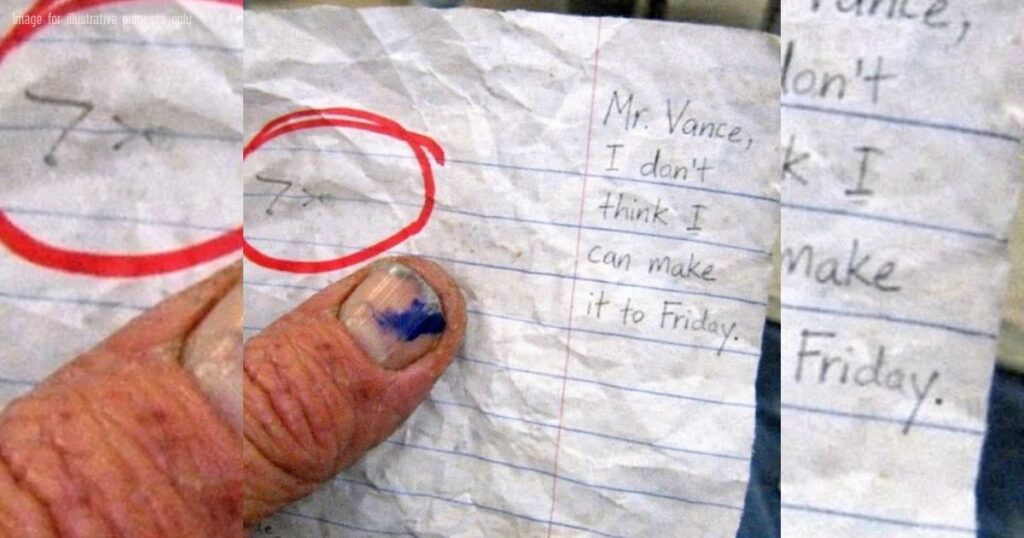
“But I didn’t write it there,” he said, tapping the quiz paper. “Because I wanted a robot to see it.”
I didn’t speak.
I didn’t fill the silence with a motivational quote.
I let him have the space.
“That note,” he whispered, voice cracking, “was for you.”
My throat tightened.
“Why?” I asked.
He shrugged, small and helpless.
“Because you’re the only one who… looks at my paper,” he said. “Like, actually looks.”
And there it was.
Not a debate.
Not a policy.
Not an algorithm.
A kid telling me the difference between being scanned and being seen.
Later that day, after Leo’s mom was taken to get care and Leo was with a safe adult—handled properly, responsibly, no hero fantasies—Ms. Ruiz and I returned to school.
The building buzzed like a disturbed hive.
My email inbox had exploded.
A district notice.
A meeting invite.
And a new memo with a bold title:
MANDATORY IMPLEMENTATION OF APEX-LEARNING FEATURES — EFFECTIVE IMMEDIATELY
Under it, a cheerful line that made my teeth grind:
“This will enhance student safety and ensure consistent instructional outcomes.”
Enhance student safety.
I wanted to throw the memo through a window.
Because the safest thing Leo had all week wasn’t a feature.
It was a tired old man with a red pen who still believed margins mattered.
At 4:00 p.m., the district held an emergency “listening session.”
That’s what they called it.
Listening, in their world, meant letting people talk and then doing what they already planned.
The auditorium was packed.
Teachers.
Parents.
A few students brave enough to show up.
Dr. Sterling stood on stage, smiling like a man selling an upgrade.
“We understand emotions are high,” he began. “But we must evolve. We must modernize. We must remove inconsistency.”
A parent stood up and shouted, “My kid needs results, not feelings!”
Another parent yelled back, “My kid needs a reason to stay alive!”
The room erupted.
That’s America right now, isn’t it?
Everyone desperate.
Everyone tired.
Everyone terrified they’re losing their children to something they can’t name.
Dr. Sterling raised his hands.
“This is exactly why we need systems,” he said. “Human judgment is unreliable.”
I stood up slowly.
My knees complained.
My back cracked.
But I stood anyway.
“I found a note in the margin of a quiz,” I said.
The room went quieter, like someone had turned down the volume.
“It wasn’t flagged,” I continued. “It wasn’t scanned. It wasn’t caught.”
I held up the paper—not showing the message in full, not turning a boy’s pain into content, just holding the evidence of something fragile.
“That note was written for a human,” I said. “Because a human is the only thing Leo trusted.”
Sterling’s smile tightened.
“We have safety features for that,” he said quickly. “With full implementation, the system—”
“The system didn’t catch pencil,” I said.
A murmur spread.
Sterling’s voice sharpened.
“Teachers cannot be the sole safety net,” he said. “You are not trained mental health professionals.”
“I didn’t diagnose him,” I said. “I noticed him.”
That line landed like a match.
Not because it was poetic.
Because every teacher in that room had, at some point, saved a kid by simply paying attention.
And every parent in that room knew what it felt like to pray someone would notice before it was too late.
Sterling stepped forward.
“Are you suggesting we abandon tools that increase efficiency and safety?” he asked.
I looked out at the crowd—parents with crossed arms, teachers with clenched jaws, students staring like they were watching adults decide the future of their lungs.
Then I said the thing that would guarantee comments for days:
“I’m suggesting this,” I said, voice steady. “If you want a frictionless school, you have to be honest about what you’re sanding away.”
Silence.
“A classroom isn’t an app,” I continued. “It’s a relationship. And relationships are messy. They take time. They require eye contact. They require adults who don’t look away when a kid is drowning.”
I pointed gently—not at Sterling, not at the district, but at the idea that everything can be optimized.
“If you remove the mess,” I said, “you remove the moments where a child dares to whisper the truth.”
I lowered the quiz.
“The truth is in the margins,” I said. “And the future that scares me isn’t technology.”
I paused, letting the words settle.
“The future that scares me is a world where we stop reading each other.”
After the meeting, the debate didn’t end.
It exploded.
Teachers argued in the parking lot.
Parents argued online.
Students argued in group chats.
Some people demanded full AI everything.
Some people demanded a ban on devices.
Some people blamed teachers.
Some people blamed parents.
Some people blamed “kids these days.”
And the kid at the center of it all—Leo—just wanted someone to ask him one simple question without turning it into a war:
Are you still here?
That night, I sat at my kitchen table with a stack of blank index cards.
I wrote one sentence on top of each:
“Tell me something you can’t say out loud.”
The next day, I gave them to my students.
“No names,” I told them. “No grades. Just truth.”
Some kids rolled their eyes.
Some laughed.
Then the room went quiet.
Not the dead, humming auditorium quiet.
The alive quiet.
The kind of silence where something real is being born.
By the end of class, the cards were in a pile on my desk like fallen leaves.
I didn’t read them immediately.
I just held the stack.
Because even without reading a single word, I could feel the weight of them.
That weight wasn’t data.
It was humanity.
And here’s the message I wish someone would tattoo on every screen we hand a child:
Speed is not the same as care.
Efficiency is not the same as love.
And a system that can’t notice suffering will always call suffering an “outlier.”
If you want to argue, argue.
If you want to comment, comment.
But answer this honestly:
Would you rather your child be perfectly measured… or truly seen?
Thank you so much for reading this story!
I’d really love to hear your comments and thoughts about this story — your feedback is truly valuable and helps us a lot.
Please leave a comment and share this Facebook post to support the author. Every reaction and review makes a big difference!
This story is a work of fiction created for entertainment and inspirational purposes. While it may draw on real-world themes, all characters, names, and events are imagined. Any resemblance to actual people or situations is purely coincidenta