The blood on my left sneaker was barely dry. It belonged to a nineteen-year-old boy we lost in the ER Trauma Bay less than an hour ago. I hadn’t had time to wipe it off. I hadn’t had time to call his mother back. I hadn’t even had time to cry.
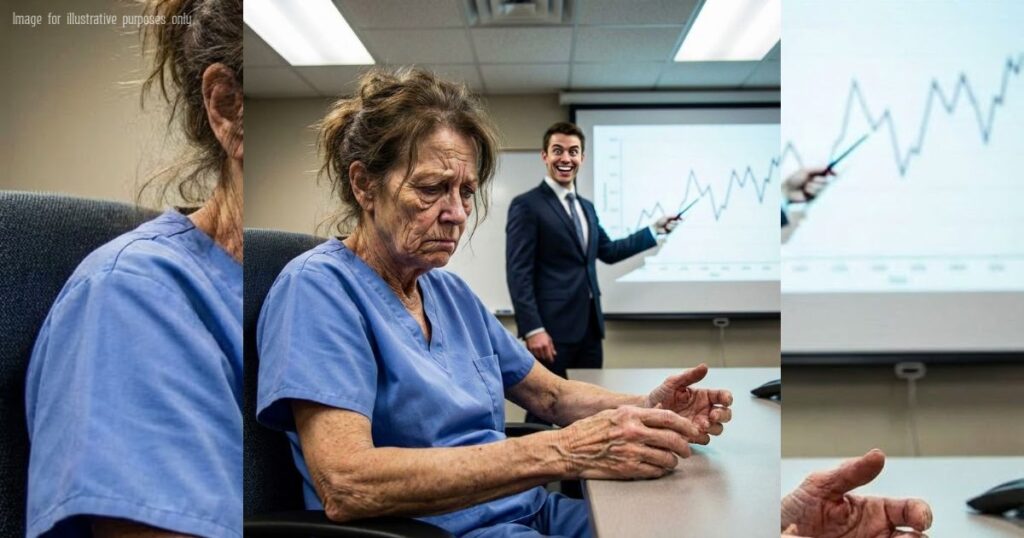
Instead, I was sitting in a freezing conference room, listening to a twenty-something consultant named Jared explain why I was inefficient.
Jared wore a suit that cost more than my car. He pointed a laser at a graph that looked like a jagged mountain range. He called it “Optimizing the Care Funnel.”
I looked down at my hands. They are rough, dry, and shaking just a little. These hands have held newborn babies and dying grandmothers. My badge says Martha, RN. I have been a nurse for thirty-four years. I was inserting IVs when Jared was still in diapers.
“By leveraging AI-driven predictive triage,” Jared said, beaming like he had just discovered electricity, “we can reduce nurse-to-patient physical touchpoints by 45%. This creates a ‘frictionless’ experience. It allows us to pivot to a Lean Staffing Model.”
“Lean Staffing.”
That is corporate code for: We are going to fire three nurses, give you ten more patients, and buy you a pizza when you have a mental breakdown.
The room was silent. Fifty of us—doctors with gray circles under their eyes, nurses with aching backs—sat in the dark. We were too tired to fight. We are always too tired.
Then, Jared said the thing that made me stand up.
“Think of the patient as a customer,” he smiled. “We need to process them through the system faster. Less talking, more logging. The algorithm handles the empathy now.”
The algorithm handles the empathy.
I stood up. My knees popped like a gunshot in the quiet room.
“Excuse me,” I said. My voice was raspy from a twelve-hour shift with no water.
Jared blinked, his laser pointer shaking on the screen. “We’re doing Q&A at the end, ma’am.”
“I won’t be here at the end,” I said. I walked to the front of the room. I don’t walk fast anymore, but I take up space. “You used the word ‘process.’ You talked about ‘touchpoints.'”
I turned to face the room. I looked at the hospital administrators in the front row, tapping on their phones.
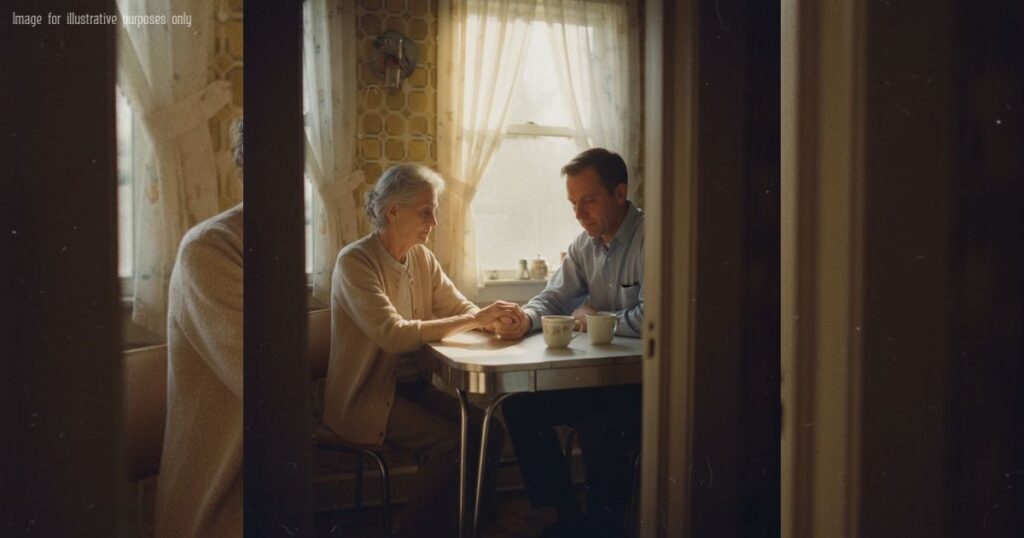
“Let me tell you about my morning,” I said. “I didn’t ‘process’ a customer in Room 412. I sat with Mr. Henderson. He is eighty-two. He worked at the Ford plant for forty years. Today, his insurance provider denied the rehab facility he needs.”
I took a breath. The anger was hot in my chest.
“Mr. Henderson is terrified. He isn’t scared of the pain. He is scared because his wife died two years ago, and tomorrow we have to send him to an empty house. He asked me, ‘Martha, if I die tonight, who will feed my cat?'”
I looked at Jared. He looked confused. His data didn’t have a column for cats.
“Your iPad can read his blood pressure,” I said. “It can bill his Medicare automatically. But can your algorithm hold a trembling hand? Can your AI tell when a grown man is crying silently because he feels like a burden to his children? Because that is what I did for twenty minutes. That was the ‘inefficiency’ you want to cut to save the shareholders a few dollars.”
The silence in the room was heavy. It was the kind of silence you hear in a church.
“I remember before the tablets,” I continued. “Before we spent seven hours a shift staring at screens, clicking boxes to make sure the hospital doesn’t get sued. We used to look people in the eye. We treated souls, not credit scores.”
I pointed to a young nurse in the back row. Her name is Zoe. She started three weeks ago. She looked pale, exhausted, and barely old enough to buy a lottery ticket.
“You want to know why nurses are quitting?” I asked the Board of Directors. “It’s not the blood. We can handle blood. It’s not the long hours. We are used to missed birthdays and Thanksgiving dinners heated up in a microwave.”
My voice cracked.
“We are quitting because you have turned a sacred calling into an assembly line. You are trying to run a hospital like it’s an Amazon fulfillment center. You want us to scan, bag, and tag. But people aren’t packages.”
I looked at Zoe. She was wiping a tear from her cheek.
“We have the best technology in America,” I said. “We have robots that can do surgery. We have drugs that cost $5,000 a pill. But right now, in this country, people are more afraid of the ambulance bill than the heart attack. And when they are lying in that bed, scared and broke, the last thing they need is a chatbot. They need a human being who gives a damn.”
I grabbed my bag.
“I’m going back to the floor,” I said. “Mr. Henderson needs his pain meds. And he needs someone to look at a picture of his late wife. Your computer can’t do that. I can.”
I started walking out. I didn’t look back.
But then I heard it.
The scrape of a chair.
Then another. Then another.
I looked over my shoulder. Zoe was standing up. Then Dr. Evans, the chief of cardiology. Then the respiratory therapists. One by one, the “human capital” stood up. They turned their backs on the graph and followed me out the door. Back to the elevators. Back to the work.
Later, in the breakroom, Zoe sat next to me. Her hands were shaking.
“I was going to resign today,” she whispered. “I have $60,000 in student loans, and I cry every drive home. I thought… I thought I wasn’t cut out for the modern world.”
I poured her a cup of the terrible, burnt coffee we all drink.
“The world is changing, honey,” I told her. “Everything is faster. Everything is digital. But pain? Pain is ancient. Fear doesn’t change. And the need for comfort? That never goes out of style.”
I put a hand on her shoulder.
“Don’t let them convince you that you are just a data processor,” I said. “You are the one thing keeping the humanity in this building. You are the only thing standing between these people and the dark.”
Here is the truth we need to remember:
We live in an age obsessed with optimization. We track our sleep, our steps, and our productivity. We want everything instant, cheap, and automated.
But you cannot automate empathy. You cannot optimize compassion.
When the worst day of your life comes—and it comes for all of us—you won’t care about the hospital’s quarterly efficiency margins. You won’t care if the nurse logged the data in real-time.
You will only care that someone is holding your hand, looking you in the eyes, and saying, “I’m here. I’ve got you. You aren’t alone.”
Technology is a tool. But humans are the cure.
Let’s stop building systems that treat patients like products, and start building a world that treats nurses like the lifeline they are.
Click the button below to read the next part of the story.⏬⏬