She stopped, ashamed of her own exhaustion.
Like being overwhelmed was a moral failure.
I hate that.
I hate what this country does to people—makes them apologize for needing help.
I squeezed her shoulder. “You’re not failing,” I said. “You’re carrying too much.”
Behind her, the little CareBuddy screen blinked cheerfully.
“I can provide resources for caregiver wellness,” it offered.
She stared at it like it had slapped her.
I watched her expression change—from confusion, to anger, to the kind of laugh that isn’t funny.
“What is that?” she demanded.
“Administration,” I said quietly.
Her eyes flashed. “So they can buy that, but they can’t approve his rehab?”
There it was.
The sentence that sparks comment sections into bonfires.
Because people will fight over it.
They always do.
Half of them will say, Healthcare is a business. That’s reality.
Half of them will say, No human being should be treated like a profit margin.
And the truth is, we’re all stuck inside that argument while real people bleed in real beds.
That night, the clip went online.
I didn’t post it.
Zoe didn’t post it.
Somebody in that conference room had filmed my speech—the part about “the algorithm handles the empathy”—and leaked it into the world where things don’t stay private.
By midnight, my phone was buzzing like an angry beehive.
Texts from nurses I hadn’t spoken to in years.
Messages from strangers.
Voicemails from unknown numbers.
And in the middle of it all, Zoe stood in the breakroom with her own phone shaking in her hands.
“Martha,” she whispered. “It’s… everywhere.”
She turned the screen toward me.
There I was.
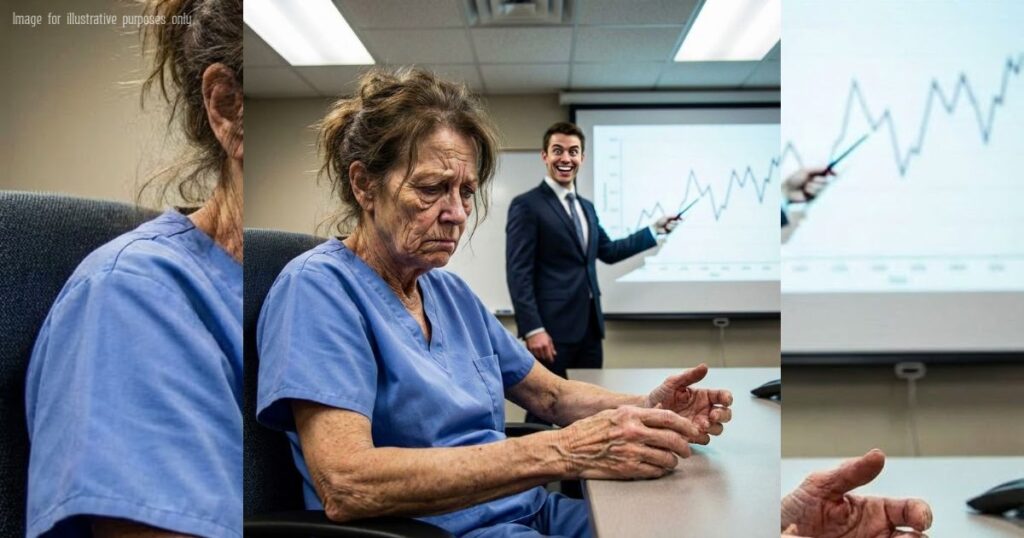
Older, tired, hair frizzed from sweat, voice rough, eyes fierce.
A caption under the video screamed in giant letters:
“A NURSE JUST EXPOSED WHAT HOSPITALS REALLY ARE NOW.”
The comments were already a war.
SHE’S RIGHT.
NURSES ARE ANGELS.
DO YOUR JOB AND STOP COMPLAINING.
THIS IS WHY COSTS ARE OUT OF CONTROL.
IF YOU DON’T LIKE IT, QUIT.
THEY’RE REPLACING YOU WITH ROBOTS ANYWAY.
Zoe stared at the screen like it was a monster.
“Is this… good?” she asked.
“It’s loud,” I said. “That’s what it is.”
A loud truth is dangerous.
Not because it’s untrue.
Because it forces people to pick sides.
And sides are great for engagement.
Terrible for human beings.
At 6:05 AM, after another night of sprinting from room to room, after cleaning blood off my shoe with a paper towel that fell apart in my hands, I got another email.
SUBJECT: Mandatory Meeting — Human Resources
I didn’t have to open it to feel the weight.
I walked into HR at 8:30, still smelling like antiseptic.
A woman with perfect hair sat across from me, smiling the way people smile when they’re about to hurt you politely.
On the table was a printed screenshot of my face from the video.
A stranger’s version of me—cropped, captioned, turned into content.
“We’re concerned about your public statements,” she said gently. “They may violate organizational policy.”
“What policy?” I asked.
She slid a paper toward me.
NON-DISPARAGEMENT ACKNOWLEDGMENT
I looked at the signature line.
And suddenly, I understood the whole game.
They couldn’t stop the bleeding.
They couldn’t fix the staffing.
They couldn’t make Mr. Henderson’s rehab magically approved.
But they could control the narrative.
They could silence the people who actually see the truth.
“You want me to sign this,” I said, “so you can keep pretending nothing is wrong.”
She leaned forward, still smiling. “We want to move forward constructively.”
I laughed once—short and tired.
“Constructively,” I echoed. “Like a funeral brochure.”
Her smile flickered.
“Think carefully,” she warned, voice softer now. “This could impact your employment.”
Thirty-four years.
Tens of thousands of patients.
Countless hands held in the dark.
And here it was.
My career reduced to a signature on a piece of paper designed to protect the system, not the people inside it.
I picked up the pen.
Zoe’s face flashed in my mind—young, terrified, trying to become a nurse in a world that wants nurses to be quiet.
Mr. Henderson’s daughter flashed in my mind—furious, exhausted, asking why a gadget gets funding but her father doesn’t get care.
And the nineteen-year-old boy from the trauma bay flashed in my mind—the blood on my shoe, the mother I didn’t call back yet, the reality that never makes it into the graphs.
I set the pen down.
“No,” I said.
The HR woman’s smile vanished completely.
“Martha,” she said slowly, “do you understand what you’re doing?”
I stood up.
My knees popped again—loud in the quiet office.
“I understand exactly,” I said. “I’m doing what you all forgot how to do.”
I walked to the door.
Behind me, she spoke like a final warning.
“You can’t fight the future.”
I turned back, hand on the handle.
Her eyes were sharp now, not kind.
Not human.
I thought about the little rolling device with the cheerful face.
I thought about the phrase the algorithm handles the empathy.
And I felt something settle inside me—calm, heavy, certain.
“I’m not fighting the future,” I said. “I’m fighting for the part of us that still deserves to be in it.”
Then I opened the door.
And I went back to the floor.
Because someone, somewhere in that building, was scared.
And no screen in the world can hold a trembling hand the way a human can.
Not yet.
Not ever.
Thank you so much for reading this story!
I’d really love to hear your comments and thoughts about this story — your feedback is truly valuable and helps us a lot.
Please leave a comment and share this Facebook post to support the author. Every reaction and review makes a big difference!
This story is a work of fiction created for entertainment and inspirational purposes. While it may draw on real-world themes, all characters, names, and events are imagined. Any resemblance to actual people or situations is purely coincidenta