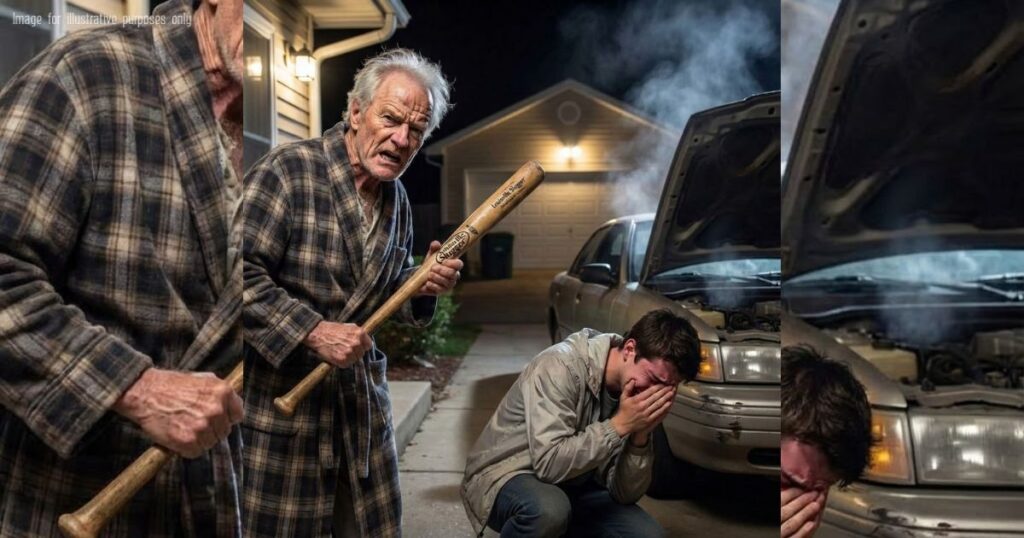
I was standing on my porch in my bathrobe at 1:00 AM, gripping a 1982 Louisville Slugger baseball bat, ready to swing at the shadow lurking in my driveway.
I didn’t call 911. In my neighborhood, by the time the sirens wail, it’s usually too late. I just opened the door, flooded the driveway with the motion-sensor light, and yelled, “You picked the wrong house, son!”
The figure didn’t run. It collapsed.
I didn’t find a thug stealing my catalytic converter. I found a boy, maybe twenty years old, sobbing over the open hood of a smoking sedan that looked like it had been held together by duct tape and prayers.
My name is Walt. I’m 72. I’m what the world calls a “Boomer,” a term usually spat out like an insult these days. I come from a time when you fixed your own toaster, knew your neighbor’s grievances, and didn’t need a “wellness app” to tell you if you were sad.
Now, I live in a cookie-cutter subdivision where the only community interaction is people fighting on the Nextdoor app about whose dog pooped on whose lawn.
I see them every day—the invisible workforce. The Gig Workers. They sprint to porches in the rain, drop off organic dog food or bubble tea, and vanish. They are chased by invisible timers. They are the ghosts of the modern economy.
It was a Tuesday, and the Pennsylvania winter was biting hard. The wind chill was five below zero.
I lowered the bat. “Engine trouble?”
The boy looked up. He was shaking—not just from the cold, but from panic. He wore a thin, trendy windbreaker that was useless against the frost.
“I’m sorry, sir,” he stammered, wiping his nose on his sleeve. “The app… the app is going to deactivate me. I have a priority delivery. If I’m late, my rating drops below 4.8. If it drops, I lose my tuition assistance. I just… the car just died.”
He wasn’t afraid of freezing to death. He was afraid of an Algorithm. He was terrified of a piece of code in Silicon Valley that decided if he ate next week.
“Pop the hood,” I grunted.
“I… I don’t know how,” he admitted, shame coloring his cheeks.
I sighed. I walked over, reached through the grill, and popped the latch. “Hold this flashlight. And stop shaking, you’re making me nervous.”
I looked inside. It was a disaster. A battery terminal was so corroded it had lost contact. A simple fix if you have a wire brush and a wrench. A catastrophe if you’ve never been taught to look away from a screen.
I went into my garage—my sanctuary. It smells of sawdust, grease, and the year 1985. I grabbed my wire brush and a socket set.
“Watch me,” I commanded. “Don’t look at your phone. Look at the battery.”
I scrubbed the terminal. I tightened the bolt. I showed him how to feel for the resistance, so he wouldn’t strip the screw.
“Try it now.”
He turned the key. The engine sputtered, then roared to life.
The kid looked at me like I had just performed a miracle. He fumbled with his phone. “What’s your Venmo? I have twelve dollars in my account. I can send it.”
I wiped my hands on a rag. “Keep your money. And for God’s sake, go to the thrift store and buy a wool coat. That plastic jacket isn’t doing you any favors.”
“But why?” he asked, tears welling up again. “Nobody stops. Everyone just yells at me to move.”
“Because,” I said, looking him in the eye. “We don’t leave a man behind. Even if the enemy is just a rusty bolt.”
His name was Mateo. He drove off to deliver a burrito to someone who probably wouldn’t even say thank you.
I thought that was the end of it.
Three nights later, the motion light clicked on. It was Mateo. He wasn’t delivering. He was holding a broken standing fan under his arm.
“I found it by the dumpster,” Mateo said, looking at his sneakers. “It doesn’t spin. My dorm is hot, and I can’t afford a new one. I thought… maybe you could show me?”
I opened the garage door. “Put it on the workbench.”
That winter, my garage stopped being a storage unit and became a sanctuary.
It started with Mateo. Then he brought a friend, a frantic nursing student named Sarah whose side-view mirror was hanging off by a wire. Then came a young guy from down the street who didn’t know how to assemble a crib for his expecting wife.
We didn’t talk about politics. We didn’t discuss the angry news cycle or the election. We turned off the phones. We listened to Bob Seger on the radio, drank cheap percolator coffee, and we worked with our hands.
I taught them that stripping a screw isn’t the end of the world. I taught them that patience fixes more things than force. I saw the anxiety leave their shoulders when they realized they could control their environment, not just consume it.
Then came the “Karen.”
Her name is actually Linda, the President of the Homeowners Association. She marched up my driveway one evening with a clipboard and a scowl that could curdle milk. She saw three cars in my driveway and four young people laughing over a disassembled vacuum cleaner.
“Walt,” she warned, her voice tight. “We have strict bylaws about running unlicensed businesses. This looks like a commercial repair shop. The neighbors are concerned about property values.”
Mateo stepped up before I could say a word. He was wearing a thick flannel shirt now—one of my old ones. He didn’t look like the scared kid from that first night.
“It’s not a business, ma’am,” Mateo said respectfully but firmly. “It’s a classroom.”
Linda looked at the vacuum cleaner. She looked at Mateo’s greasy hands. She looked at the joy on Sarah’s face as she successfully rewired a lamp.
Then Linda looked at her own car parked on the street. It was a pristine, luxury SUV.
“Tuesday nights?” Linda asked, her voice dropping to a whisper.
“Tuesday nights,” I confirmed. “Is there a problem, Linda?”
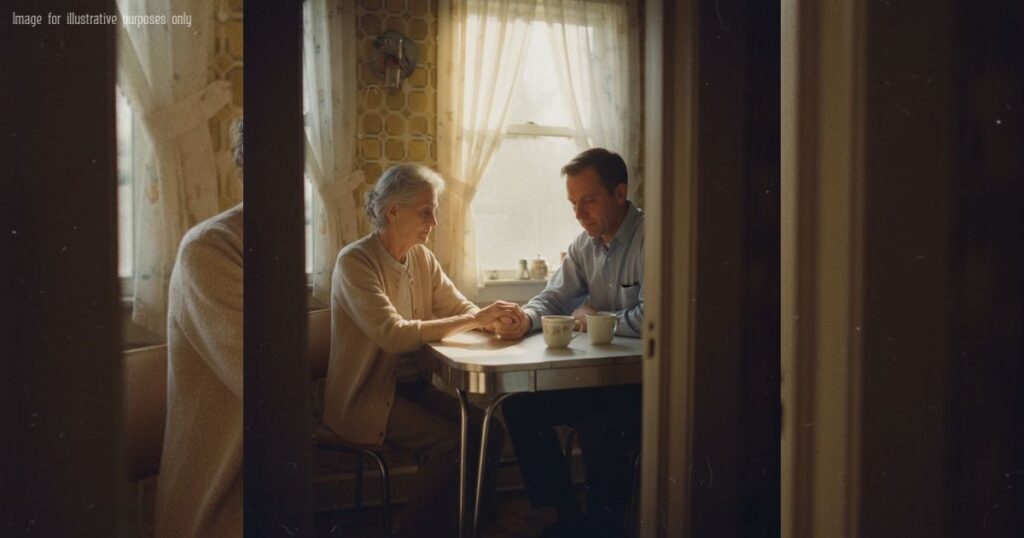
She hesitated. The armor cracked. “My late husband’s music box,” she said softly. “It stopped playing three years ago. I’ve been… I’ve been too afraid to take it to a shop. I didn’t want them to lose it.”
“Bring it over,” I said. “We have a spot on the bench.”
She didn’t write a fine. She walked away, and the next week, she brought cookies and a music box that just needed a little oil and a lot of love.
I realized something that night, looking at this strange, mismatched family in my garage.
These “kids” aren’t lazy. They aren’t entitled snowflakes. They are lonely. They are starving for a world that feels real. They are desperate for something they can touch, fix, and keep.
We live in a “Throwaway Culture.”
If a phone breaks, we trash it. If a job gets hard, we quit. If a person disagrees with us, we “cancel” them or block them. We treat everything—and everyone—as disposable. We have traded connection for convenience.
But here is the truth from an old man in a grease-stained garage: Nothing is broken beyond repair if you are willing to get your hands dirty.
So, here is my challenge to you.
Stop scrolling. Put the damn phone down. Look at the things around you that are broken. Your front gate. Your relationship with your neighbor. Your own patience.
Don’t throw them away.
Pick up a tool. Learn how it works. Ask for help. Fix it.
Because the most revolutionary thing you can do in a world that screams at you to buy new… is to love what you already have.
Click the button below to read the next part of the story.⏬⏬