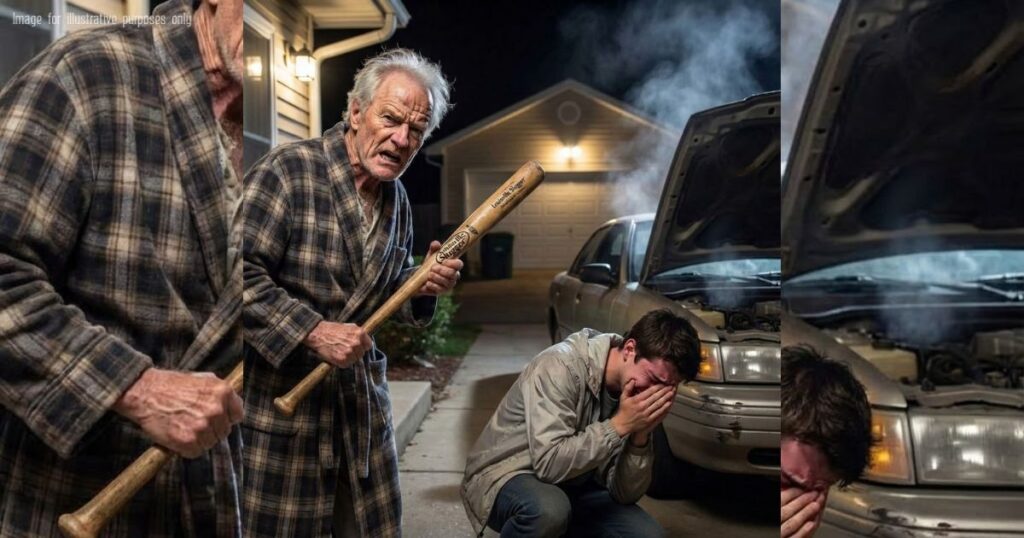
It rolled into the driveway slow, like a wounded animal.
Her headlights flickered.
Then died.
I opened the door and stepped onto the porch.
Bathrobe.
Cold air.
Same driveway.
Different kind of shadow.
Mrs. Keene got out, arms wrapped around herself.
No clipboard.
No smile.
Just embarrassment.
“My car won’t start,” she said quietly.
Behind her, I saw her phone in her hand.
And I saw her thumb hovering.
Ready to call someone.
A service.
A stranger.
An app.
Anything but… this.
Mateo appeared from the garage, wiping his hands on a rag.
He froze when he saw her.
Sarah stepped beside him.
Darnell looked up from the bench.
Linda came out too, still holding her cookie plate like a peace offering.
Mrs. Keene’s eyes flicked over all of them.
Young people.
Grease.
Tools.
The “problem.”
She swallowed.
“I… I have an appointment early,” she said, voice thin. “And I can’t afford to miss it.”
Mateo’s laugh was short and bitter.
“Funny,” he said. “When I can’t afford to miss something, it’s my fault.”
Mrs. Keene flinched.
And there it was—the moment that could’ve turned ugly.
The moment people online live for.
The moment where someone gets “put in their place.”
But here’s the thing those commenters don’t understand:
In a real garage, with real people, humiliation doesn’t fix anything.
It just breaks more.
I looked at Mateo.
Then at Mrs. Keene.
And I said the only thing that mattered.
“Pop the hood.”
Mrs. Keene blinked.
“You’re going to help me?”
I shrugged.
“I’m not doing it for your bylaws,” I said. “I’m doing it because you’re a human being with a dead car on a cold night.”
Mateo stared at me like he didn’t know whether to be proud or furious.
“Why?” he asked under his breath.
I leaned closer so only he could hear.
“Because,” I said, “if we only help people who agree with us, we’re not building community. We’re building teams.”
His throat worked.
His eyes went shiny.
Mrs. Keene stood there while Mateo held the flashlight.
While Sarah pointed out the loose connection.
While Darnell fetched the socket set without being asked.
And while Linda—Linda, of all people—handed Mrs. Keene a cookie with hands that shook a little.
The car started.
Mrs. Keene let out a sound that was half relief, half shame.
She stood there like she wanted to apologize but didn’t know how without losing her pride.
So she did what people do now.
She tried to turn it into a transaction.
“How much do I owe you?” she asked.
Mateo’s mouth twitched.
I wiped my hands on my rag.
“Nothing,” I said. “But you’re going to do something for me.”
Her eyes narrowed, wary.
“Not money,” I said. “Not a fine. Not a rule.”
I nodded toward the garage.
“You’re going to stand right here,” I said, “and look at these kids in the eyes and say they belong in this neighborhood as much as you do.”
Silence.
Cold air.
Motion light humming.
Mrs. Keene’s face tightened.
Her pride wrestled her fear.
Her fear wrestled her shame.
And then—quiet as a confession—she said it.
“You belong,” she told them.
Mateo didn’t smile.
He didn’t forgive her on the spot.
That’s not how real life works.
But his shoulders dropped a fraction.
Sarah exhaled like she’d been holding her breath for months.
Darnell nodded once.
Linda dabbed her eyes with a napkin and pretended it was the wind.
After she drove away, Mateo stayed behind while the others drifted back to the bench.
He looked at me.
“You know people are going to argue about this forever,” he said.
“I know,” I said.
“They’ll say you’re a hero,” he said. “Or they’ll say you’re stupid.”
“I know.”
“They’ll say she didn’t deserve help.”
“I know.”
He swallowed.
“Why does it feel like everything is a fight now?”
I leaned against my workbench, surrounded by tools older than most of the people who hated us online.
“Because we forgot something,” I said.
“What?”
I lifted my rag, black with grease.
“This,” I said. “This is what connection looks like. It’s messy. It’s inconvenient. It takes time. It doesn’t come with a ‘like’ button.”
Mateo nodded slowly.
Then he said something that hit harder than any comment thread.
“Most people don’t want connection,” he whispered. “They want comfort.”
I didn’t answer right away.
Because he was right.
And that’s the part that will make people furious enough to comment:
We live in a country where we’ll tip a screen, but we won’t look a person in the eyes.
We’ll pay extra for “priority,” but we won’t pay attention.
We’ll say “kids are entitled,” while expecting them to carry our convenience on their backs for pennies.
We’ll scream “personal responsibility,” while building a world where a faceless rating decides if a young man eats.
I turned the radio up—just a little.
Not loud.
Just enough to fill the silence.
“Alright,” I said, clapping my hands once. “Who’s got something broken?”
Sarah raised her hand.
“My faith in humanity,” she said.
Darnell snorted. “Start with the toaster, doc.”
Mateo smiled for real that time.
And we went back to work.
Because here’s the message I’ll die on, and you can argue with me in the comments all night:
A neighborhood isn’t valuable because the lawns are perfect.
It’s valuable because, when the light clicks on at 1:00 AM… somebody opens the door.
Thank you so much for reading this story!
I’d really love to hear your comments and thoughts about this story — your feedback is truly valuable and helps us a lot.
Please leave a comment and share this Facebook post to support the author. Every reaction and review makes a big difference!
This story is a work of fiction created for entertainment and inspirational purposes. While it may draw on real-world themes, all characters, names, and events are imagined. Any resemblance to actual people or situations is purely coincidenta