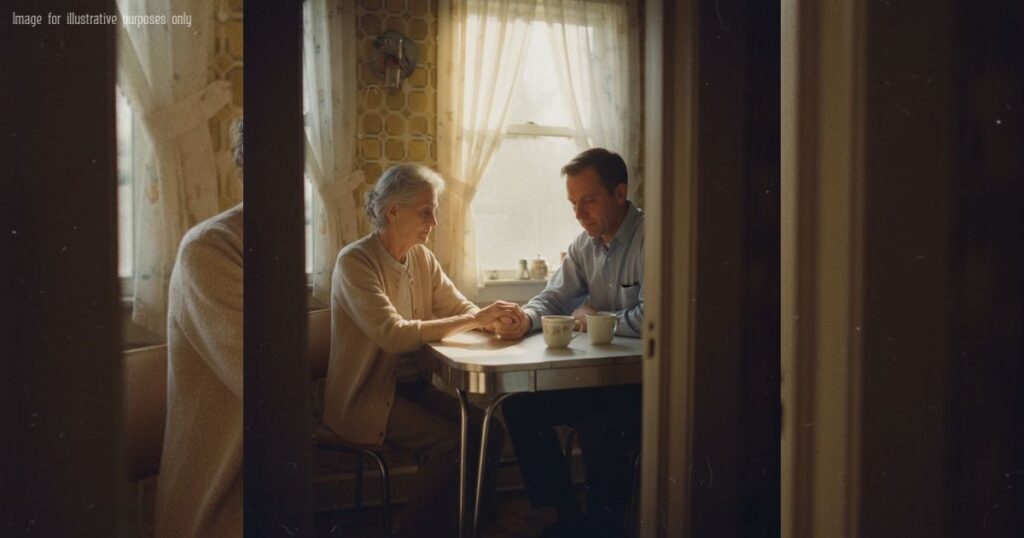
The night my dad told me our old dog was “waiting for your car to come home so he can die,” I thought he was being dramatic.
Two hours later, I was driving through the dark with my hazards on because I couldn’t stop crying.
I live in the city now, in a tiny apartment stacked on top of other people’s lives. I was up late finishing a slide deck for a big presentation, empty takeout boxes on the table, laptop light burning my eyes.
Dad.
It was almost midnight.
“Hey, Dad. Everything okay?” I kept typing while I asked.
He didn’t answer right away. I heard his breathing, slow and shaky.
“It’s Buddy,” he said finally. “He’s… baby, I think he’s waiting on you.”
Buddy is our old mutt we rescued when I was fifteen, back when gas was cheaper and my biggest problem was passing algebra. He’s about fifteen now—hips bad, eyes cloudy, hair going white around his nose.
“You can call the vet in the morning,” I said, rubbing my forehead. “Let them give him something so he isn’t hurting. I’ll drive down this weekend, okay? I’ve got this presentation at eight—”
“He’s not in his bed, Em.”
Dad’s voice broke on my name. I hadn’t heard that crack since my mother’s funeral.
“He’s out in the driveway,” Dad whispered. “Lying by the driver’s door. I tried to move him. He growled at me. He keeps staring at the road like he’s waiting for you to pull in.”
My fingers froze on the keyboard.
Suddenly those slides didn’t matter. The emails, the deadlines, the little glowing screen that had become my whole world—all of it felt small and mean.
“I’m coming,” I said. I was already looking for my car keys.
The highway between Chicago and my little hometown in Indiana has never felt longer. Streetlights flashed over me like a heartbeat. I remembered that first day we brought Buddy home in the back of Dad’s old blue van. Mom laughed while he tried to climb over the seat and lick my face. Dad kept saying, “He’s your dog, Em. You feed him, you walk him, you clean up his mess.”
We took that van everywhere: Friday night football games, grocery runs, cheap road trips when gas dropped a few cents. I drove when I finally got my license, Dad in the passenger seat, Buddy in the back with his head out the window like he owned the whole state.
I hadn’t really thought about that van in years.
When I turned onto our street, the houses looked smaller, like someone had washed them in hot water. Dad’s porch light was on, but it flickered. The mailbox leaned a little. The kind of small changes you only see when you stay away too long.
I didn’t go inside. I went straight to the driveway.
The night air hit me—cold, and carrying that mix of wet leaves, gasoline, and something I can only call “home.”
There was the van. Rust on the wheel wells. A dent on the side from when I misjudged the distance to the basketball hoop post one summer.
And there was Buddy.
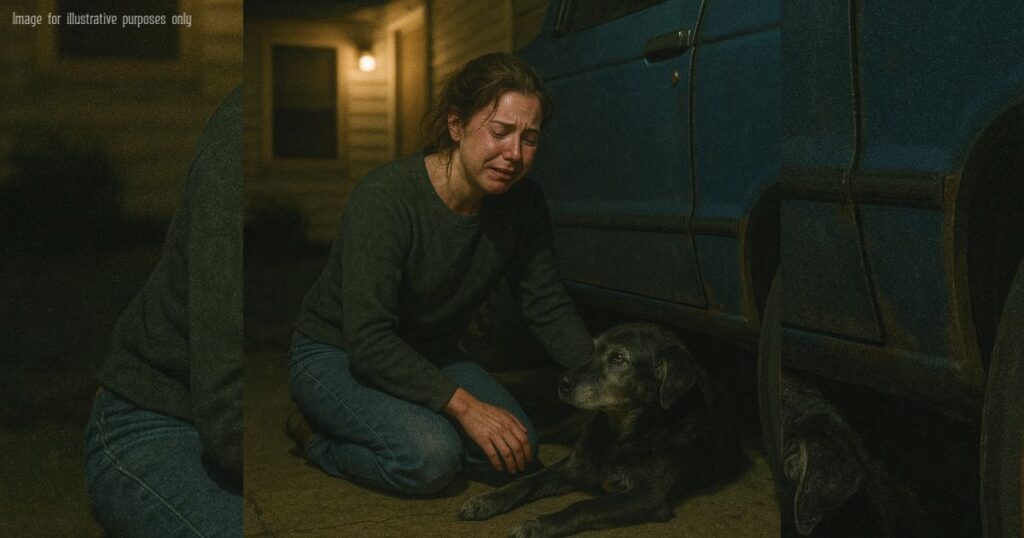
He was curled against the driver’s door like a guard. His fur, once almost black, was faded and patchy. His breath came in short, sharp pulls. His paws were dirty like he’d dragged himself there.
Dad stepped out of the shadows in his old winter coat.
“He did it yesterday,” Dad said, voice rough. “Crawled all the way from the kitchen to here. I tried picking him up. He snapped at me, like he was saying, ‘No, this is my spot.’”
I knelt down, my knees protesting on the cracked concrete.
“Hey, old man,” I whispered.
His ears twitched. His tail tried to wag, just once. He didn’t open his eyes, but his breathing changed. He knew.
That’s when I saw it.
Hanging on the mirror inside the van was my old high school hoodie—the gray one with my graduation year peeling off in cracked letters.
“You saved that?” I asked.
Dad looked away. “Every evening around five, I come out here. I hang your hoodie up. I open the driver’s window a bit. I turn on the radio to the kind of music you used to blast. I sit in the passenger seat, and Buddy lies right there.” He nodded toward the driveway. “He eats better afterward. I tell him you’ll be home soon. That you just stopped to grab snacks.”
My chest hurt in a way no deadline had ever made it hurt.
While I was moving up, leveling up, “making something” of myself, my dad and my dog had been rehearsing the same memory for ten straight years. Keeping me eighteen. Keeping that van full.
Buddy wasn’t lying by a vehicle. He was waiting at a door. Holding his station. Making sure the driver got home safe.
I knew what I had to do.
I didn’t try to carry him. Instead, I opened the driver’s door very slowly. I slipped into the seat, careful not to bump him.
I pulled the old hoodie over my work shirt. It was tight across my shoulders now, but it still smelled faintly of fabric softener and teenage sweat.
I turned the key.
The engine coughed, complained, then settled into that familiar low rumble. The dashboard lights glowed weakly in the dark.
Dad walked around and got into the passenger seat, like he had a thousand times before. He didn’t say a word.
I rolled the window down halfway and reached my hand out, resting it on Buddy’s side.
The vibration of the van traveled through my palm into his body. His breathing evened out. His muscles relaxed. For a minute, time bent: I was a kid again, Dad was younger, Buddy was strong and wild, and the world was simple.
Buddy took one big, careful breath. He pushed his nose against my hand like he always did when he wanted one more scratch.
And then, with his family finally in “our spots”—me at the wheel, Dad beside me, the engine humming—Buddy’s body went soft and still.
He didn’t leave us alone on a random Tuesday.
He waited until the ride was “ready.”
Dad’s hand found my shoulder. He squeezed once. No speech. No “I told you so.” Just a tired, heavy kindness.
WHAT I LEARNED THAT NIGHT
We tell ourselves our absence is temporary.
We say, “When things calm down, I’ll visit.”
We treat the people who raised us—and the animals who loved us without conditions—like calendar items we can drag and reschedule.
But for your parents, and especially for your pets, you are not background noise.
You are the show. You’re the face they listen for at the door, the footsteps they know by sound.
My old dog waited days on freezing concrete for a car ride that went nowhere… just to feel my hand on his fur one more time.
So here’s my gentle push, from one busy person to another:
Stop scrolling.
Close the laptop.
Go home while “later” is still an option.
Sit in the old van.
Stand in the tiny kitchen.
Hold the wrinkled hand.
Because work will always want more of you.
But the people—and the dogs—who see you as their whole world?
They won’t be here forever.
—
This is Part 2 of Buddy’s story—the part that happens after you think the saddest part is already over.
The part where you go back to “real life” and realize real life doesn’t care that you just buried your best friend in the frozen ground behind your childhood home.
If you didn’t read the first part: my old dog Buddy dragged himself out to our battered blue van and refused to move until I came home. He waited, on cold concrete, for me to sit in the driver’s seat one last time… and only then did he let go.
The morning after we buried him, my inbox thought nothing had happened.
Click the button below to read the next part of the story.⏬⏬