PART 2 — The Taillights Didn’t Fade. They Multiplied.
I thought that night ended when Sarah’s little gray sedan disappeared into the sunrise.
I thought the blizzard swallowed the story the way the highway swallows everything—quietly, without witnesses.
I was wrong.
Because in America, the moment you help someone, you don’t just pick up their problem.
You pick up everyone’s opinion about it.
And opinions are heavier than freight.
Three days later, my phone buzzed while I was rolling through a stretch of interstate so flat it looked like the earth had given up. Unknown number. I almost ignored it—truckers don’t get “good news” calls at noon on a Wednesday.
But something in my gut tightened.
I answered.
“Miller?” a woman whispered.
It was Sarah.
Her voice sounded smaller than it had in the snow. Like the cold had found a new way inside her.
“Hey,” I said, eyes flicking between mirrors. “You okay? Is the kid okay?”
A pause. A swallow.
“He’s okay,” she said. “For now.”
That for now landed like a tire blowout.
“What happened?” I asked.
She exhaled, shaky. “I made it to work that morning. I didn’t miss the shift. I didn’t even cry in the bathroom like I wanted to. I stacked boxes. I smiled at supervisors. I did everything right.”
Another pause.
“Then security asked me to come outside.”
I felt my hands tighten on the wheel.
“They said someone reported a ‘family living in a vehicle’ in the employee lot,” she continued, voice cracking. “They said it’s a ‘liability.’ They said the company can’t have ‘that kind of thing’ on the property.”
Her words were careful—like she was trying not to trigger a trap.
I didn’t need details to see it.
A clipboard. A polite voice. A rule that sounded clean on paper and cruel in real life.
“They fired you?” I asked.
“I don’t know what to call it,” she whispered. “They said ‘separation.’ They said I could reapply in ninety days. They said it like it was merciful.”
My jaw clenched so hard it hurt.
“And the boy?” I asked again.
“He was in the back seat,” she said. “Doing homework on his knees. Because I told him this was just… temporary. Because I told him we were okay.”
Her breath hitched.
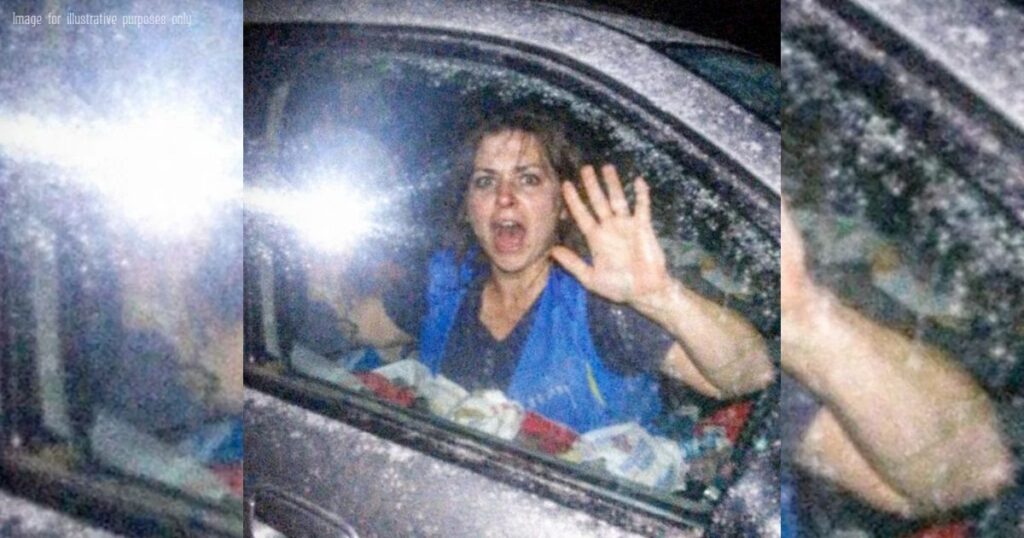
“And then a woman in a bright vest—someone I don’t even know—took a picture.”
I felt a chill that had nothing to do with February.
“A picture?” I repeated.
Sarah’s voice dropped lower. “She said she was ‘just documenting.’ She said she was ‘keeping kids safe.’ She said she was ‘doing the right thing.’”
I’d heard those words before.
Not on the CB.
On the news.
On the internet.
In comment sections where people loved to play judge because it didn’t cost them anything.
“They posted it,” Sarah said. “Not my name. Just the car. My son’s backpack. My face if you zoom in.”
I swallowed hard. “Sarah…”
“It spread,” she whispered. “People found the city. They guessed the warehouse. They started calling me things.”
She didn’t say the words out loud. She didn’t need to.
Some insults don’t belong in a child’s world.
“Some people offered help,” she added quickly, like she felt guilty for admitting it. “Some people were kind. But the loudest ones… they said I should lose my kid. They said I was using him. They said I was lying about working. They said I should’ve ‘made better choices.’”
The truck hummed beneath me, steady as a heartbeat.
But inside my chest, something ugly stirred.
Because here’s what nobody tells you about “personal responsibility” speeches:
They’re always delivered by people who’ve never had to choose between warmth and food, between pride and survival, between calling for help and losing everything.
“Did anyone… show up?” I asked carefully.
“Yes,” Sarah said. “Two men. Not cops. They said they were ‘with child services.’ They weren’t mean. They weren’t screaming. They were polite.”
That word again.
Polite.
Like a knife with a ribbon on it.
“They asked if we had somewhere to go,” she continued. “They asked if I had family. They asked if my son had a bed.”
A long silence.
“Miller,” she whispered, “I told them the truth.”
“What truth?” I asked, even though I already knew.
“I told them we were in the car,” she said. “I told them I was working. I told them my alternator died and strangers saved us in a blizzard.”
Her voice broke on the last part.
“And they asked… why I didn’t call 911.”
There it was.
The question that turns kindness into a courtroom.
I stared out at the highway, at the endless lines and exit signs and billboards selling comfort to people who had money for comfort.
“I didn’t know what to say,” Sarah whispered. “I didn’t want to say I was scared. Because if you’re scared, people hear ‘guilty.’”
My throat tightened.
“Where are you right now?” I asked.
“In the car,” she said. “At a gas station off the interstate. They gave me twenty-four hours to ‘make a plan.’ Like plans come in vending machines.”
I didn’t tell her everything my brain was thinking.
I didn’t tell her I wanted to rip apart every neat little phrase people use to justify watching someone drown.
Instead, I did what truckers do when the road throws a problem at you.
I called the network.
I grabbed the CB mic and put my voice into the static like dropping a flare into darkness.
“Breaker one-nine,” I said, calm on the outside, burning on the inside. “This is Big Miller. Sarah’s in trouble. Not mechanical. Human.”
Static.
Then Tank’s voice. Low. Immediate.
“Where?”
I gave coordinates.
Red Dog came in right after. “Ten-four.”
And then a new voice I hadn’t heard before—older, steady, female.
“This is Mama J,” she said. “I’m two exits away. I got hot soup and a back seat clean enough for Sunday.”
I blinked.
The network wasn’t just men.
It never was.
It was anyone who understood the unspoken rule of the road:
If you see someone freezing, you don’t ask what they did wrong. You bring heat.
By the time I pulled into that gas station, the sun was already dropping like it had somewhere better to be.
Sarah’s car was parked near the air pump, tucked against the building like it was trying to hide.
I spotted her immediately—not because she stood out, but because she looked like she’d been made invisible one too many times.
Her shoulders were hunched.
Her eyes kept flicking to every passing vehicle.
Her son sat in the passenger seat with a coloring book open, pretending it was normal to color while your whole life balanced on a stranger’s opinion.
Mama J was there first. A thick, older woman with gray hair pulled into a bun, wrapped in a worn coat that looked like it had hugged a lot of people. She handed Sarah a steaming cup like it was sacred.
Tank arrived next, carrying a duffel bag that clanked—tools, probably, because that’s how he loves. Fix what you can fix.
Red Dog rolled in behind him, reefer trailer humming. He stepped down holding a small cooler like it was a newborn.
“For the insulin,” he said, nodding at the kid. “Still steady.”
Click the button below to read the next part of the story.⏬⏬