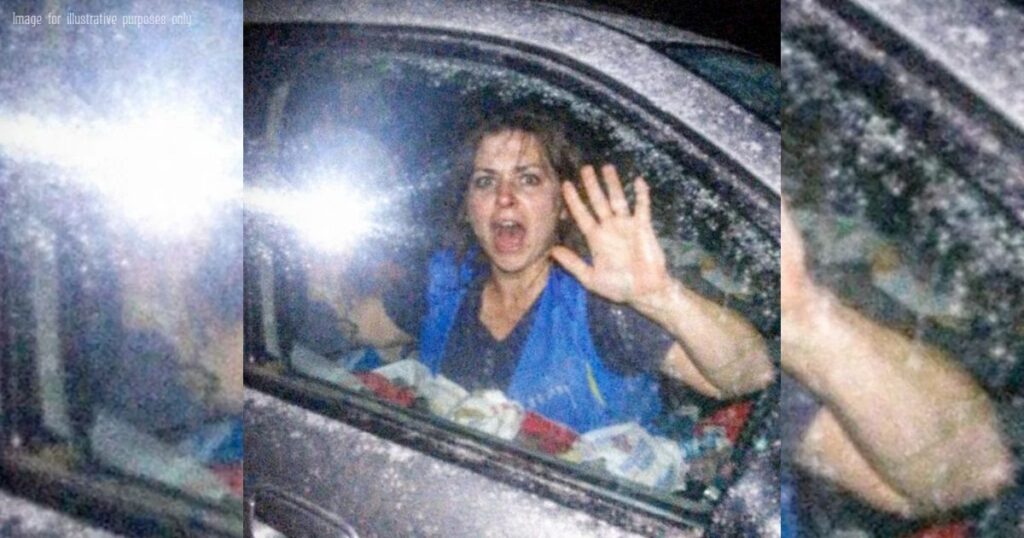
Sarah stared at us like she couldn’t believe the world had shown up twice.
And then she started crying—not loud, not dramatic.
Just quiet tears that slid down her face like her body had finally run out of ways to stay strong.
“I didn’t ask for this,” she whispered.
“I know,” Mama J said, touching her arm. “Most storms don’t ask permission.”
We sat inside the diner section of the gas station—no brand names, no bright logos, just stale coffee and fluorescent lights that made everyone look tired.
And that’s where the real controversy walked in.
A man at the next booth recognized Sarah.
I could see it on his face—the flicker of I’ve seen you somewhere.
His phone was already out.
Not to call help.
To collect content.
He didn’t say a word. Just angled the camera slightly, like he was filming wildlife.
Tank noticed first.
Tank stood up.
Tank is the kind of man who doesn’t need to raise his voice to change the temperature in a room.
He walked over, planted both hands on the table, and leaned in—not threatening, not screaming, just present.
“Buddy,” Tank said quietly, “you can put the phone away, or you can take it outside and explain to me why you think filming a child is a hobby.”
The man blinked, offended—because people hate being confronted when they’re doing something ugly in a polite way.
“I’m just—this is the lady from the post,” he said. “People need to know. You can’t just—”
“You can’t just what?” Mama J cut in, her voice sharp as broken glass. “You can’t just be poor in public? You can’t just struggle without permission?”
Heads turned.
Forks paused mid-air.
You could feel it—the room splitting into invisible sides.
Some faces hardened with judgment.
Some softened with discomfort.
Some looked away because looking costs courage.
The man puffed up. “Kids deserve safety,” he said, like it was a slogan.
“They do,” I said, standing now too, voice steady. “So do mothers. So do people who work until their hands crack open and still can’t afford a warm room.”
He sneered. “Then call the authorities.”
And there it was again.
That idea that help only counts if it comes with paperwork.
That compassion is suspicious unless it’s approved.
Red Dog stepped forward, calmer than all of us, like he’d been saving his words for the exact right moment.
“Let me ask you something,” he said. “If you saw your neighbor’s kid shivering, would you hand them a blanket… or would you make them prove they deserve it first?”
The man opened his mouth.
Closed it.
Because some questions don’t have answers that make you look good.
He shoved his phone into his pocket and stormed out, muttering about “enablers.”
The word hit the air like exhaust.
Enablers.
As if keeping a child warm is a moral failure.
As if human beings are supposed to suffer as a lesson.
Sarah sank back into her seat, trembling—not from cold this time.
“See?” she whispered. “No matter what I do, someone thinks I’m wrong.”
I looked at her son.
He was coloring a truck.
A big one.
With three rectangles around a small car, like a fortress.
He didn’t know what “comment sections” were.
He didn’t know what “liability” meant.
He just knew strangers had once made the wind stop.
I leaned in toward Sarah, voice low.
“Listen to me,” I said. “You’re not a headline. You’re not a debate. You’re a mother doing math every day that most people never have to learn.”
Her eyes flicked up.
“And the people who are yelling?” I continued. “They don’t get to be your judge just because they’re loud.”
Tank slid a paper across the table. Not money. Not a lecture.
A list.
Addresses. Phone numbers. A community shelter. A family resource office. A clinic that stored medication. A mechanic who worked cheap and didn’t ask humiliating questions. Names we trusted because the network had tested them over years of breakdowns and bad nights.
“We’re not solving your whole life in one diner,” Tank said. “But we can solve tonight.”
Mama J nodded. “And tomorrow morning.”
Sarah stared at the list like it was a lifeline she was afraid to touch.
“What do you want in return?” she asked, almost angry with fear. “Because everyone wants something.”
I felt that one in my bones.
Because the world teaches people like her that nothing is free.
Not kindness.
Not safety.
Not even rest.
I shook my head.
“Just one thing,” I said.
She swallowed. “What?”
“When you’re back on your feet,” I said, “and you see someone else on the shoulder in the cold… don’t drive past.”
Her eyes filled again.
“That’s it?” she whispered.
“That’s it,” I said. “That’s how the safety net actually works.”
Later, when we walked them out to the car, the wind had picked up again, snapping at our jackets like it was jealous of warmth.
Sarah’s boy looked up at me, serious.
“Are you the radio man?” he asked.
I smiled. “Yeah, buddy. I guess I am.”
He nodded like that meant something important.
Then he asked the question that made my chest ache.
“Why were people mad?” he said. “You helped us.”
Sarah froze.
Mama J looked away.
Tank stared at the ground like he wanted to punch winter itself.
I crouched down so I was eye-level with him.
“Sometimes,” I said slowly, choosing words a kid could carry, “people get scared when they see someone else’s hard times. Because it reminds them life can change fast.”
He frowned. “But helping makes it better.”
“It does,” I said. “And some people don’t know what to do with that.”
He thought about it, then went back to the car, clutching his coloring book like armor.
As I watched them drive away—toward a shelter bed for the night, toward a plan that wasn’t perfect but was real—I felt something settle inside me.
Not relief.
Resolve.
Because here’s the part nobody puts on billboards:
In this country, kindness will get you praised and criticized in the same breath.
They’ll call you a hero.
They’ll call you reckless.
They’ll say you should’ve stayed out of it.
They’ll say you didn’t do enough.
And if you let the noise decide your actions, you’ll end up doing nothing.
I climbed back into my rig, grabbed the CB mic, and stared at the blinking lights on the dash like they were stars.
The highway rolled on.
Lonely.
Unforgiving.
But alive with voices if you listened.
And before I signed off, I thought of Sarah’s question, the one that started the argument:
Why didn’t you call 911?
So I’ll leave you with a question of my own—because I already know this story is going to split people right down the middle:
If you saw a mother and a sick child freezing at 3:00 AM… would you call for official help and risk tearing them apart—
or would you do what we did and build a wall against the wind?
Over and out.
Thank you so much for reading this story!
I’d really love to hear your comments and thoughts about this story — your feedback is truly valuable and helps us a lot.
Please leave a comment and share this Facebook post to support the author. Every reaction and review makes a big difference!
This story is a work of fiction created for entertainment and inspirational purposes. While it may draw on real-world themes, all characters, names, and events are imagined. Any resemblance to actual people or situations is purely coincidenta