
They say I’m the nurse who slept while a hero died. They’re calling for my license, my pension, and my head on a spike. All because of a 12-second clip filmed by a stranger in the hallway.
You’ve probably seen it on your feed. It’s titled: “LAZY NURSE IGNORES DYING VET. #HealthcareFail#FireHer.”
Millions have watched it. In the video, the red cardiac light is flashing frantically above the door, screaming an emergency. And there I am—a heavy-set woman in blue scrubs, sitting in the chair next to the bed, chin down on my chest, eyes closed, seemingly oblivious to the crisis.
The comments are brutal. “Monster.” “This is why the system is broken.” “She should be in jail.”
They saw a villain. They saw negligence.
But the camera didn’t capture the bottom half of the frame. The bed rail blocked the view.
They couldn’t see my hand. It was under the sterile sheet, gripping Mr. Henderson’s fingers so tightly my knuckles were white. And they couldn’t hear what I was doing, because I had turned the volume off inside my own head. I wasn’t sleeping. I was listening to the only thing that mattered in that room: the silence between his last two shallow breaths.
I started nursing in 1982. Back then, we didn’t have “Client Satisfaction Scores.” We didn’t have computers on wheels that tracked our every footstep. We didn’t have barcode scanners that shrieked at you if you were four minutes late with a pill.
We had paper charts. We had intuition. We had time.
In those days, a hospital floor sounded like hushed conversations and the squeak of polished shoes. Today? It sounds like a casino. Ding. Buzz. Beep. Whir. A constant, low-level panic of metrics and efficiency.
I’ve survived four corporate mergers, a dozen new “management systems,” and the shift from calling them “Patients” to calling them “Customers.” I’ve seen American medicine become miraculous—we can keep a heart beating long after the soul has left the room. But somewhere along the way, amidst the billing codes and liability concerns, we forgot how to let people die.
The new nurses—God bless them—are brilliant. They can navigate three different software systems while mixing a complex IV. They know every protocol. But they are terrified of the quiet.
If a patient starts to cry, they check the pain meds. If a patient wants to talk about the end, they page the social worker. They are taught to treat the screen, not the person.
They look at me, the dinosaur in the corner, and they see someone who types too slow with two fingers. Someone who spends too much time “chatting.”
“Martha,” my Supervisor told me last week, tapping her tablet with a perfectly manicured nail. “Your ‘Time-to-Task’ ratio is lagging. You spent twenty-five minutes in Room 412. The corporate standard is eight minutes per vitals check.”
“Room 412 has no family coming,” I told her. “And he’s scared of the dark.”
“We aren’t therapists, Martha. Chart it, bill it, and move on. We need the bed.”
Room 412 was Mr. Henderson.
He was seventy-four, a retired factory worker with lungs full of scars and a heart that was simply too tired to keep marching. He had no wife—she passed five years ago. No kids. Just a faded tattoo of an eagle on his forearm and a terrifying fear of drowning.
“It feels like being underwater,” he whispered to me two nights ago. “Martha… when the time comes… don’t let me drown in the noise. Please. I hate the beeping.”
Hospitals are never quiet. Even at 3:00 AM, the hallway hums with the electric anxiety of a thousand machines keeping a thousand people from crossing over.
On my last shift—the night of the video—Mr. Henderson’s decline started at 02:15.
The monitors picked it up first. His oxygen tanked. His heart rate fluttered like a trapped bird against a windowpane.
Now, the protocol says I should have called the Code Team. A dozen people would have rushed in. We could have intubated him. We could have cracked his frail ribs with chest compressions, shocked him with electricity, filled his veins with adrenaline, and bought him maybe six more hours of agony in the ICU.
But Mr. Henderson had a DNR. A Do Not Resuscitate order. He had made his choice. He wanted peace.
But the protocol for a DNR is still loud. You check vitals. You adjust oxygen. You page the on-call doctor. You document. You create a flurry of activity to prove to the insurance company that “Care Was Rendered.”
I walked into the room. The monitor was alarming—a high-pitched, frantic shriek signaling the end.
Mr. Henderson’s eyes were wide. He was gasping. He looked at the screaming machine, then at me. There was pure terror in his face. He was drowning in the noise, just like he feared.
I made a choice. It wasn’t a medical choice; it was a human one.
I reached up and hit the “Silence” button on the monitor. The red light kept flashing—that’s what the camera saw later—but the room went blessedly quiet.
Then, I did the unthinkable. I lowered the bed rail. I took off my latex glove.
That’s a huge rule violation now. Infection control. Liability. “Biohazard.” But you can’t transmit dignity through a layer of blue nitrile rubber.
I took his hand. It was rough, calloused, and cold.
“I’m here, Robert,” I said, using his first name. My voice was the only sound in the room. “I’ve got you. You aren’t underwater. You’re on the shore. Just look at me.”
His shoulders dropped. The panic left his eyes. He squeezed my hand—a weak, fluttering grip.
And that’s how we sat.
Outside in the hallway, someone—maybe a visitor, maybe a content creator looking for clicks—saw the flashing red light. They saw an old, heavy woman sitting in a chair, chin down, eyes closed, doing absolutely “nothing” while a crisis unfolded.
They pulled out their phone. They thought they were exposing incompetence. They thought they were being a hero.
They didn’t know I was counting. Squeeze. Breath. Squeeze. Silence.
I sat there for ten minutes after he was gone. I didn’t rush to call the Time of Death. I didn’t rush to clear the room so Housekeeping could sanitize it for the next admission. I just held his hand until the warmth began to fade.
Because in a world that treats people like broken cars on an assembly line, the only thing I had left to give him was a pause.
The next morning, I was called into the Administrator’s office. The video had 300,000 views. The hashtags were trending.
The Administrator, a man who has never wiped a patient’s backside in his life, looked at me with panic in his eyes. “Martha, this is a PR nightmare. Legal is freaking out. Why didn’t you intervene? Why were you just… sleeping?”
I took my ID badge off my lanyard. I placed it on his mahogany desk.
“I wasn’t sleeping,” I said softy. “I was holding the door open.”
He looked confused. “The door?”
“We usher them into the world, and we usher them out,” I said. “That used to be the job. Now the job is billing codes and liability management. You can fire me for the ‘optics,’ sir. But Mr. Henderson didn’t die alone. And he didn’t die afraid. If that’s not good nursing, then I don’t want to be a nurse anymore.”
I walked out. I left the 401k. I left the benefits.
I’m home now. My feet still hurt from forty years of walking those hard linoleum floors. The internet is still angry. They are still sharing that video, using my face as a meme for laziness.
But I received a letter yesterday. No return address. Just a handwritten note on plain paper.
“I saw the video,” it read. “I’ve been an ICU nurse for 20 years. Everyone sees you sleeping. But I zoomed in. I saw your forearm muscle tense. I saw the lack of gloves. You were doing ‘The Hold.’ Thank you. We aren’t allowed to do The Hold anymore. But we should be.”
I taped that letter to my fridge.
To the person who filmed me: You captured a tragedy, but not the one you think. The tragedy isn’t that I sat down. The tragedy is that in a building full of millions of dollars of advanced technology, the only thing that could offer that man any peace was an old woman’s bare hand—and the system thinks that’s a waste of billable time.
You can’t bill insurance for holding a hand. You can’t capture compassion on a spreadsheet.
But listen to me closely. When your time comes—and it will—you won’t care about the state-of-the-art machines. You won’t care about the brand of the hospital or the private room. You will scan the room, desperate, through the noise and the fear, looking for just one thing.
You’ll be looking for someone who isn’t afraid to turn off the alarm, take off the glove, and just sit with you in the quiet.
I hope you find her.
—
If you’ve already decided I’m a “killer in scrubs” because of that twelve-second video, you’re really not going to like what happened next. Because given the same night, the same man, and the same choice, I would do it again.
The day after the clip exploded, my front porch looked like a lost-and-found bin for human reactions.
Someone left a bouquet of plastic flowers with a note that said, in jagged red marker: “HOPE YOU SLEEP THROUGH YOUR OWN CODE.” No return address. No name.
Right beside it, there was a paper bag from a discount store. Inside were compression socks, a bar of chocolate, and a Post-it: “From one tired nurse to another. I get it.”
That’s the thing nobody tells you about going viral: it doesn’t just split strangers. It splits everything—neighbors, families, even the people in your own house.
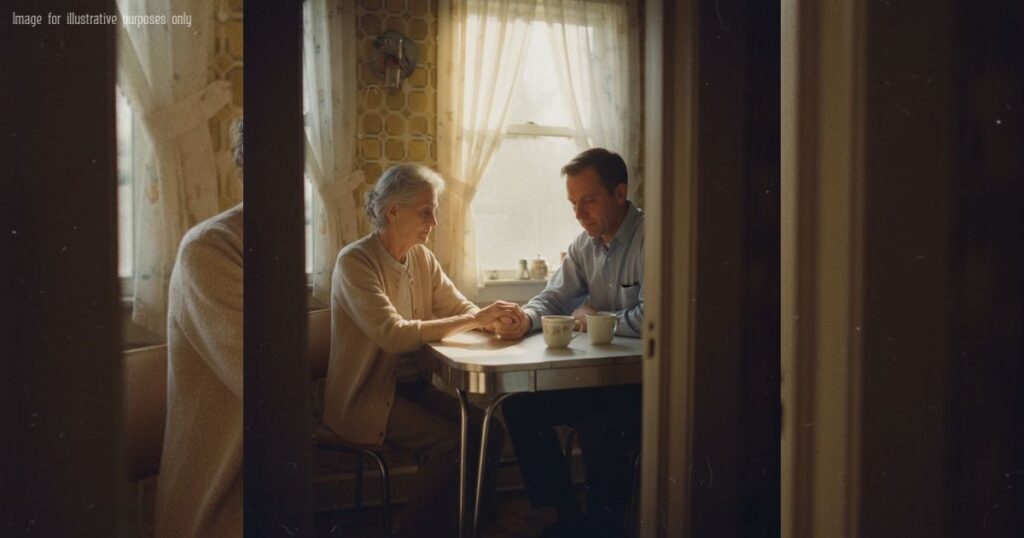
My son, Daniel, came over that afternoon. He stood in my kitchen, arms crossed over his chest, staring at the printed screenshot of the video the hospital had sent me: my head bowed, red light flashing above Mr. Henderson’s door like an accusation from the ceiling.
“Mom, have you read the comments?” he asked.
Click the button below to read the next part of the story.⏬⏬