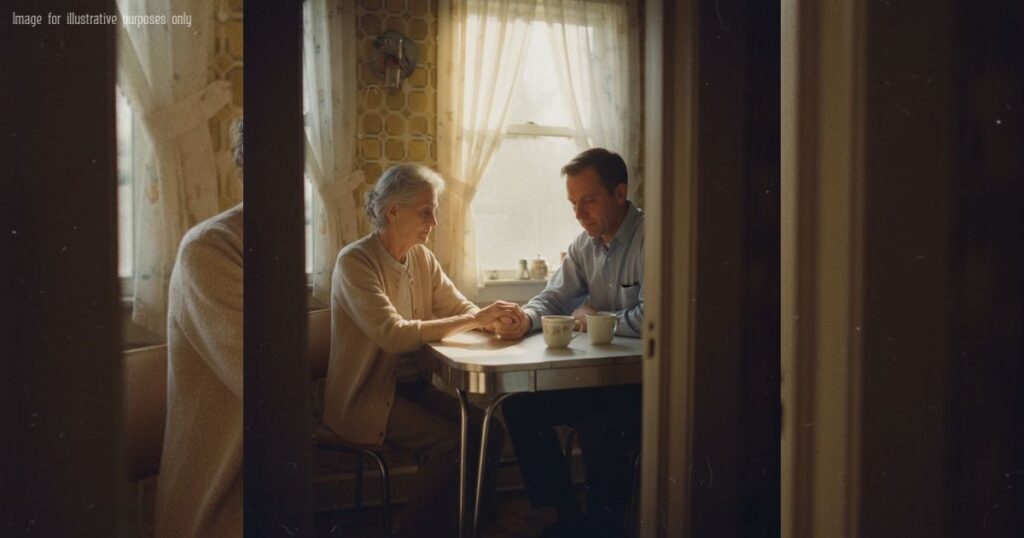

My son, Daniel, came over that afternoon. He stood in my kitchen, arms crossed over his chest, staring at the printed screenshot of the video the hospital had sent me: my head bowed, red light flashing above Mr. Henderson’s door like an accusation from the ceiling.
“Mom, have you read the comments?” he asked.
“I’ve read enough,” I said, turning off the little TV on my counter. Even the morning talk shows were discussing it now. “Lazy nurse. Broken healthcare. Another example of why nothing works.”
“They’re talking about suing,” he said. “There’s a thread saying the state board should yank your license forever. People are tagging politicians.”
I rinsed my coffee cup slowly. “People tag whoever they want when it’s not their face on the screen.”
“I’m serious.” His voice cracked. “You need a lawyer. You need to go online, explain it was a mistake, that you were exhausted. Tell them it’s burnout. People forgive burnout.”
“It wasn’t a mistake,” I said.
He blinked. “Mom—”
“I didn’t fall asleep on him, Danny. I made a choice. There’s a difference.”
He looked at me like I had just confessed to something unforgivable. “So you’re just… okay with the whole country thinking you let some veteran die because you were too tired to stand up?”
“No,” I said quietly. “I’m not okay with that. But I’m not going to replace the real story with a prettier lie just so strangers feel better.”
He rubbed his forehead. “You could at least say you wished you’d done more.”
“I did enough,” I said. “And that sentence is exactly why people are so angry. They don’t want to hear about enough. They want ‘everything.’ Even when ‘everything’ means breaking a promise to the person in the bed.”
He shook his head and changed the subject, which is what people do when love and fear are colliding in their chest.
Two days later, the official letter came.
STATE BOARD OF NURSING HEARING NOTICE.
The envelope was heavy, cream-colored. Someone had taken the time to choose a serious paper for it, as if weight alone could make it more respectable. They attached a printed transcript of the video comments, as if capital letters and hashtags were evidence.
“Alleged Failure to Respond Appropriately to Cardiac Event,” it said.
I traced the words with my finger and thought: That man didn’t have a cardiac event. He had a death. A scheduled one. Signed off on. Documented. Just not televised.
My hearing was scheduled for three weeks out.
In those three weeks, the video climbed from hundreds of thousands to millions of views. It spawned opinion pieces, a trending argument about “lazy healthcare workers,” and a chorus of people demanding “accountability.”
A former patient’s daughter called into a radio show to say she recognized me and that I’d once taken too long to bring water. A retired doctor wrote a column about “declining standards.”
Nobody mentioned the DNR form in Mr. Henderson’s chart.
No one talked about how many times I’d walked into Room 412 with an extra blanket, or how I’d once stayed an extra hour after my shift to find the song he used to dance to with his wife so he could listen to it before bed.
Kindness doesn’t trend.
But outrage? Outrage is free advertising.
A week before the hearing, a young reporter from a local online outlet knocked on my door. She couldn’t have been more than twenty-four, with a notepad in one hand and her phone in the other.
“Ms. Carter?” she asked. “I’m doing a piece on your case. Would you like to share your side of the story?”
She looked nervous, like someone who had been told to go get a quote from the villain and was quietly hoping the villain wouldn’t bite.
“Will you run the whole thing?” I asked. “All of it, not just a sentence that makes me sound like a slogan?”
She hesitated. “My editor will… choose what fits the format.”
“Then no,” I said. “I told the truth at the hospital. I’ll tell it to the board. I’m not feeding it into a machine that gets paid by the click.”
“People might be more sympathetic if they knew you weren’t really sleeping,” she said.
“Or,” I replied, “they might just get angry that I turned the alarm off.”
She looked genuinely confused. “You… turned it off?”
“I silenced it,” I said. “So he could die the way he asked to.”
Her pen hovered in the air, unsure whether to write the sentence down. “So you admit you broke protocol?”
“Protocols are written for people we’re trying to pull back from the edge,” I said. “He had already stepped over. The paperwork said so. He said so. The only thing the alarm was saving at that point was liability.”
She left with nothing but a polite quote about “trusting the process.” Her article, when it came out, used a photo of me from ten years ago and a headline with a question mark that did nothing to soften the accusation.
Did This Nurse Let a Patient Die?
The comments section answered for her: YES.
The day of the hearing, the conference room where they held it was colder than any ICU I’ve ever worked in.
There were three board members behind a long table—two in suits, one in a cardigan. There was someone from Legal, someone from Risk Management, and a representative from the hospital system I used to serve.
My son sat behind me, hands clasped so tight his knuckles had gone white. I could feel worry rolling off him like heat.
They showed the video first.
The lights dimmed. The little clip played on a big screen, over and over, slowed down, zoomed in. The red alarm light blinking above the doorway; my head bowed; my body very still. No sound.
“This is the footage that was shared widely on social media,” the Legal representative said. “Ms. Carter, can you tell us what you were doing at this moment?”
“I was holding his hand,” I said. “Under the sheet, out of the camera’s view.”
“You were not performing chest compressions?” the hospital rep asked.
“He had a Do Not Resuscitate order on file,” I answered. “Signed by him, witnessed, and confirmed by his attending physician.”
The board member in the cardigan—an older woman with tired eyes that told me she’d done her own time in scrubs—flipped through the file in front of her.
“The DNR is here,” she said quietly. “It was valid.”
Click the button below to read the next part of the story.⏬⏬