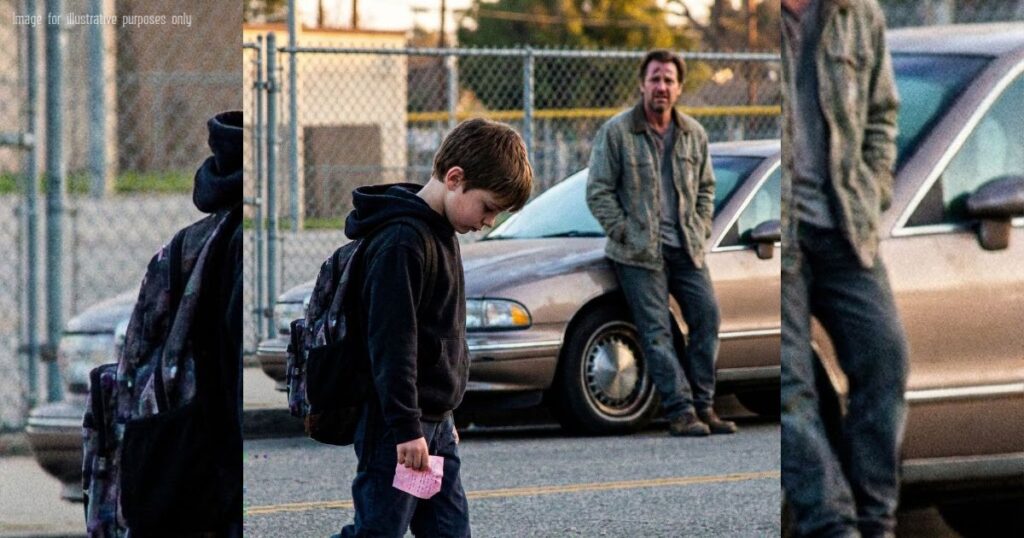
The pink slip in my six-year-old’s hand wasn’t just a piece of paper. To him, it looked like a prison sentence. To me, as I watched him walk out of the school gates with his head hanging low, it looked like the first crack in his spirit.
My name is Mark, and I’m just an ordinary dad trying to raise a good kid in a complicated world. My son, Leo, had only been in first grade for two months. He’s six—still small enough to want a hug when he scrapes his knee, but big enough to think he knows how the world works.
When I picked him up that Tuesday, I knew something was wrong. He didn’t run to the car. He didn’t ask about snacks. He just climbed into the booster seat, clutching that pink slip, his knuckles white.
“Everything okay, buddy?” I asked, checking the rearview mirror. He nodded, but he wouldn’t look at me.
I decided to wait until we were in the safety of our kitchen. As soon as we walked through the door, he spun around, his big brown eyes swimming with tears.
“Dad… I got written up.”
I froze. My internal monologue immediately went to: Here we go. Is he bullying? throwing erasers? running in the halls?
I knelt down to his level. “It’s okay, Leo. Just tell me what happened.”
He burst into tears. Real, heavy sobs. “I didn’t mean to be bad! I just… I told the truth!”
“What do you mean, you told the truth?”
“Mrs. Gable… she told the class that you can’t take big numbers away from small numbers. She said below zero, there is nothing.”
I frowned. “Okay…”
“Dad, didn’t you teach me that numbers are like the floors in a building?”
“I did.”
“If I am on floor 2, and I go up 3 floors, I’m on floor 5. Right?”
“Exactly.”
“And if I am on the ground floor—Zero—and I go down into the parking garage… isn’t that below zero?”
“Yes, it is,” I said, a smile tugging at the corner of my mouth. “We call those negative numbers.”
Leo threw his hands up, a mix of vindication and heartbreak. “See! I knew it! But she gave me the pink slip because I wouldn’t stop saying she was wrong!”
He wiped his nose on his sleeve. “She said, ‘Leo, stop confusing the other students. There is nothing below zero.’ But Dad… what about when it freezes in winter? The weatherman says ‘minus five degrees’! What about the basement? I tried to explain, but she just got mad.”
I felt a flash of anger—not at my son, but for him. He felt betrayed. He trusted his teacher to be the source of truth, and when reality contradicted her “lesson plan,” she penalized him for noticing.
“I’m sad, Dad,” he whispered. “And I’m mad. Because she lied.”
I hugged him tight. “She didn’t mean to lie, Leo. Sometimes, teachers want to keep things simple for the other kids who might not understand the basement yet. But you were right. You used your brain.”
That wasn’t enough for me, though.
I’m not the type of “Helicopter Parent” who storms the school every time my kid gets a scraped knee. But this wasn’t about behavior. This was about critical thinking. A six-year-old was punished for using logic.
I requested a meeting the next morning.
When I walked into the classroom, Mrs. Gable looked at me over her glasses with that tired, defensive look of someone who expects a fight. She started talking before I even sat down.
“Mr. Davison, we have a curriculum to follow. Leo was disrupting the flow of the lesson. First graders are learning 0 to 20. We do not do negative numbers. It’s not in the state standards for this age group.”
I stayed calm. “I understand standards. But my son wasn’t being disrespectful. He was engaging with the material. He made a connection to the real world—elevators, temperature. Isn’t that what we want? Critical thinking?”
She sighed, tapping her pen on the desk. “He needs to learn that in this classroom, he follows the instructions. He can’t just make up rules because he thinks he knows better. It undermines my authority.”
I looked at her, really looked at her. I realized it wasn’t about math. It was about control.
“With all due respect,” I said, my voice steady. “He didn’t make up rules. He discovered a mathematical truth that you were trying to hide because it wasn’t in the textbook. You gave a six-year-old a disciplinary record because he was smart enough to see past the first page.”
She didn’t budge. To her, I was just another annoying parent. To me, she was a wall. A wall that was teaching my son to stop asking “Why?” and start just nodding his head.
We left. I didn’t yell. I didn’t make a scene. But I knew I couldn’t leave his spirit in that room.
Thankfully, a few months later, Mrs. Gable transferred to a different district. I’d like to say it was karma, but it was probably just administrative shuffling. We got a new teacher, young and energetic, who laughed when Leo asked about black holes and negative integers.
But I still think about that pink slip.
It sits in a drawer in my office. I keep it as a reminder.
We live in a society that loves boxes. We love standardized tests, standardized lives, and standardized thoughts. We tell our kids to “dream big,” but the moment they color outside the lines or ask a question that isn’t on the test, we shut them down.
That day, I realized how fragile a child’s mind is. It is a spark. And it takes very little—just a tired adult, a rigid rule, or a pink piece of paper—to snuff that spark out forever.
If your child asks a question that challenges the rules, don’t silence them. Listen to them.
Because the world is full of people who will tell them “there is nothing below zero.” We need to be the ones to remind them that there are basements, there are deep oceans, and there are whole worlds waiting to be discovered if they are brave enough to keep looking.
Don’t let the world flatten your child’s imagination.
—
Part 2 — Below Zero, Above the Rules
The week after the pink slip, Leo stopped raising his hand.
Not just in math—everywhere. At dinner, he stopped telling stories. At bedtime, he stopped asking questions. Like that little piece of paper didn’t just crack his spirit… it taught him a new rule: curiosity costs you.
I didn’t notice right away, because life doesn’t pause for a six-year-old’s heartbreak.
Laundry still piled up. Bills still came. The mornings still moved like a stampede—shoes, backpacks, missing socks, “hurry up,” “we’re going to be late.”
Click the button below to read the next part of the story.⏬⏬