Then came the night of Curriculum Night.
The school gym was filled with folding chairs and tired parents and the hum of quiet frustration. A projector glowed at the front with bullet points that sounded polished and empty.
“Alignment.” “Benchmarks.” “Targets.” “Rigor.”
A man in a polo shirt—some kind of instructional coordinator—spoke in the calm tone of someone who never had to convince a six-year-old that they were still good.
He clicked through slides and said things like, “We’re building strong foundations,” and “We need fidelity to the curriculum.”
Fidelity.
Like learning was a marriage contract.
I sat there with my hands clenched, thinking about a worksheet filled with zeros.
When they opened the floor for questions, a mom two rows ahead stood up.
“My son struggles,” she said, voice tight. “He needs structure. He needs rules. When kids derail the class, it hurts everyone.”
A few heads nodded. A few parents murmured agreement.
Then a dad in the back spoke up. “My daughter gets bored and acts out because she’s ahead. She gets punished for it. That hurts everyone too.”
Now the room shifted. You could feel the invisible lines forming.
Structure parents.
Curiosity parents.
Both exhausted. Both scared in different ways.
My heart pounded, but I stood anyway.
“My name is Mark,” I said. “My son is in first grade.”
The coordinator smiled politely, like he was already preparing the response.
I kept my voice even. “I’m not here to blame anyone. Teachers are overwhelmed. Parents are overwhelmed. Kids are… kids.”
A few people softened at that.
“But I want to ask a simple question,” I continued. “When a child notices something true—something real—and it doesn’t fit the day’s lesson… what do we teach them to do with that truth?”
Silence.
I could hear the gym’s old ventilation system rattling like it was nervous too.
The coordinator cleared his throat. “We teach appropriate time and place,” he said.
“And if the truth never gets a time and place?” I asked, still calm. “If the message becomes: ‘Don’t bring it up. Don’t ask. Don’t challenge.’ What kind of adults are we training?”
A woman near the front muttered, not quietly, “Here we go.”
Heat climbed up my neck, but I didn’t bite.
I nodded toward her. “I get it,” I said. “Nobody wants chaos in a classroom. I don’t either. I want kids to feel safe.”
Then I paused. “But my son came home and filled an entire worksheet with zeros because he thought zero was the only place he couldn’t get in trouble.”
That made a few people sit up straighter.
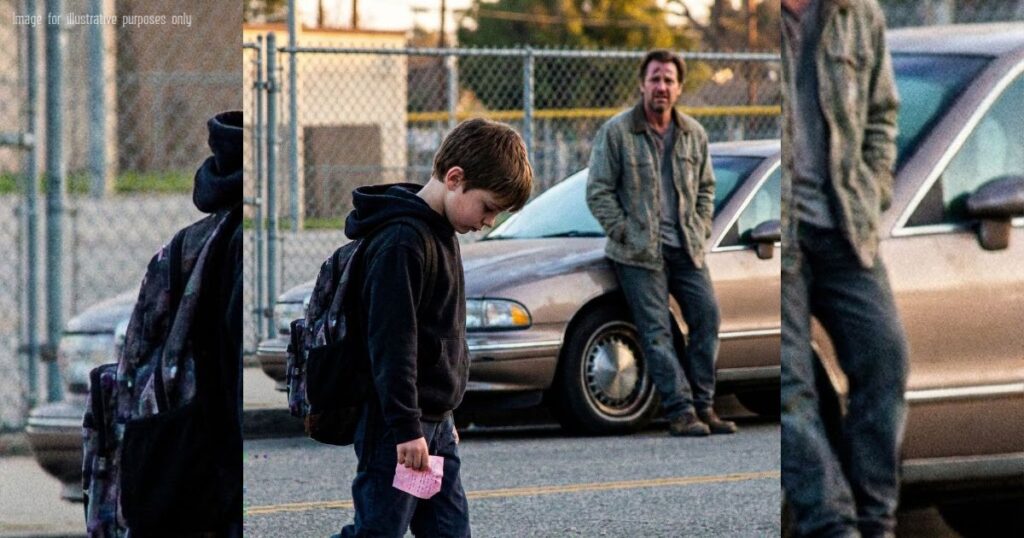
I didn’t name a teacher. I didn’t point fingers. I didn’t wave the pink slip around like a weapon.
I just let the truth sit in the air.
“And that,” I said quietly, “doesn’t feel like safety. That feels like fear.”
For a moment, nobody spoke.
Then Ms. Hart—standing off to the side with other teachers—met my eyes and gave the smallest nod.
Not agreement with everything I said.
Just acknowledgment.
Like: I see it too.
The coordinator offered a careful, practiced answer about balancing needs and supporting all learners. Some parents clapped politely. Some didn’t.
But as the meeting broke up, something unexpected happened.
A mom approached me, holding her purse like a shield. “My kid is like yours,” she whispered. “He asks questions that make adults uncomfortable. He got labeled ‘defiant’ in kindergarten.”
A dad came up next. “My daughter stopped talking in class after she got embarrassed for answering wrong,” he admitted.
And then—this one surprised me most—a teacher in the hallway, not Ms. Hart, leaned in and said under her breath, “Thank you for saying it without making us the villains.”
I drove home that night with Leo’s backpack in the backseat, the pink slip still in my desk drawer, and a heavy thought settling in my chest:
This isn’t a “bad teacher” problem.
It’s a fear problem.
Fear of falling behind. Fear of looking incompetent. Fear of losing control. Fear of kids who don’t fit neatly into the boxes we built.
And the most controversial part—the part people hate admitting out loud—is this:
A lot of adults would rather have a quiet wrong answer than a loud honest question.
Because quiet looks like success.
But it isn’t.
At bedtime, Leo curled under his blanket while I sat on the edge of his bed.
“Dad?” he asked softly.
“Yeah, buddy.”
“Am I a trouble kid?”
My throat tightened. I forced my voice steady.
“No,” I said. “You’re a thinking kid. And sometimes the world mistakes thinking for trouble.”
He blinked slowly. “What if I get another pink slip?”
I reached into my pocket and pulled out a small sticky note I’d written earlier. I handed it to him.
It said:
Questions are brave.
He stared at it like it was a secret code.
I smoothed his hair back. “If you ever get in trouble for asking a real question,” I said, “we’ll handle it together. You don’t have to protect yourself by shrinking.”
His eyes glistened. He nodded once.
And as I turned off the light, I realized something that made my stomach twist with both pride and dread:
I could fight for my son.
But one day, he’d be out there alone—at a job, in a relationship, in a world full of people who still believed there was nothing below zero.
People who’d call him “difficult” just because he refused to pretend the basement didn’t exist.
So I kissed his forehead and whispered the promise I wished every kid could hear:
“Don’t trade your mind for approval.”
Because if we teach children that truth is disrespect, we don’t raise obedient angels.
We raise adults who confuse silence for goodness… and control for love.
And that kind of world looks orderly from the outside.
But inside?
It’s just a building with a locked basement—full of everything real we were too afraid to face.
Thank you so much for reading this story!
I’d really love to hear your comments and thoughts about this story — your feedback is truly valuable and helps us a lot.
Please leave a comment and share this Facebook post to support the author. Every reaction and review makes a big difference!
This story is a work of fiction created for entertainment and inspirational purposes. While it may draw on real-world themes, all characters, names, and events are imagined. Any resemblance to actual people or situations is purely coincidenta