PART 2 — The Door Leo Kicked In (And the Things That Crawled Out After)
If you’re reading this, it means I made it back into my house.
That sentence should feel ordinary. It isn’t.
The day after rehab discharged me, the van rolled into my driveway like a slow apology. Ohio was still wearing winter like a threat—gray sky, dirty snow, that wind that doesn’t just touch your skin, it argues with it.
My front door was no longer a door.
It was a sheet of plywood screwed into my frame, the kind you see after a storm or a bad night. Leo had painted it a careful beige that almost matched the old color, but you could still see the violence of it: the splintered wood, the warped molding, the place where my home had been forced open because my body had failed.
Sarge sat beside the plywood, rigid and proud, like a soldier guarding a temporary border.
When he saw me in the wheelchair, his whole back end wiggled like a flag. He tried to trot and remembered his hips. He turned the attempt into dignity and came anyway, inching toward me with that stubborn old-man energy I’d fallen in love with.
I buried my face in his fur.
He smelled like Leo’s apartment—cheap detergent, warm air, the faint ghost of fast food—and underneath that, he smelled like life refusing to quit.
Leo stood on my porch with his hands shoved into his pockets. Blue hair. Dark circles under his eyes. The young look of someone who has never had a safety net and has learned to joke about it.
“I’m sorry about the door,” he said, like he’d broken a vase and not kicked his way into a stranger’s house to save her from dying on hardwood.
“Don’t you dare apologize for that,” I told him. My voice cracked halfway through, not from weakness—more like something inside me was thawing and it hurt.
He nodded, but his jaw clenched anyway, because some people only know one way to carry gratitude: as guilt.
Inside, the house looked the same.
But it didn’t feel the same.
Because once your home has been breached—by cold, by pain, by the knowledge that you can disappear in it—you stop pretending walls are magic.
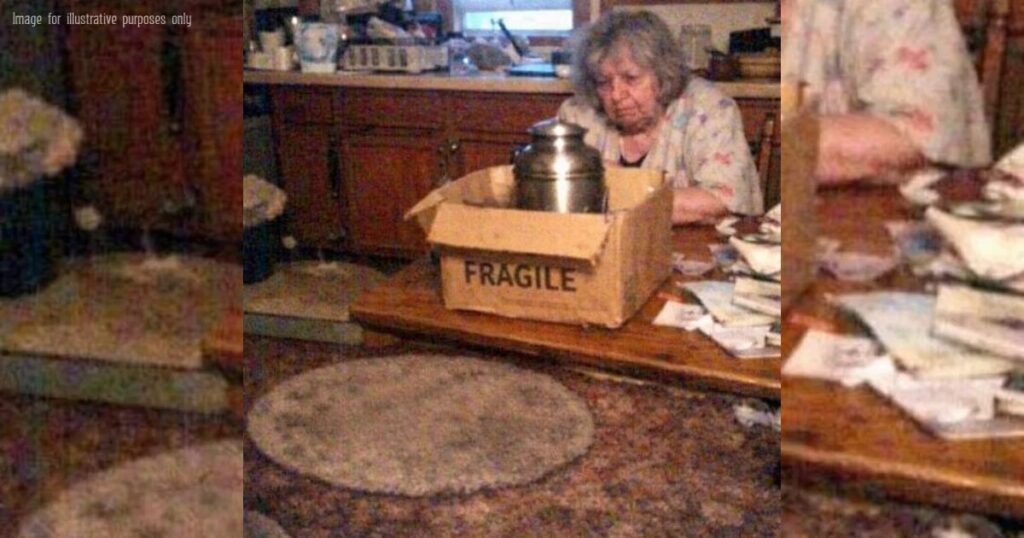
The first thing I noticed was the paper taped to my kitchen cabinet, right above the counter where the urn receipt used to sit.
It was handwritten, block letters, like a kid trying to look official.
“MEDS: 8 AM + 8 PM. WATER ALWAYS. NO STAIRS. LOVES YOU.”
Below that, Leo had drawn a crude heart and, inexplicably, a little stick figure dog with an eyepatch. I don’t know why the dog had an eyepatch. I didn’t ask.
My throat tightened so hard I tasted metal.
“I made a schedule,” Leo said too quickly, like he was defending himself in court. “So you don’t have to remember everything. I mean—obviously you remember. But—”
“You’re allowed to be kind without explaining it,” I said.
He blinked like I’d slapped him.
Then he gave me a small smile that looked like it hadn’t been used in a while.
That night, after Leo left and the house settled into its familiar creaks, I rolled myself into the living room and turned on one lamp.
The light made a small, stubborn island.
Sarge lay at my feet, his heavy head pressed against the wheel of my chair like he was anchoring me to the earth. His chest rose and fell with that soft, uneven rhythm I’d learned to listen to—his heart murmur whispering its little secret.
I should have felt safe.
Instead, I felt exposed.
Because the first thing the world does when you almost die is paperwork.
The next morning, the phone started.
Not my daughter. Not a friend.
Companies.
Departments.
People with polite voices and sharp systems.
A woman from the insurance office asked me to “describe the incident.”
An adjuster scheduled a visit to “assess property damage.”
Someone from the hospital billing office used the words “your responsibility” like they were reading scripture.
And then—because America has a sense of humor that borders on cruelty—a letter arrived from the Neighborhood Association.
It was printed on thick paper with a tasteful logo and a signature that looked practiced.
NOTICE OF NONCOMPLIANCE.
My plywood door, apparently, did not meet the aesthetic standards of our little suburb.
There were rules about “curb appeal,” about “maintaining community value,” about “timely repairs.” There was even a deadline, like my hip had ruptured on a schedule they could approve.
I sat at my kitchen table and laughed.
Not because it was funny.
Because if I didn’t laugh, I would have started screaming and maybe never stopped.
When you’re young, you think emergencies come with sirens.
When you’re old, emergencies come with forms.
Sarge watched me with his cloudy eyes.
He didn’t understand bylaws.
But he understood my breathing.
He stood up, wobbling, and placed his forehead against my knee the way he did at the shelter—the same quiet pressure that said, I’m here. Don’t leave yet.
So I did what old women have done for centuries.
I made tea.
I took my pills.
I stared at the letter like it was a challenge.
And then I did something I hadn’t done in years.
I knocked on a neighbor’s door.
Her name is Diane. She lives two houses down. I’ve waved at her for a decade. We’ve never spoken.
She opened the door a crack, chain still on, like I was selling religion.
Her eyes dropped to my wheelchair.
“Oh,” she said, softening. “Eleanor. I heard… something happened.”
I held up the letter from the Association.
She squinted at it, then snorted.
“They’ll send that to a dying houseplant,” she said. “Come in.”
Inside, her house smelled like cinnamon and laundry. The air was warm. The kind of warm you don’t notice until you’ve been cold for too long.
She made a face when I told her about the fall.
“Do you have family?” she asked.
“My daughter lives… far,” I said, choosing my words the way people choose what to carry in a fire.
Diane stared at her own living room wall for a moment, then said, “My son lives five miles away and I haven’t seen him since summer.”
There it was.
That shared, humiliating truth.
Distance isn’t always measured in miles.
Sometimes it’s measured in notifications you don’t receive.
I told her about Sarge.
Her eyes flicked to him, standing behind my chair like a weary bouncer.
“He looks like he’s been through it,” she said.
“So do I,” I replied.
She laughed, and it broke something open in the room.
That’s how it starts, you know.
Not with speeches.
With two people admitting they’re lonely.
By lunchtime, I’d knocked on two more doors.
Not because I suddenly became brave.
Because I became tired of disappearing.
Some people were kind. Some were awkward. Some pretended not to be home—curtains shifting like guilty eyelids.
And one man, across the street, looked at Sarge and said, “That dog looks like trouble.”
I felt my spine straighten.
“He looks like survival,” I said.
The man shrugged. “Just saying. Big dog. Older woman. Liability.”
There’s a word people use when they want to sound reasonable while being cruel.
Liability.
It means: If something goes wrong, I want someone to blame.
It means: I see your life as a risk on my sidewalk.
I wheeled away from him shaking, not with fear—more like rage trying to find a place to land.
When I got home, my phone buzzed.
It was a text from Leo.
you watching the internet?
I stared at it, confused.
Then another message came through.
A link.
I clicked it.
And there I was.
Or rather—there was my living room floor, filmed from someone’s phone. Shaky footage. Flashlight glare. My old sweater half-dragged across the hardwood. Sarge’s body in frame, braced like a draft horse, pulling with a sound that was half grunt, half prayer.
The video wasn’t mine.
It wasn’t from the paramedics.
It was Leo’s.
He must’ve recorded part of it—maybe to show the dispatcher, maybe because he panicked and wanted proof that he wasn’t making it up.
And now it had been posted.
Not by him, he said later—by someone he’d sent it to privately. Someone who’d sent it to someone else. Someone who’d added a caption.
Click the button below to read the next part of the story.⏬⏬