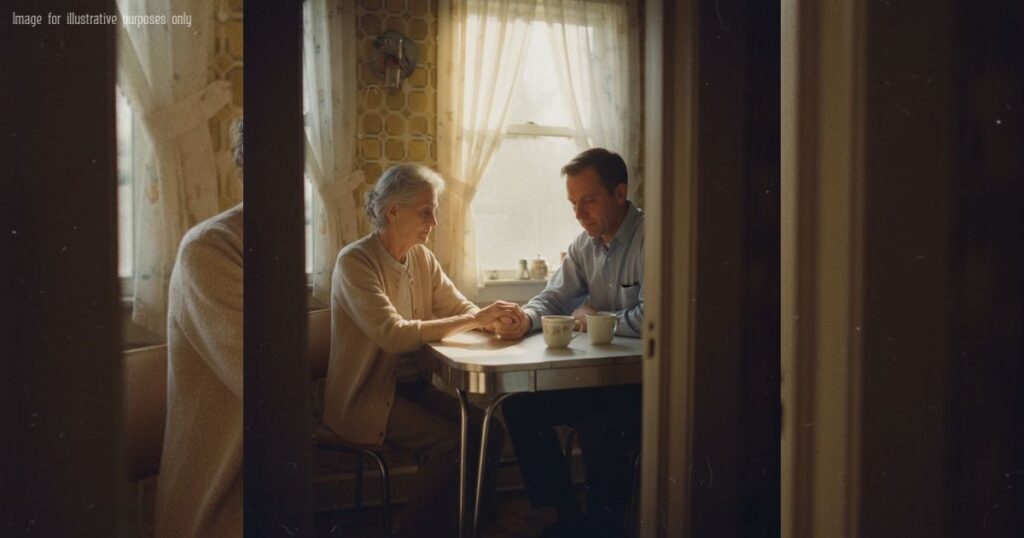
I broke into my own grandfather’s house because he wouldn’t answer the phone, only to find him staring at a dead television screen, listening to ghosts through a pair of ancient headphones.
I had been driving for six hours straight, fueling my exhaustion with lukewarm gas station coffee and the relentless anxiety of a looming corporate deadline. My name is Alex, and like half of America, I am tired. Not just “need a nap” tired. I mean soul-deep, bone-weary exhausted. I work for a massive logistics firm in the city, the kind of place where “Urgent” is the subject line of every email and your value is determined by how quickly you reply at 11:00 PM on a Sunday.
I hadn’t planned to stop at Pop’s house. But the highway was a parking lot, and the radio was making me sick. Every station was the same: angry pundits screaming over each other about the latest bill in Congress, the economy, or the impending collapse of society. It didn’t matter which channel I flipped to; the volume of the hate was the same. Red tie, blue tie—it was just noise. A cacophony of people desperate to be right, desperate to be heard, but refusing to listen.
So, I took the exit toward the old industrial town where I grew up, a place the economy forgot about two decades ago. I needed a break from the noise.
When I got to the house, the porch light was off. The lawn was overgrown, dandelions reclaiming the territory where Pop used to meticulously manicure his hydrangeas. I knocked. Nothing. I called his landline. I heard it ringing inside, echoing through the empty hallway. Panic set in. He was eighty-five. He lived alone.
I used the spare key hidden under the loose brick near the gutter and let myself in.
“Pop?” I called out, my voice trembling.
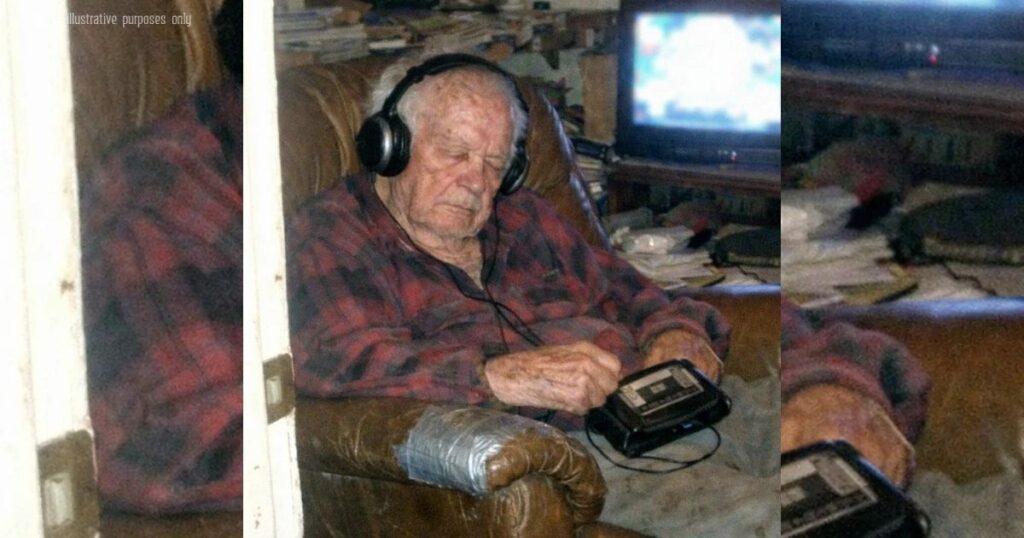
I found him in the living room. He was sitting in his worn-out leather recliner, the one with the duct tape on the armrest. The television was on, tuned to one of those 24-hour news networks, showing footage of a protest somewhere, tickers scrolling red across the bottom. But the volume was muted.
Pop wasn’t watching the chaos. His eyes were closed. He was wearing a pair of bulky, wired headphones connected to a cassette player that looked like a relic from the Smithsonian. On the small wooden table next to him sat two cups of black coffee. Both were cold.
I walked over and gently touched his shoulder. “Pop?”
He didn’t jump. He just opened his eyes, blinked at me as if returning from a very long journey, and slowly slid the headphones down to his neck. He looked at me, then at the muted TV screen where a politician was visibly yelling at a reporter, then back to me.
“You’re early,” he said, his voice raspy. “Or I’m late. I lose track.”
“I was worried,” I said, collapsing onto the sofa opposite him. I pulled my smartphone out of my pocket—habit, pure addiction—and checked for signal. “You didn’t answer the phone. Is everything okay?”
“Everything is fine, kid,” he said. He reached out and pressed the ‘Stop’ button on the cassette player. The mechanical click sounded incredibly loud in the quiet room.
“What are you listening to?” I asked, gesturing to the device. “Audiobooks? Old war stories?”
Pop smiled, a sad, distant shifting of wrinkles. “No. I’m listening to breakfast.”
I frowned. “Breakfast?”
“August 14th, 1993,” Pop said, looking at the cassette label. “It was a Saturday. Your Nana and I were having pancakes. I used to record us sometimes. Just… us. Testing out a new recorder I bought for work.”
He picked up the headphones and held them out to me. “Put them on.”
I hesitated, then took them. The foam pads were crumbling slightly. I put them over my ears. Pop pressed ‘Play.’
At first, I heard nothing but a hiss. Then, the sound of a fork scraping against a ceramic plate. A chair scraped against the floor.
“Pass the syrup, will you, Frank?”
It was Nana’s voice. Clear as day. I felt a chill run down my spine. She had been dead for seven years.
“You put too much on, Mary. You’ll rot your teeth,” Pop’s voice, thirty years younger, strong and teasing.
“It’s my teeth, old man. I’ll do what I want. besides, the coffee is bitter today.”
“Coffee is supposed to be bitter. That’s how you know you’re awake.”
Then, silence. But not empty silence. It was the sound of chewing, the rustle of a newspaper, the hum of a refrigerator. Then, a soft laugh from Nana.
“Look at that bird, Frank. The red one. He’s back.”
“Yeah. He’s back.”
That was it. Just two people existing in the same space, comfortable enough not to fill the air with words.
I took the headphones off, my chest feeling tight.
“Nothing happens,” I said quietly.
“Exactly,” Pop whispered. He leaned forward, pointing a crooked finger at the muted television flashing images of angry crowds. “Look at that. Look at your phone. Everyone is screaming. Everyone has an opinion. Everyone wants to win the argument. The whole country… we’re drowning in noise, Alex. We think connection means constant updates, constant talking, constant validation.”
He picked up the cold cup of coffee on the side of the table closest to the empty chair—Nana’s chair.
“For fifty years, I sat across from that woman,” he said softly. “We didn’t agree on everything. She voted for the other guy half the time. She hated my cigars; I hated her soap operas. But we knew how to sit together. We knew how to listen to the silence between us. That’s where the love was. Not in the big speeches. It was in the quiet.”
He looked at the cassette player. “I listen to these tapes because it’s the only place left where people aren’t performing. It’s just… life. Real life. Before we all got so busy proving we were important.”
I looked down at my phone. It buzzed. An email from my boss: WHERE IS THE REPORT? followed by a news alert: Markets tumble as tensions rise.
It felt heavy in my hand. Heavier than a brick.
I looked at Pop, sitting in his fading living room in a forgotten town, ignoring a world on fire to listen to the sound of his dead wife eating pancakes. He looked peaceful. He looked richer than anyone I knew in the city.
“I’m so tired, Pop,” I confessed, the words slipping out before I could stop them. My voice cracked.
Pop nodded. He reached over and poured the cold coffee from Nana’s cup into the plant pot nearby, then stood up with a groan to refill it from the carafe on the sideboard.
“You’re tired because you’re carrying the weight of a million strangers’ opinions,” he said. “You’re starving, kid. And you’re trying to eat the menu instead of the food.”
He sat back down and pushed the second cup toward me.
“Turn it off, Alex.”
“The TV?”
“The phone. The world. All of it.”
My thumb hovered over the power button. The fear of missing out, the fear of consequences, the fear of silence—it was paralyzed me.
“Just for an hour,” Pop said. “Sit with me. Let’s be quiet together.”
I pressed the button. The screen went black. The buzzing stopped.
For the first time in years, the room wasn’t filled with the static of expectation. I took a sip of the coffee. It was bitter. It was cold. But as I sat there, watching the dust motes dance in the shaft of afternoon light, listening to the rhythmic breathing of my grandfather, I felt something I hadn’t felt since I was a child.
I felt here.
We didn’t say a word for the rest of the afternoon. We just drank our coffee. And in that silence, I heard more than I had heard in a decade of shouting.
We are forgetting how to be human. We are trading the warmth of a hand for the glow of a screen, and the comfort of silence for the adrenaline of outrage.
Do yourself a favor. Go home. Find the person you love—your spouse, your parent, your child, or even just your own reflection. Turn off the news. Put down the phone. Don’t say a word. Just sit there.
Because one day, the house will be empty, and you would give anything—your job, your savings, your pride—just to hear the sound of them pouring a cup of coffee one last time.
—
PART 2 — The Hour I Turned My Phone Back On
I turned my phone back on after that hour of silence with Pop, and the screen lit up like a crime scene—missed calls, red badges, “URGENT” emails stacked like knives—proof that the world hadn’t calmed down just because I finally did.
For a second, I just stared at it.
It felt obscene, like bringing a bullhorn into a chapel.
Pop didn’t flinch. He was still in his recliner, hands folded over his stomach, eyes on nothing in particular. The muted TV kept throwing rage-colored light across the room, but he might as well have been sitting in the dark.
“Well?” he asked.
“It’s… a lot,” I said, as if “a lot” could describe the panic that comes from remembering you belong to a machine that never sleeps.
My thumb hovered. Habit pulled me toward the inbox the way gravity pulls a dropped coin.
Pop nodded toward my hand. “How many strangers are screaming at you right now?”
I swallowed. “It’s my boss.”
Click the button below to read the next part of the story.⏬⏬