“I didn’t have to,” Pop said. “He knows your car. He knows your patterns. He knows you disappear when you’re overwhelmed. He just pretends not to notice so he doesn’t feel like a bad father.”
I stared at him, stunned.
Pop took another bite, then said the quiet part out loud:
“He learned that pretending is safer than feeling.”
I exhaled hard, like I’d been holding my breath for ten years.
The front door opened without a knock.
Footsteps.
Heavy.
A shadow fell across the kitchen doorway.
My father stood there, older than I remembered, jaw clenched, eyes darting from me to Pop like he was walking into a courtroom.
“Alex,” he said.
“Dad,” I replied.
The air between us instantly filled with everything we hadn’t said.
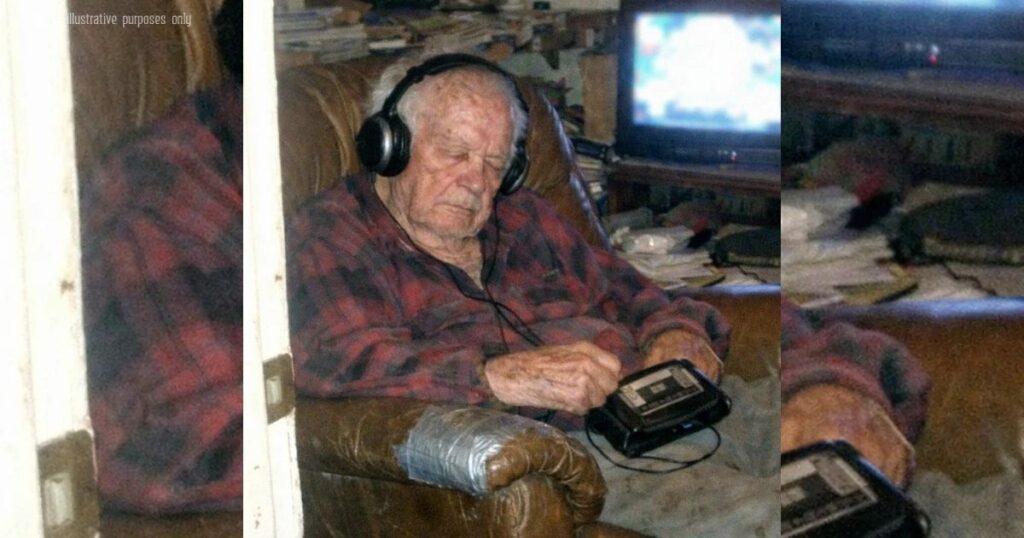
My father’s gaze went to the cassette recorder, the pancakes, the quiet.
He scoffed, too loud. “What is this? Some… little nostalgia ritual?”
Pop didn’t even blink.
“It’s breakfast,” he said. “Try it sometime.”
My father’s face tightened.
“I called you,” he said to me. “You didn’t answer.”
“I was—” I started.
“In here,” he snapped. “Playing house.”
Pop set his fork down gently.
The sound was small, but it commanded the room.
“Watch your mouth in my kitchen,” Pop said.
My father laughed—bitter, sharp. “Oh, now you’ve got rules?”
Pop looked him dead in the eye.
“I always had rules,” he said. “You just never stayed long enough to learn them.”
Silence hit like a wave.
I felt twelve years old again, sitting between them, trying to predict weather patterns I didn’t control.
My father’s voice dropped. “You can’t just turn everything off,” he said, looking at me now. “You can’t just disappear. That’s not how real life works.”
There it was.
The fight my whole generation has with itself:
Is unplugging self-care… or irresponsibility?
Is rest a right… or a privilege?
Is family a duty… or a trap?
I heard my own voice before I fully decided to speak.
“Maybe real life is the part we’ve been turning off,” I said.
My father stared at me like I’d betrayed him.
Pop leaned back in his chair, like he’d been waiting for that sentence.
My father gestured toward my pocket. “So what? You’re gonna ignore your job too? You’re gonna throw away stability because Grandpa wants to listen to tapes?”
Pop’s eyes narrowed.
“Don’t you dare blame me for the life you built,” Pop said quietly. “You chose it.”
My father flinched, as if struck.
I stood up, hands flat on the table. My heart was pounding.
“I didn’t come here to fight,” I said. “I came because I was scared you’d be dead in a chair and no one would notice.”
My father’s face went pale for half a second. Then he covered it with anger.
“You’re dramatic,” he muttered.
Pop’s voice softened, almost tender.
“He’s not dramatic,” Pop said. “He’s awake.”
My father’s eyes flicked to the muted TV in the other room, where a talking head silently raged.
Then to my phone.
Then back to Pop.
And for a moment, I saw the truth: my father wasn’t angry at me.
He was angry at the idea that there was another way to live, because if there was another way, then all the years he’d spent choking down stress and calling it responsibility would suddenly look like what it was—fear.
My phone buzzed again.
A message from my boss.
FINAL WARNING.
My stomach twisted.
My father saw my face and pounced. “See? That’s real. That’s life. You don’t get to sit here and—”
Pop held up one finger.
“Stop,” he said.
Then he did something that felt so absurd, so simple, it almost made me laugh.
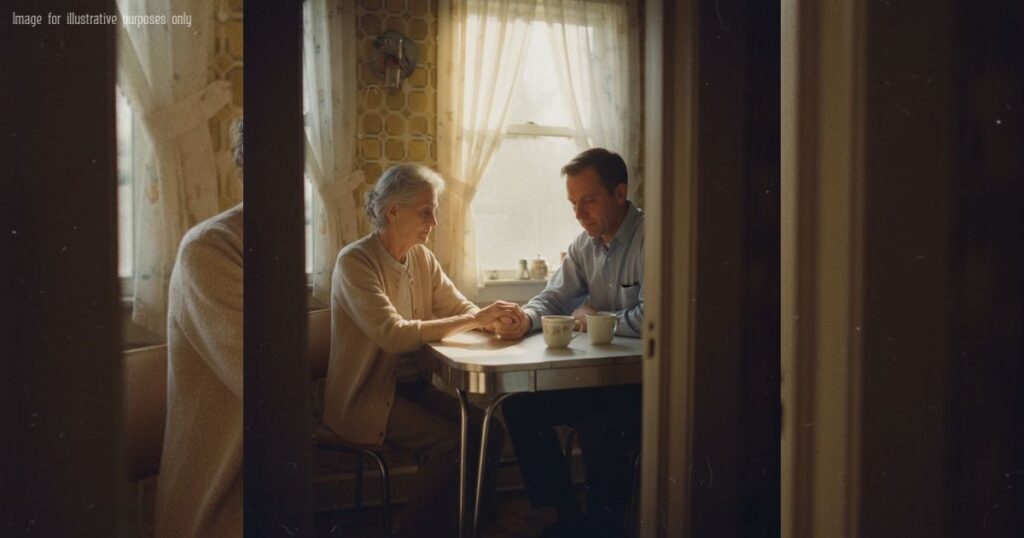
He reached across the table and took my hand.
My father stared, confused.
Pop extended his other hand.
After a beat—because even love has pride—my father took it.
So there we were.
Three generations.
Hands linked over pancakes and coffee.
No speeches.
No winning.
Just… contact.
Pop looked at both of us like a preacher without a pulpit.
“Ten minutes,” he said. “No talking. No phones. Just be here.”
My father scoffed. “This is ridiculous.”
Pop’s grip tightened slightly. “Then prove me wrong by surviving it.”
I felt my throat tighten.
Because ten minutes shouldn’t feel radical.
And yet, in 2026 America, ten minutes of quiet with your family might be the most rebellious thing you can do.
We sat.
At first, my brain screamed.
Send the report. Fix it. Apologize. Perform.
But then my father’s hand—warm, calloused, real—grounded me in a way no notification ever had.
I heard Pop breathing.
I heard the clock ticking.
I heard the tape recorder capturing it all—this fragile, imperfect moment that no algorithm would ever recommend because it wasn’t loud enough.
And then—halfway through the silence—
Pop’s hand trembled.
Not the gentle tremor from age.
Something sharper.
He winced.
His face tightened, and suddenly, the calm in the room cracked.
“Pop?” I whispered, forgetting the rule.
He tried to wave it off.
“I’m fine,” he lied, the way old men lie when they don’t want to be a burden.
But his skin looked gray, and fear surged through me like ice water.
My father’s chair scraped back. “Dad—”
Pop’s breath hitched.
I didn’t think.
I grabbed my phone.
Not to check email.
Not to soothe anxiety.
To call for help.
My hands shook as I dialed.
The screen that had felt like a leash now felt like what it was supposed to be: a tool. A lifeline. A bridge.
As I spoke to the dispatcher, Pop looked at me, pain in his eyes—and something else too.
Relief.
Like he’d been waiting for this moment to prove his point.
He squeezed my fingers with surprising strength.
“I never hated your phone,” he rasped. “I hated what it replaced.”
Tears burned behind my eyes.
My father stood on the other side of the table, trembling, his tough mask gone.
And in that moment—more than any political debate, more than any trending outrage—I understood the real fight we’re in:
Not red versus blue.
Not old versus young.
It’s human versus noise.
It’s whether we’re going to let our lives be swallowed by constant performance… or whether we’re going to remember that love is quiet, and fragile, and doesn’t care if you answered fast enough.
The sirens came.
Strangers rushed in.
The house filled with urgent movement.
But the tape recorder kept rolling, capturing something no news network could ever broadcast:
Three hands held together over a table.
A moment of silence strong enough to break a cycle.
And as they wheeled Pop toward the door, my phone buzzed again—another threat, another demand.
I looked at it.
Then I did something that would start fights in comment sections, split opinions, and make people call me reckless or brave depending on what they worship:
I turned the phone face down.
And I followed my grandfather into the real world.
Thank you so much for reading this story!
I’d really love to hear your comments and thoughts about this story — your feedback is truly valuable and helps us a lot.
Please leave a comment and share this Facebook post to support the author. Every reaction and review makes a big difference!
This story is a work of fiction created for entertainment and inspirational purposes. While it may draw on real-world themes, all characters, names, and events are imagined. Any resemblance to actual people or situations is purely coincidenta