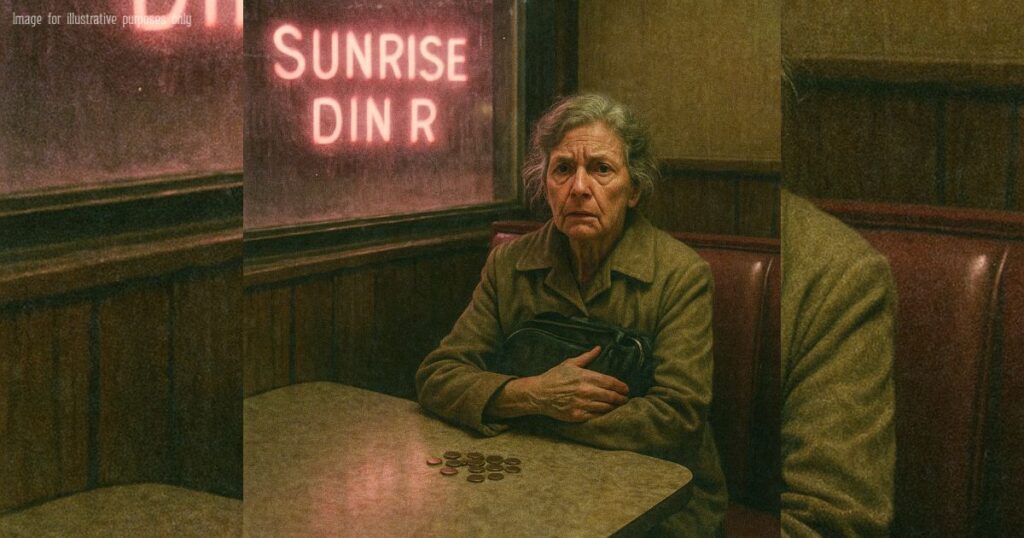
The night at the Sunrise Diner, when my mother finally ate the burger she’d been pretending to eat for forty years, should have been the end of the story. It wasn’t.
After her last bite, she leaned back and smiled with a satisfaction I remembered from childhood. For a moment I saw the woman who used to come home smelling like coffee and grease, kicking off tired shoes in the dark. Then the smile slipped, and confusion moved back in.
“Do I need to get back for my shift?” she asked. “If I’m late, they’ll give my tables away.”
That hurt more than anything.
“There’s no shift tonight, Mom,” I said. “You’re off. For good.”
I helped her into her coat while the young waiter boxed the remaining fries like they were breakable. I tipped him more than the whole meal cost. Kids like him were still living the life my mother had given her body to, one double shift at a time.
At Maple Hills, the automatic doors sighed open and swallowed us into lemon cleaner and TV noise. The nurse at the desk—Janelle—looked up in relief.
“There you are,” she said. “We were about to send someone to check the diner again.”
Again. My stomach tightened.
“She had a real dinner,” I told her. “Burger, fries, the whole thing.”
Janelle smiled, then hesitated. “I’m glad. Just…try not to bring heavy food too often, okay? Her chart—”
I knew what lived inside that unfinished sentence: sodium, cholesterol, choking risk, liability.
“I understand,” I said. “But I’m not letting her last years be nothing but pudding and paperwork.”
In her room, I helped Mom into bed and tucked the blanket around her shoulders.
“Did you get enough to eat?” I asked.
She turned toward the wall clock like she was listening for her old timecard to punch. “Oh, honey,” she said automatically, “I already ate at work.”
She didn’t remember the burger.
Driving home, I wasn’t ready to walk into my stainless-steel kitchen and decorative fruit bowl life. So I sat in my parked car, phone lighting up my face, and did what people my age do when our hearts are too full and our hands are empty.
I opened a social media app.
I typed: “My mother spent my whole childhood saying, ‘I already ate at work.’ Tonight I finally learned what that really meant.”
The rest poured out: the chipped mugs, the imaginary staff-meeting buffets, the way her quiet hunger had wrapped my childhood in normalcy. I didn’t name the diner or the facility. I didn’t blame a company or a politician. I just told the truth about one woman, one kid, and a country that loves to brag about hard work without asking who quietly goes without.
When I went to bed, the post had a few likes.
By morning, it had thousands.
People added their own stories: moms “on a diet” while scraping plates into the trash, dads “not hungry” as kids fought over the last slice, grandparents “not dessert people” who never seemed to sit down when everyone else did.
And then came the other side.
“If your mom chose to have you, that was her responsibility, not yours.”
“Parents shouldn’t guilt-trip kids with stories like this. You don’t owe anyone anything.”
“So now being successful is toxic? You worked hard. Stop romanticizing struggle and enjoy your steak.”
Reading them, I felt defensive and oddly grateful at the same time. They were wrong about my mother, but they were right about one thing: no one should be forced into sacrifice by guilt. The problem is we almost never talk about sacrifice at all until it’s too late.
Around lunchtime, my boss leaned into my doorway, phone in his hand.
“You know you’re trending, right?” he asked. “My sister sent me this post. Took me a second to realize I pay the woman who wrote it.”
I cringed. “I didn’t plan on going viral. I just…couldn’t swallow it anymore.”
He shrugged. “Well, welcome to the conversation. Listen, the promotion’s still yours. But if you want to shift your hours, take some afternoons for your mom, say so. I’d rather lose a few meetings than lose you to burnout and regret.”
In the past, I would have smiled and said, “I’m fine.” That’s the unofficial national anthem of every open-plan office.
Instead, I thought of my mother staring at an $11.99 burger like it was a cruise ticket.
“I want two evenings a week,” I said. “Not to ‘visit.’ To have dinner. Real dinner.”
That night, I went back to Sunrise before heading to Maple Hills. The same waiter was there.
“How’s your mom?” he asked.
Click the button below to read the next part of the story.⏬⏬