I walked in to deliver a greasy fast-food bag to a nurse laughing at a viral video on her phone, but I walked out shaking with a kind of rage I haven’t felt in years, leaving my own dinner behind to feed a starving hero I couldn’t afford to save.
It was 7:15 PM on a Tuesday in November. It was already dark, the kind of cold that seeps through your jacket, and my gas light had been staring back at me for the last twenty miles. I work for one of those delivery apps—you know the ones. You press a button on your glass screen, and a guy like me, tired, running on caffeine and anxiety, drops dinner at your doorstep so you don’t have to put on real pants.
It’s the modern American economy. We are all hyper-connected, yet we have never been more distant from one another. We are ghosts passing in the night, exchanging goods for digital credits.
My last drop-off for the night was a nursing facility on the edge of town. Let’s call it “Oak Creek Manor.” The website probably boasts about “luxury care” and “dignity for seniors,” but the flickering fluorescent light in the parking lot and the potholes told a different story.
I walked in with the brown paper bag. The smell of synthetic grease was the only thing cutting through that specific nursing home scent—a mix of industrial pine cleaner, boiled cabbage, and something stale that hangs in the air like a heavy fog.
At the nurses’ station, there was no one. Just a tablet buzzing on the counter and a half-drunk iced coffee sweating onto some paperwork. I waited. Time is money in this gig—literally. The algorithm watches you. If I’m slow, I get fewer offers tomorrow.
I heard laughter coming from the break room down the hall. Loud, raucous laughter. A TikTok sound loop played over and over.
“Hello? Delivery!” I called out.
Nothing. Just the sound of the digital world distracting the people paid to care for the real world.
I decided to walk down the hallway to find someone to sign off on the order. I needed that tip. Rent is up 15% this year, and my car needs new brakes. I couldn’t just leave it.
As I walked past room 304, I stopped cold.
The door was wide open. Inside, the TV was blaring a rerun of a baseball game from the 90s, the volume turned up to a static roar. But that wasn’t what stopped me.
It was the man in the bed.
He looked small. Not just physically small, but diminished, as if the world had slowly engaged in the act of erasing him. He was pale, his skin like crumpled parchment paper stretched over fragile bones. He was staring at a tray of food on the rolling table. It was pushed just out of his reach—maybe six inches too far. A cruel gap.
On the tray, a plastic cup of apple juice sat next to some unidentifiable gray meat that had formed a hard skin on top. It had been there a while. The gravy had congealed into a rubbery mess.
But what boiled my blood was the smell. Beneath the pine cleaner, the sharp, ammonia sting of urine was unmistakable. It hit me like a physical slap.
I looked back toward the nurses’ station. Still empty. The laughter from the break room got louder. “Oh my god, send that to me!” someone shrieked.
I looked back at the man. His eyes met mine. They weren’t angry. They were just… defeated. Hollow.
“Sir?” I stepped in, breaking protocol. breaking the rules. “Can I help you get that?”
He tried to speak, but his voice was like dry autumn leaves scraping together on pavement. “Thirsty,” he whispered. “Just… a little thirsty.”
I dropped the delivery bag on a visitor’s chair. I walked over and touched the plastic cup. Warm. The juice was bathwater warm.
“Hang on,” I said.
I went to the sink in his room, rinsed a clean cup I found on the shelf, and filled it with cold water. I held the straw to his lips. He drank like a man who had been wandering a desert. He drank until he coughed, and I had to gently pat his back, feeling the vertebrae of his spine through his thin pajamas.
“Thank you, son,” he wheezed, his eyes watering. “Thank you.”
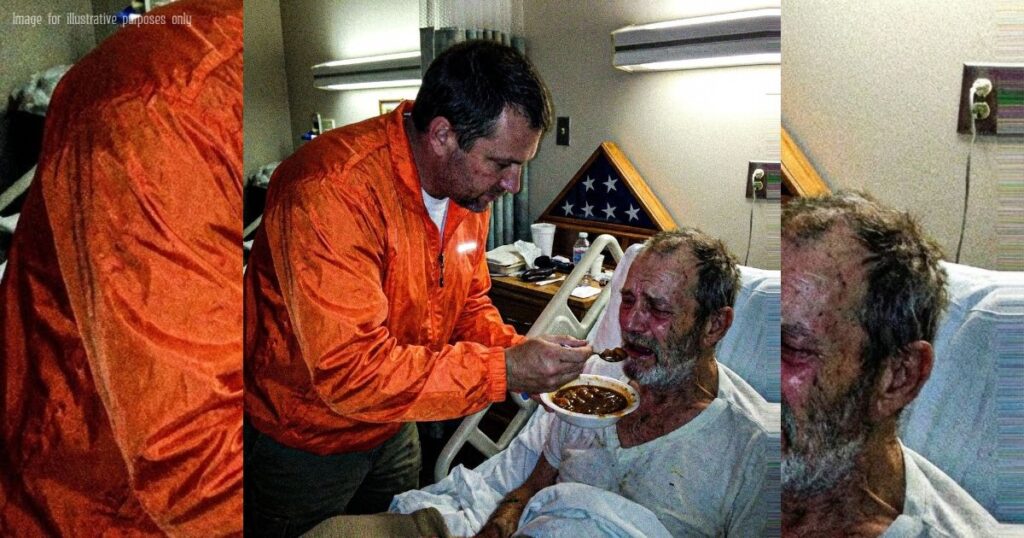
That’s when I saw the bedside table. No iPad. No smartphone. Just a pair of thick glasses and a framed black-and-white photograph. It was a picture of a young man, jaw square as granite, leaning against a tank, holding a helmet. He looked like a movie star from a bygone era.
Beside the photo was a wooden triangular case with a glass front.
A folded American flag.
My grandfather had one of those. You don’t get that flag because you paid a subscription fee or bought the premium package. You get that flag because you served. You get that flag when you’ve watched friends die in mud and snow so that people back home can sleep in peace.
“Is that you?” I asked, pointing to the photo.
He managed a weak, trembling smile. “Korea. 1951. Chosin Reservoir. Seems like a different planet now.”
“It is,” I muttered.
I looked at his food tray again. Cold, gross, and pathetic. It wasn’t fit for a stray dog, let alone a man who once carried the weight of freedom on his shoulders.
Then I remembered the thermal bag in my hand. I had packed my own dinner for the shift—a wide-mouth thermos of homemade beef stew and a soft roll. I had made it yesterday to save money on lunch. It was my fuel for the night.
I didn’t think twice. I opened my thermos. Steam poured out, smelling of rosemary, potatoes, and beef. The old man’s nose twitched. The smell of real food changed the atmosphere of the room instantly.
“I’m not supposed to…” he started, his pride fighting his hunger.
“My shift is over, and I made way too much,” I lied. “You’d be doing me a favor. I hate throwing food out.”
I cranked the bed up. For the next twenty minutes, I didn’t worry about my gas tank. I didn’t worry about the algorithm punishing me for a late delivery. I spoon-fed beef stew to a man who once carried a rifle to defend democracy.
Between bites, he talked. He didn’t complain about the staff. He didn’t complain about the government or the cost of living. He talked about his wife, Eleanor.
“She used to make stew,” he said, his eyes misting over, looking past me at something I couldn’t see. “We didn’t have much money. But on Sundays, we’d sit on the porch. The whole neighborhood was out. You knew everyone’s name. You didn’t need to lock the doors. We looked out for each other.”
He looked at me, his eyes surprisingly clear for a moment, piercing through the fog of age. “We built things to last back then, son. Cars, bridges, marriages. Now… it feels like everything is just disposable. Even people. Especially old people.”
That hit me harder than a punch to the gut. Disposable.
That’s what we’ve become. We live in a world of one-day shipping, 15-second videos, and disposable relationships. We outsource our care, our food, and our compassion. We pay strangers to do the things we used to do for each other, and then we get mad when the strangers don’t do it with love. We are so busy scrolling through the lives of others that we ignore the life dying in the room next to us.
By the time he finished the stew, his color had returned a little. I checked his sheets. Wet. Soaked.
“I’m sorry,” he whispered, looking away in shame, clutching the blanket. “I rang the bell. An hour ago. I didn’t mean to…”
“Don’t you dare apologize,” I said, my voice shaking. “Not to me. Not ever. You are a hero, sir.”
I walked out of the room. The delivery bag for the nurse was still on the chair. I grabbed it.
I marched to the break room. The door was ajar. Two young women were in there. One was vaping near the window; the other was scrolling through her feed, laughing at a dance challenge.
I slammed the greasy bag of burgers onto the table. The noise made them jump. The girl with the phone looked up, annoyed, her face lit by the blue glow of the screen. “Excuse me? You can’t be back here. DoorDash stays at the front.”
“Room 304,” I said. My voice was low, but it filled the room.
“What?”
“The man in Room 304. Mr. Henderson. He’s a veteran. He fought in a freezing hell in 1951 so you could have the freedom to sit here, vape, and watch videos on that phone.”
The girl rolled her eyes. “We’re on break. We’re understaffed. The night shift is late.”
“He was lying in his own urine,” I cut her off, stepping closer. “And he was starving. His food was out of reach. I fed him. I changed his water. I did your job because you were too busy liking a post.”
The room went silent. The vape smoke hung in the air like a guilty cloud.
“I don’t know who you think you are—” she started, standing up, defensiveness flaring in her eyes.
“I’m nobody,” I said. “I’m just the invisible guy bringing you your burgers. But that man in there? He’s somebody. He’s a human being. And if I come back here next week and he looks like that again, I’m not talking to you. I’m calling the State Board of Health, the local news, and every single family member listed in this facility’s directory.”
I turned around and walked out. My heart was pounding out of my chest. I’ve never done anything like that in my life. I’m not a confrontational guy. I keep my head down. I pay my taxes. I try to survive inflation. I try not to rock the boat.
But some things are bigger than a paycheck. Some things are about the soul of who we are.
I got to my car and sat there in the dark. My phone pinged. Delivery Complete. Rate your driver.
I declined the next order. I turned the key, and the engine sputtered to life. But before I put it in drive, I pulled out my phone.
I didn’t open social media. I didn’t check the news. I went to my contacts and scrolled down to “Dad.”
We hadn’t talked in three months. No big fight, really. Just… life. Busy schedules. And the unspoken tension of the last election. Politics getting in the way of conversation. It’s easy to let the gaps widen until they become canyons. It’s easy to be right; it’s hard to be connected.
I pressed call.
“Hello? Mike?” His voice sounded surprised. “Everything okay? It’s late.”
“Yeah, Dad,” I said, choking back a sob I didn’t know was waiting there. “Everything’s okay. I just… I wanted to hear your voice. I wanted to see how you’re doing.”
“I’m doing fine, son. Just watching the game. You working hard?”
“Dad?”
“Yeah?”
“I’m coming over Sunday. I don’t care about the game. I’ll bring stew. Let’s just sit on the porch. I want to hear your stories.”
There was a pause on the other end. A long, heavy pause.
“I’d like that, Mike. I’d like that a lot.”
I hung up and drove home, tears blurring the streetlights.
Look, I know we can’t fix the whole healthcare system overnight. We can’t fix the economy, or the division in this country, or the fact that the world feels like it’s spinning off its axis. We can’t fix the fact that “profit” often comes before “people.”
But we can fix the room in front of us.
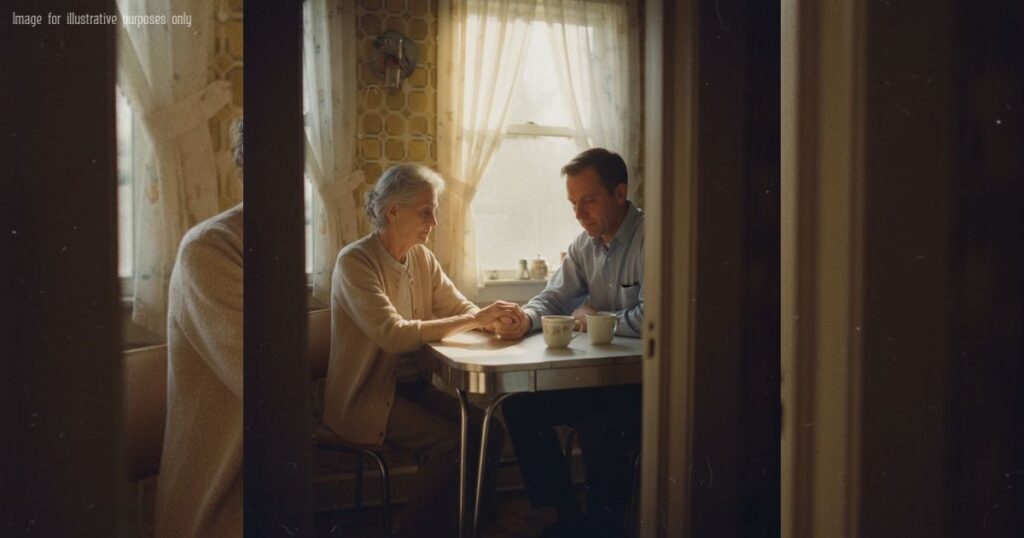
If you have someone in a home, go see them. Don’t call. Go. Look at their tray. Look at their sheets. Look them in the eye and hold their hand. Make sure they know they aren’t disposable.
And if you still have your parents, call them. Forgive the small stuff. Forget the politics for an hour. Because one day, the “good old days” will just be memories in a frame on a dusty table, and you’ll give anything—absolutely anything—to have one more Sunday on the porch.
Don’t wait until it’s too late to be a human being. We have to take care of each other, because right now, nobody else will.
—
PART 2 — THE COMPLAINT
By the time I got home, my stew smell still clung to my hoodie like smoke.
I hadn’t even kicked off my shoes when my phone buzzed again.
“Your account is under review.”
No explanation. No human name. Just a cheery little banner on my glass screen that basically said: Congrats. You tried to be a person today. The algorithm didn’t like it.
I stared at it until my eyes burned.