I poured stew into bowls.
My dad ate like he’d been starving too, just not for food.
For a while, we didn’t talk about anything important.
We talked about weather.
About gas prices.
About how his knee was acting up.
Then he set his spoon down and looked at me like he’d been waiting for the right moment.
“I saw your post,” he said.
My stomach dropped.
“You did?”
“It popped up everywhere.” He nodded toward my phone on the porch table. “People have been calling me. Your aunt. Your cousin. Even Frank from the hardware store.”
I braced for the lecture.
Instead, my dad exhaled slowly and said, “I’m proud of you.”
That hit me harder than the administrator’s phone call.
I swallowed. “They paused my account.”
“I know.” He looked out at the street, eyes distant. “They don’t like it when the little people cause friction.”
I let out a bitter laugh. “So what was I supposed to do? Ignore him?”
My dad’s jaw tightened.
He didn’t answer right away.
Then he said, “When you were ten, you found an injured bird in the driveway. You cried like it was your brother. You wrapped it in a towel and tried to feed it cereal.”
I blinked. “What does that have to do with—”
“You’ve always been like this,” he said, voice softer now. “You can’t walk past suffering. You never could.”
He paused, and I watched something painful move across his face.
“And that’s why I’m scared for you.”
I stared down at my bowl.
“Dad…”
He took a breath. “The system doesn’t reward people who care. It rewards people who comply.”
There it was.
The real American lesson.
Be useful.
Be quiet.
Don’t make trouble.
I looked at him. “So what do we do? Just… accept it?”
My dad leaned forward, elbows on knees.
“No,” he said. “We do what people used to do before everything got outsourced.”
He pointed at the pot of stew between us.
“We show up.”
He pulled his phone out, old and scuffed, and started scrolling.
“I’ve got a buddy from my old job,” he said. “His wife runs a volunteer group that does visits. Not a big organization. Just neighbors. They bring books. They sit. They talk. Sometimes they raise money for extra supplies. The stuff families assume is ‘included’ but somehow never is.”
I felt my throat tighten.
“You’d do that?” I asked.
He didn’t even look up.
“I’m already doing it,” he said. “I just forgot.”
We sat there in the cold, stew steaming between us like a peace offering.
And for the first time in years, I could see the line clearly.
Not left or right.
Not red or blue.
Just two kinds of people:
The ones who believe someone else will handle it.
And the ones who know someone else is just a story we tell ourselves so we can sleep at night.
My phone buzzed again.
A new message from the delivery app.
“Investigation complete.”
My heart thumped.
I opened it with my thumb shaking.
“Your access has been reinstated.”
No apology.
No acknowledgment.
Just: You may now return to being invisible.
I stared at the message for a long time.
Then I set the phone face-down on the table.
My dad watched me, waiting.
I took a breath that felt like it came from a deeper place than my lungs.
“I want to go back,” I said.
He raised his eyebrows. “They told you not to.”
“I don’t mean like that,” I said quickly. “Not to cause a scene. Not to storm in like some hero.”
I looked down at my hands.
“I mean… I want to go back as a person. With you. During visiting hours. With stew. With a clean blanket. With a damn cold cup of water.”
My dad nodded slowly, like he understood something I’d finally learned.
“Okay,” he said. “We’ll go.”
I swallowed hard.
“And if they tell us everything’s fine—” I started.
My dad’s voice cut in, calm but solid.
“Then we’ll ask to see his room.”
“And if they say no?”
“Then,” he said, “we’ll keep showing up until they can’t pretend we don’t exist.”
The porch went quiet.
Wind moved through dead leaves.
Somewhere down the street, a dog barked like it was trying to warn the world about something.
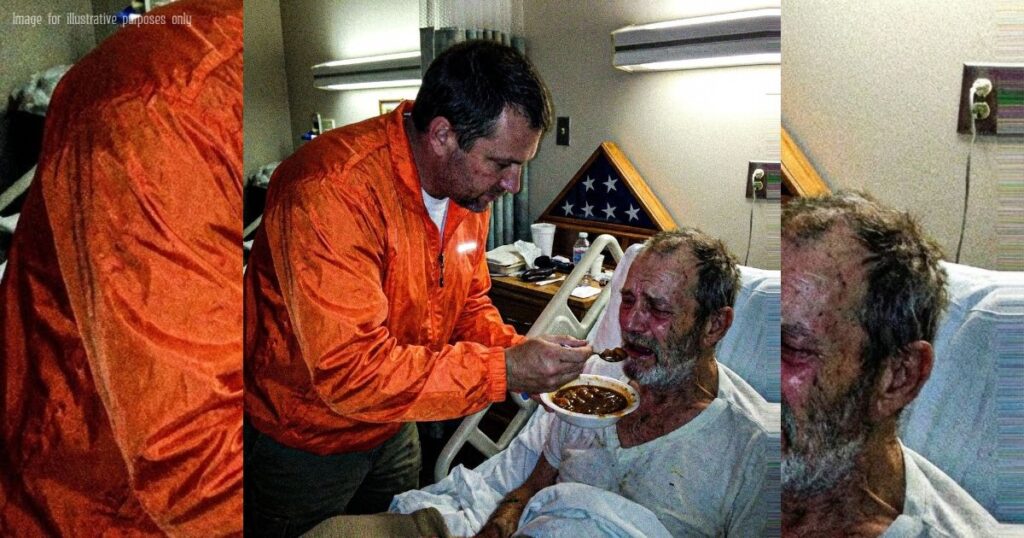
I thought about Mr. Henderson’s photograph.
That young soldier leaning against a tank, eyes bright, future wide open.
I thought about how he ended up in a room where nobody answered a call button.
And I realized the most controversial thing you can say in America right now isn’t political at all.
It’s personal.
It’s this:
If we keep treating care like a product, then sooner or later, we’ll all be returned.
My dad stood up, took my empty bowl, and clapped a hand on my shoulder.
“Finish your stew,” he said. “We’ve got a long week.”
I nodded.
But my eyes drifted back to my phone, face-down on the porch table, like a guilty secret.
Because I knew something now.
The algorithm gave me my job back.
But it didn’t give me my peace back.
And I had a feeling Oak Creek Manor wasn’t done with me yet.
Thank you so much for reading this story!
I’d really love to hear your comments and thoughts about this story — your feedback is truly valuable and helps us a lot.
Please leave a comment and share this Facebook post to support the author. Every reaction and review makes a big difference!
This story is a work of fiction created for entertainment and inspirational purposes. While it may draw on real-world themes, all characters, names, and events are imagined. Any resemblance to actual people or situations is purely coincidenta