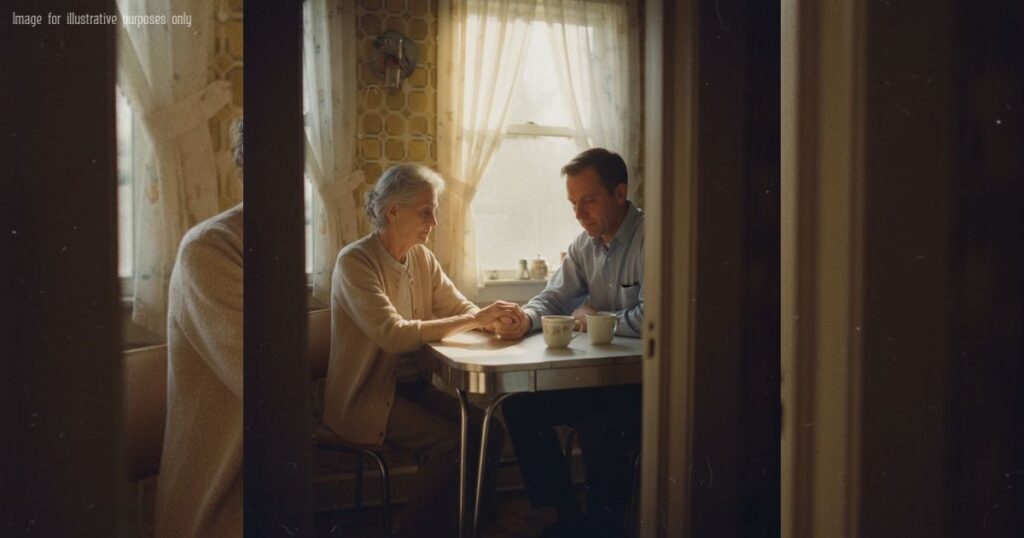
I wished my brother had never been born. I know how that sounds—monstrous. But when you’re seventeen and your parents hand your college fund to a specialist instead of a university, love feels a lot like theft.
That resentment was the fuel that powered my entire adult life. It was the reason I took out six figures in student loans. It was the reason I moved to the city, clawed my way up the corporate ladder at a major tech firm, and bought a condo that looked like a magazine cover. I built a fortress of success just to prove I didn’t need them. I didn’t need the town that forgot me, the parents who overlooked me, and specifically, the brother who consumed every ounce of oxygen in our house.
His name is Billy. He’s thirty-four, two years older than me, but he lives in a permanent state of childhood, navigating the world with non-verbal autism and a cognitive delay that anchors him in a simpler time.
For the last decade, I’ve been the “Good Son” from a distance. I sent checks. I sent generic text messages on holidays. I curated a digital life that looked perfect, hiding the fact that I was drowning in burnout and lonely as hell.
But this year, I had to go back.
Driving my leased electric sedan off the interstate and onto the cracked asphalt of my hometown felt like time travel. The Rust Belt grayness hung over the town. Main Street was half-empty, the old diner was now a “Cash for Gold” spot, and the political yard signs—red, blue, whatever—were fading in the November chill, reminders of a neighborhood that stopped talking to each other years ago.
I pulled into the driveway. The house looked smaller than I remembered. The siding was peeling. My father was on the porch, looking older, his back bent under the weight of invisible burdens.
“David!” my mom cried out, wiping her hands on an apron. She hugged me, and I felt how frail she’d become.
Then, there was Billy.
He was sitting on the living room floor, surrounded by his “collection”—a mountain of VHS tapes and old sports almanacs. He was rocking back and forth, making that low humming sound that used to drive me insane when I was trying to study for the SATs.
He didn’t look up. He was wearing a faded baseball cap, the logo worn off, and clutching a leather baseball glove that looked like it had survived a war.
“Hi, Billy,” I said, my voice stiff.
He didn’t respond. He just kept humming, tracing the stitching on the glove.
Dinner was excruciating. We sat around the table, the turkey slightly dry, the conversation drier. My parents tried to ask about my job, but I could tell they didn’t understand what a “Systems Architect” actually did. I didn’t have the energy to explain. I checked my work email under the table. Three new urgent flags. On Thanksgiving.
“Everything okay, Davey?” my dad asked.
“Yeah, fine,” I snapped, louder than intended. “Just… the economy, the market. It’s a lot right now.”
I looked at Billy. He was happily mashing his potatoes with a spoon, oblivious to inflation, oblivious to the layoff rumors at my company, oblivious to the fact that I hadn’t slept through the night in months.
“Must be nice,” I muttered, mostly to myself. “To just sit there. No bills. No pressure. Just mashed potatoes.”
My mother froze. Her fork clinked against the plate. “David.”
“What?” I said, the old anger bubbling up. “I’m just saying. I’ve been working eighty-hour weeks to pay off the loans I took out because his therapy cost more than my tuition. And he doesn’t even know I’m here.”
“He knows,” my dad said quietly.
“Does he?” I gestured at Billy. “Because it looks like he’s in 1999, and I’m the stranger who just walked in.”
I stood up, tossing my napkin on the table. “I need some air.”
I walked out the back door into the yard. It was cold, the sky a bruised purple as the sun went down. This backyard used to be my stadium. I used to imagine hitting the winning run here. But then, Billy would have a meltdown, or a seizure, or a bad day, and the game would end. I always had to pack up my imagination and go inside. The Glass Child. That’s what they call siblings like me. See-through. Resilient, but easily shattered if you press too hard.
I lit a cigarette—a habit I hid from my fitness-obsessed colleagues in the city—and leaned against the old oak tree. I took a drag, letting the smoke fill my lungs, scrolling through social media. Everyone else’s families looked perfect. smiling faces, matching pajamas. Fake. All of it.
The back door creaked open.
I braced myself for my mom coming to lecture me. But it wasn’t Mom.
It was Billy.
He stepped onto the grass in his socks. He was shivering slightly in his t-shirt, but he didn’t seem to notice. He was holding that ancient baseball glove in one hand and a scuffed, graying baseball in the other.
“Go inside, Billy. It’s cold,” I said, turning away.
He walked over to me. He stood there, invading my personal space, smelling like laundry detergent and old paper. He shoved the glove into my chest.
I looked down. It was my glove. The Rawlings mitt I thought I lost when I moved out at eighteen. It was oiled, the leather soft. He had kept it.
“What do you want?” I asked, my voice cracking.
Billy took a few steps back. He raised his arm and awkwardly threw the ball at me. It was a terrible throw—wobbly, low, no velocity.
It hit my shin.
“I’m not playing, Billy,” I said. I bent down to pick up the ball to hand it back to him.
But when I stood up and looked at him, I stopped.
For the first time in years, I actually looked at my brother. I didn’t look at his diagnosis. I didn’t look at the “burden.” I looked at his face.
He was smiling. Not the vacant smile he sometimes had when watching cartoons. This was a direct, intentional smile. He was waiting.
In a world that demanded I be smarter, faster, richer, and more political, Billy didn’t care about any of that. He didn’t care about my job title. He didn’t care about my credit score. He didn’t care if I was a Democrat or a Republican.
He just wanted to play catch.
He had waited fifteen years for me to come back to this backyard. While I was out there chasing a version of the American Dream that left me hollow, he was here, oiling my glove, keeping my spot in the lineup open.
My throat tightened. The cold air suddenly felt sharp in my lungs.
I put on the glove. It was tight—my hands had grown—but it fit.
“Okay,” I whispered. “Okay, Bill.”
I threw the ball back. A soft, underhand toss.
Billy caught it against his chest, fumbled it, then laughed. A pure, unadulterated laugh that echoed off the neighbor’s fence. He threw it back.
Pop. The ball hit the mitt.
Smack. I threw it back.
We fell into a rhythm. The sun dipped below the horizon, and the streetlights flickered on, casting long, orange shadows across the overgrown grass. My expensive Italian shoes were getting muddy. My suit jacket was restricting my movement. I didn’t care.
With every throw, the resentment I had carried like a shield began to crack.
I realized I had blamed Billy for stealing my parents’ attention, but I was the one who had stolen my own presence. I had punished them with my absence. I thought I was the victim, but standing there, I saw the truth. Billy was the one who held the family together. He was the anchor. While I was drifting in a sea of transactions—networking, dating apps, corporate politics—Billy was pure, unconditional love.
He was the only person in the world who loved me simply because I existed.
“High fly!” I shouted, a phrase I hadn’t used since I was twelve. I threw the ball high into the twilight.
Billy looked up, stumbling back, arms outstretched, his face turned toward the sky with total faith that he could catch it.
He missed. The ball landed in the dead leaves with a thud.
But he cheered anyway. He threw his hands up like he’d just won the World Series. He ran over, grabbed the ball, and ran to me, wrapping his arms around my waist in a crushing hug.
I froze for a second, then I dropped the glove. I hugged him back. I hugged him so hard that we both swayed in the cold darkness. I buried my face in his shoulder and let out a sob that had been stuck in my chest for a decade.
“I’m sorry,” I choked out. “I’m so sorry, Billy.”
He patted my back, awkward but rhythmic. Pat. Pat. Pat.
We stayed like that until the cold became unbearable.
When we walked back into the kitchen, my parents were washing dishes. They stopped when they saw us. Me, with mud on my shoes and red eyes. Billy, wearing my suit jacket which I had draped over his shoulders.
“We’re going to have dessert now,” I said, my voice steady for the first time all day. “And then, Dad, I want to look at that leak in the roof tomorrow morning before I head back.”
My dad looked at me, his eyes shiny. “You don’t have to leave early?”
“No,” I said, looking at Billy, who was already reaching for the pumpkin pie. “I can stay. Work can wait.”
I drove back to the city two days later. nothing about my life there had changed. The emails were still piling up. The rent was still high. The news on the radio was still angry.
But on my desk, right next to my sleek, silver laptop, sits a scuffed, gray baseball.
I keep it there to remind me.
We spend our lives running away from home, convinced that success is a destination on a map. We think value is calculated in assets and accolades. But the truth is much simpler, and much harder to accept.
You can conquer the world, you can win every argument, and you can buy everything you ever wanted. But none of it matters if you don’t have someone waiting for you in the backyard, ready to play catch, loving you not for what you’ve achieved, but just because you came home.
That’s the only home run that counts.
—
PART 2 — The Phone Call After the Backyard
The scuffed gray baseball sat on my desk like an accusation, and I kept touching it the way people touch a wedding ring when they’re not sure their marriage is real.
On Monday morning, I joined a video call in my glass-walled office while my inbox multiplied like mold. Someone joked about “holiday weight,” someone else complained about travel delays, and I nodded at all the right moments like my face was a mask I’d rented.
Click the button below to read the next part of the story.⏬⏬