PART 2 — The Phone Call After the Backyard
The scuffed gray baseball sat on my desk like an accusation, and I kept touching it the way people touch a wedding ring when they’re not sure their marriage is real.
On Monday morning, I joined a video call in my glass-walled office while my inbox multiplied like mold. Someone joked about “holiday weight,” someone else complained about travel delays, and I nodded at all the right moments like my face was a mask I’d rented.
A coworker glanced at the ball behind me.
“Is that… a souvenir?” he asked.
“It’s… from home,” I said, and the word home tasted unfamiliar, like a language I used to speak fluently and forgot on purpose.
The meeting shifted into performance mode—metrics, urgency, the usual “we’re all in this together” speech that never included the people who actually cleaned up the messes. I stared at the ball and thought about Billy in my suit jacket, reaching for pumpkin pie like the world was still safe.
At 11:47 a.m., my phone buzzed.
Mom.
I didn’t answer right away, because my adult life had trained me to fear family calls during business hours. Family calls meant something broke. Family calls meant I was needed.
I let it ring twice, then swiped.
“David,” she said, and my stomach dropped because she didn’t say hi. “Your father… he fell.”
The air left my lungs like someone had punched me.
“He’s alive,” she rushed, as if she could hear the panic. “But it’s bad. They’re taking him to St. Mercy County. Billy’s… he’s not doing well. I—” Her voice cracked into that quiet, embarrassed sob my mother always tried to swallow. “I need you.”
I stared at my calendar. A “high priority” project review in thirty minutes. A performance check-in tomorrow. A planning session next week that had been scheduled like it was a medical procedure.
“I’m coming,” I said, and it didn’t feel noble or heroic. It felt like gravity.
I emailed my manager two sentences—Family emergency. I have to go.—then shut my laptop like it was a mouth that wouldn’t stop talking.
In the elevator down to the parking garage, I caught my reflection in the metal doors. Expensive haircut. Tired eyes. The face of a man who’d built a fortress and somehow ended up trapped inside it.
My phone buzzed again.
My manager: Can we discuss?
I didn’t respond.
On the drive out of the city, the radio argued with itself—voices yelling about the country, the economy, who deserved what, who ruined what. Every station felt like a courtroom, and everybody was guilty.
I turned it off.
In the silence, all I could hear was Mom saying, I need you, and a smaller voice in my head whispering the part nobody posts online:
What if I can’t do this?
By the time I reached my hometown, the sky was the color of wet cement. The house looked exactly the same as two days ago—peeling siding, sagging porch—but now it felt like a stage after the actors have left, still lit, still waiting for the next tragedy.
An ambulance wasn’t there anymore, but the tire tracks were.
Inside, Mom sat at the kitchen table with her hands wrapped around a mug she wasn’t drinking. Her eyes were swollen, her hair pulled back in a messy knot like she’d stopped caring who saw her unravel.
Billy was in the living room, rocking hard enough that the old floorboards complained. His humming was louder, sharper, like an alarm. His glove lay beside him, abandoned.
When he saw me, he froze.
For half a second, I thought he was going to smile the way he did in the backyard, like the world could still be stitched back together with a ball and a glove.
Instead, he made a sound I hadn’t heard since childhood—something between a groan and a cry—and slapped both hands over his ears.
Mom flinched like the sound hit her.
“He keeps looking for your dad,” she whispered. “He doesn’t understand why he’s not here.”
I swallowed. “Where’s Dad now?”
“ER. They think it’s his hip. He hit his head, too.” She rubbed her temple. “They’re running tests.”
I stepped closer to Billy, slow the way you approach a skittish animal. “Hey, Bill,” I said softly.
He didn’t look at me. He reached for the glove, clutched it to his chest, then stood and walked straight past me toward the back door.
The backyard.
The place where things made sense.
He stepped outside in his socks, like cold was optional when you needed something badly enough.
I followed him out.
He stood under the oak tree, staring at the patch of grass like it was a TV screen that might replay the last good moment if he waited long enough. His shoulders shook with silent frustration.
“Dad’s coming back,” I lied, because it was the only language I had in that moment: hope.
Billy turned his head slightly, not fully meeting my eyes, but close. He lifted the glove and pressed it against my chest the way he had before, insisting on a ritual like it could hold the world together.
I wanted to run. Not from him—from the weight of it. From the truth that I’d been gone so long, I didn’t even know how to be useful without a credit card.
“Okay,” I said. “Okay. We’ll wait together.”
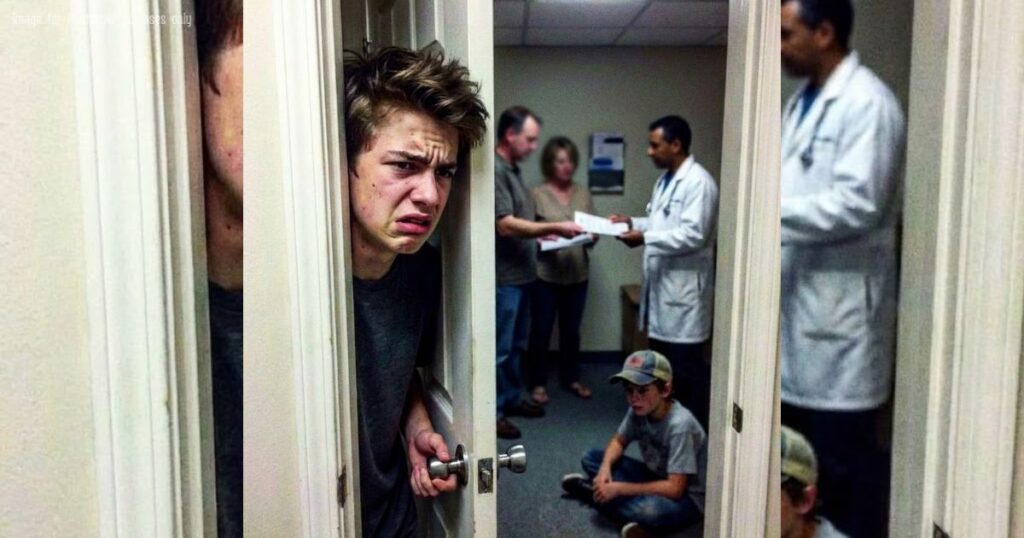
In the hospital waiting room, the chairs were plastic and the air smelled like disinfectant and tired people. Mom filled out forms with shaking hands. I watched her struggle to remember Dad’s medications and realized I hadn’t learned any of it.
Because I didn’t have to.
Billy sat beside me, humming again, quieter now, his eyes fixed on a crack in the linoleum like it was the only safe thing in the room.
A man across from us kept staring.
Not a quick glance. A stare-stare. The kind that makes you feel like you’re on display.
Billy rocked a little harder, his fingers tapping the glove in a pattern that looked like prayer. The man’s stare hardened, like Billy was doing something to him on purpose.
“Can you stop that?” the man finally snapped, loud enough for heads to turn. “Some of us are trying to think.”
Mom’s pen froze mid-form.
My body reacted before my brain. The old resentment, the old need to be perfect, to be polite, to not make a scene—gone.
“He’s not doing it at you,” I said, my voice steady and sharp. “He’s doing it to survive this room.”
The man scoffed. “Well, it’s distracting.”
I looked around at the posters on the wall—Be Kind, Speak Up, We Care—and I felt something bitter rise in my throat.
“That’s the problem,” I said. “Everyone loves kindness when it’s quiet.”
The room went silent for a second, heavy with the kind of discomfort people hate more than cruelty. A nurse walked by and pretended not to hear.
Mom touched my arm, barely. Not to stop me—more like she was shocked I had finally stepped into the mess with her.
The man turned away, muttering under his breath.
Billy didn’t react at all. He just kept tapping the glove, the same pattern, like the world had taught him a long time ago not to expect protection.
And that thought—not to expect protection—hit me harder than anything the stranger said.
Dad came out of surgery the next day with a heavy fog in his eyes and pain folded into every movement. The doctor talked about recovery and physical therapy and “safety at home,” and I watched my mother nod like she understood.
Then the doctor said the sentence that changed the air:
“He shouldn’t be alone. Not for a while. And stairs are going to be an issue.”
Mom’s mouth tightened.
Our house had stairs everywhere.
Click the button below to read the next part of the story.⏬⏬