PART 2
The morning news kept talking, like it could fill the room with numbers and make the smell disappear.
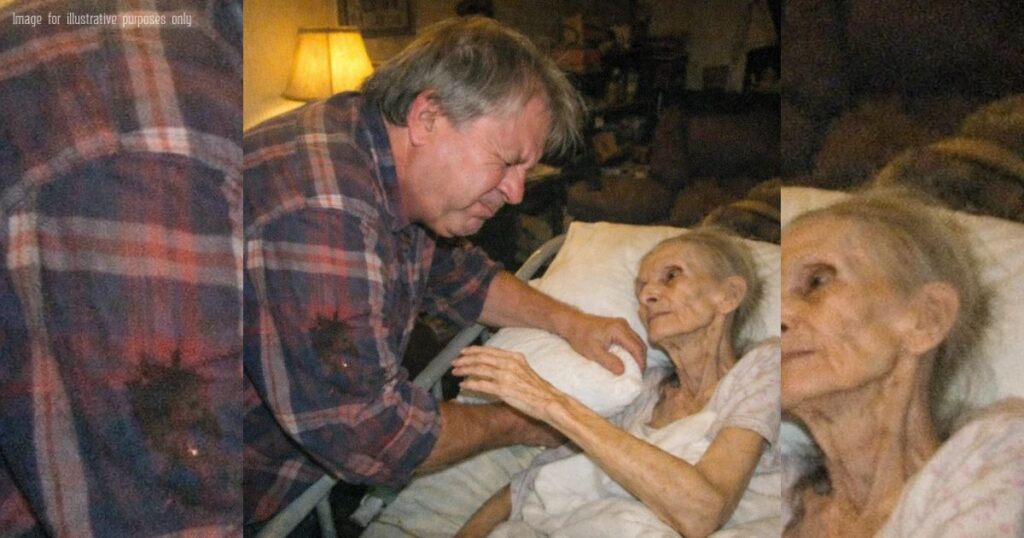
I sat in the folding chair beside Eleanor’s bed with her hand in mine, listening to a cheerful voice explain how “consumer confidence” was trending up, how “markets” were “optimistic,” how the world was “moving forward.”
In our living room, nothing moved forward.
Eleanor’s fingers were light as bird bones. Her skin felt like warm paper. Every so often her thumb twitched, like her body was trying to remember an old habit—how she used to tap my hand twice when she wanted me to stop talking and just be with her.
I leaned in closer, because I was trying. Because I meant it.
And because—if I’m telling the truth—I was afraid that if I let go, she would evaporate.
The phone rang at 9:07.
I stared at it for a full three rings before I answered, like it might be a debt collector or another letter with a human voice.
“Dad?” My daughter’s voice. Claire. Fifty-two years old and still able to turn me into a teenager with one syllable.
“Yeah,” I said.
“Are you… okay?” she asked, the way people ask you when they’re already bracing for the answer.
I looked at Eleanor. Her mouth was slightly open, her breath a soft, wet rasp. The rose soap was already fading beneath the reality.
“I’m here,” I said.
There was a pause. A rustle of movement on the other end, like she’d covered the mouthpiece to talk to someone else. Then she came back.
“Mark and I are coming over,” she said. “Today.”
My son. Mark. Forty-nine. The one who still calls the house “the old place,” like it stopped being a home the second he moved out.
“Why?” I asked, and hated myself for how sharp it sounded.
“Because,” she said, “we haven’t been there in a while.”
That was almost funny. Not because it was a joke, but because it was the kind of sentence people use when they don’t want to say the real thing.
We haven’t seen what you’re living in.
We haven’t smelled it.
We haven’t looked you in the eyes long enough to notice you’re turning into a ghost.
“I don’t need—” I started.
“Dad,” she cut in, and there it was again—that same tone from when she was sixteen and I’d told her she couldn’t go to a party. “Please. We’re coming.”
I swallowed. My pride had nowhere to stand in this house anymore. Pride was a luxury, like new tires or a vacation.
“Fine,” I said.
When I hung up, I realized my hand was shaking.
Eleanor blinked slowly. Her eyes focused on the ceiling, then slid toward me like a drifting boat.
“Who was that?” she asked.
“A voice from the past,” I said, trying to smile.
She frowned, confused. Then her brow smoothed out again, like her brain decided it wasn’t worth fighting.
“Okay,” she whispered.
At 10:30, I started cleaning like the house was going up for inspection.
Not because I’m a neat man.
Because shame has a smell too, and I thought maybe I could scrub it out.
I changed the sheets. I wiped down the bed rails. I emptied the trash can with the used gloves and the disposable wipes and the small humiliations that pile up like snowdrifts. I sprayed the room with a generic air freshener that smelled like fake pine and guilt.
It didn’t help.
You can’t Febreze grief.
At 11:58, Mark’s truck pulled into the driveway like a judge arriving at court.
I saw it through the thin living room curtains. Newer. Clean. Tires that looked like they actually trusted the road.
Claire’s car was behind him. And in the backseat—my grandson, Ethan, thirteen years old now, staring down at a phone like it was the only oxygen he needed.
They came in with forced smiles and tight eyes.
They hugged me the way people hug at funerals: quick, careful, already stepping back.
“Dad,” Claire said, and I could tell she’d practiced sounding warm.
“Frank,” Mark said, and didn’t meet my eyes.
Then they smelled it.
I watched their faces do that tiny thing—nostrils flaring, their bodies shifting back half an inch before they corrected themselves. Like you can hide disgust behind manners.
Ethan stayed by the doorway, thumb moving on his screen, pretending he wasn’t terrified.
“How is she?” Claire asked softly.
I wanted to say: How do you think?
Instead, I said, “She’s… here.”
We walked into the living room together, like we were visiting someone else’s tragedy. Like we hadn’t built this life. Like it hadn’t been inevitable the moment Eleanor’s first memory slipped away and we laughed it off because we didn’t want to be scared.
Eleanor’s head turned toward the sound of footsteps. Her eyes narrowed, trying to place them.
“Hi, Mom,” Claire whispered, bending down.
Eleanor stared at her like Claire was a stranger who’d wandered into the wrong house.
“Hello,” Eleanor said politely.
Claire flinched. Mark’s jaw tightened.
“It’s me,” Claire said, too brightly, voice trembling. “Claire.”
Eleanor blinked. Then, like the mind does sometimes—like a cruel magic trick—she smiled faintly.
“Oh,” she said. “Claire-bear.”
Claire’s face cracked. Tears came instantly. She covered her mouth, choking on them.
Mark stepped closer, voice low. “Hey, Mom.”
Eleanor looked at him longer. Her smile faded. “Do I know you?”
Mark stood there like a man taking a punch he’d deserved for years.
Ethan finally looked up from his phone. His eyes darted from Eleanor to me to his mom, like he was watching a scene in a movie where no one told him the ending was real.
“Is she… comfortable?” Claire asked, wiping her cheeks, trying to pull herself back together like tears were something she could schedule.
I heard myself laugh once, a short ugly sound.
“Comfortable?” I repeated.
Claire’s eyes flashed. “Dad—”
I held up a hand. “No. It’s fine. We can say the words. This is what it is.”
Mark stared at the tubes, the bed, the basin on the side table. “You can’t do this alone,” he said.
There it was. The sentence people love to say, because it feels like help.
It costs nothing.
I looked at him. “I’m not doing it alone,” I said. “Eleanor’s here too.”
That made Mark bristle. “That’s not what I meant.”
“I know what you meant,” I snapped. “You meant I should’ve put her somewhere.”
Claire inhaled sharply. “Dad, we’re not—”
“Then what are you doing here?” I asked, louder than I meant to. My voice bounced off the walls, and Eleanor’s eyes widened, startled.
Ethan’s fingers froze on his phone.
Claire stepped back like I’d slapped her. “We’re trying to figure out what we can do.”
I looked at the three of them—my children and my grandchild—and something bitter rose in me.
“You want to do something?” I said. “Sit.”
Claire frowned. “What?”
“Sit with her,” I said. “For an hour. Two. Let me go take a shower without rushing. Let me walk around the block without listening for the bed alarm in my head.”
Mark’s face tightened. “Dad, we—”
“We what?” I cut in. “You have jobs? I had a job too. For forty years. I had bills. I had back pain. I had nights where I wanted to sleep.”
Eleanor murmured something, confused. “Frankie?”
I turned to her instantly, voice softer. “I’m here.”
Claire’s eyes filled again. She whispered, “Dad, please don’t do this.”
And there it was again—how the world treats suffering.
Not as something to share.
As something to manage quietly so it doesn’t make anyone uncomfortable.
Mark exhaled hard. “We were thinking,” he said carefully, “maybe it’s time to look at a facility.”
The word facility landed in the room like a coffin.
I stared at him. “With what money?” I asked.
Mark blinked. “We can figure it out.”
“No,” I said. “You can’t. Because the people who send those letters already did the math. And the math says we lose the house first.”
Claire whispered, “Dad…”
I turned toward the kitchen table, where the letter was still sitting like a threat. I grabbed it and held it out.
“Read it,” I said.
Mark took it. His eyes moved across the page. I watched his face change in slow motion—from disbelief to confusion to a kind of quiet anger that had nowhere to go.
“They want you to… sell the house?” he said, voice cracking.
“They want us to become poor enough,” I said. “Then they’ll help.”
Claire sat down hard in the chair, like her legs finally gave up pretending.
Ethan stared at the letter, then at the medical bills on the table, then back at Eleanor’s bed. His mouth was slightly open.
He looked thirteen in a way I hadn’t seen in years.
Click the button below to read the next part of the story.⏬⏬