The Cashier Was Scanning My Coupon When I Started to Die.
I don’t mean metaphorically. I mean the floor turned into water and the ceiling lights started spinning like a slow-motion fan.
I’m Eleanor. I’m 74. I spent forty years teaching high school history, standing on my feet, commanding rooms. But standing in line at the pharmacy on a Tuesday morning, clutching a prescription for pain meds I wasn’t sure I could afford, my body finally went on strike.
Stage four pancreatic cancer. The doctor gave me a timeline that ended before Christmas.
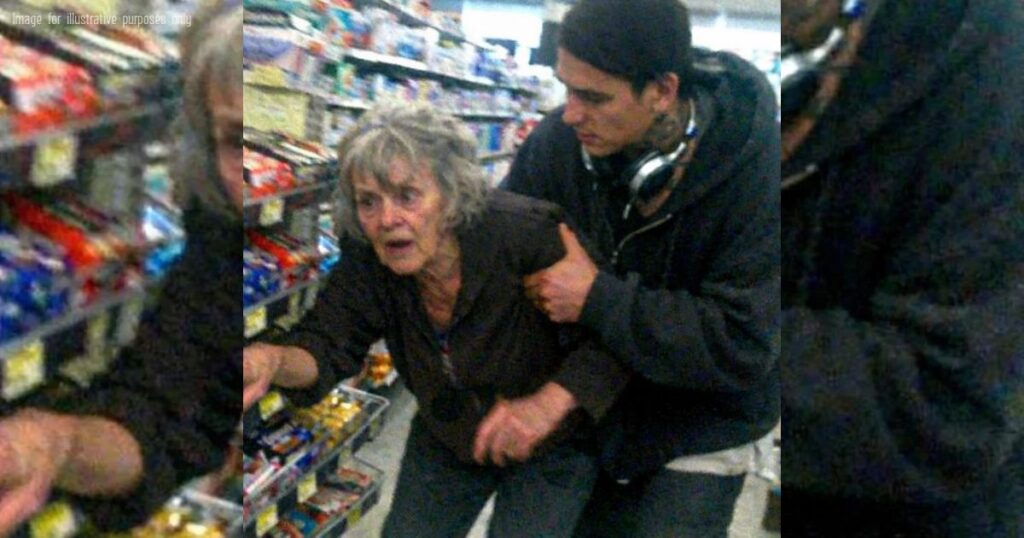
The line was long. People were impatient. Everyone was staring at their phones, scrolling, scrolling, scrolling. When I stumbled, grabbing the candy rack to keep from hitting the linoleum, a woman in a business suit actually sighed. She checked her watch.
Then, a hand grabbed my elbow. Strong. Steady.
I looked up. It was a kid who looked like everything the news tells old ladies like me to fear. baggy hoodie, neck tattoos, headphones blasting something loud enough for me to hear the bass. He looked about 20.
“I got you,” he said. Voice low. Rough.
He didn’t ask if I was okay—he knew I wasn’t. He just became a human crutch. He maneuvered me to the counter, took my wallet out of my shaking hands, paid my co-pay (I tried to stop him, he ignored me), and walked me to the bench outside.
He sat with me for twenty minutes until the dizziness passed. He didn’t check his phone once.
“You good to drive?” he asked. “No,” I admitted. A terrifying admission for an American woman who values her independence above everything. “I’ll follow you home. Drive my car, leave it, drive yours back. Don’t worry about it.”
His name was Marcus.
Three weeks later, the chemo hit me like a freight train. I lost my hair, my appetite, and my ability to drive. My son lives in Oregon; he calls, but he has three kids and a mortgage. He couldn’t fly out every week.
Uber was bleeding my savings dry.
I swallowed my pride and posted on our town’s community Facebook group. “Senior citizen needs ride to Cancer Center. Tuesdays at 8 AM. Can offer gas money and homemade cookies.”
Most comments were “prayers” or sad emojis. Then a DM popped up. “I know where you live. I’ll be there at 7:45. Keep the money.”
It was Marcus.
For five months, this boy—who worked stocking shelves at the grocery store on the night shift—drove me to treatment. He drove a beat-up sedan that rattled when it went over 40 mph. The interior smelled like energy drinks and old receipts.
It became my sanctuary.
He saw me at my worst. He held a plastic bag for me when I got sick. He wrapped me in a blanket he kept in the back seat when the chills set in.
One day, stuck in traffic on I-95, I asked him. “Marcus, why? You work all night. You should be sleeping.”
He tightened his grip on the steering wheel until his knuckles turned white against his dark skin.
“My Nana,” he said softly. “She raised me. She got sick two years ago. We didn’t have a car. The bus took two hours. Sometimes she was too tired to go, so she skipped appointments. She didn’t want to ask the neighbors. She died because she didn’t want to be a bother.”
He looked at me in the rearview mirror, tears welling in his eyes. “I can’t bring her back, Ms. El. But I ain’t letting that happen to you. Not on my watch.”
I realized then that this boy wasn’t just driving a car. He was trying to outrun his grief.
The chemo was hell, but it worked. The tumor shrank. I’m in remission. I got my time back.
Marcus still comes by. Not for rides, but for coffee. He sits on my porch, headphones around his neck. My neighbors used to peek through their blinds, suspicious of the “hoodlum” at Eleanor’s house. Now? They wave. They know.
I tried to write him a check. He tore it up.
So I did something else. I knew he was saving up to fix his transmission so he could take more shifts. I called the mechanic in town—an old student of mine—and paid the bill in full, plus a credit for future work. Anonymous.
When Marcus found out, he came over, bewildered. “Ms. El, you won’t believe it…” “The world works in mysterious ways, honey,” I said, sipping my tea.
Last week, he showed me an acceptance letter. He’s going to school to be an EMT. “I want to be the one who shows up,” he said.
I’m an old woman in a country that often feels angry, divided, and lonely. We are told to fear our neighbors. We are told everyone is out for themselves.
But let me tell you something.
I am alive today not just because of medicine. I am alive because a boy with tattoos and a broken heart decided to be the family I needed.
Don’t judge the book by its cover. And please, if you are drowning, let someone save you. Refusing help doesn’t make you strong; it just makes you the casualty of your own pride.
We belong to each other. We just forget it sometimes.
—
PART 2 — The Post That Turned My Savior Into a Suspect
If you read Part 1, you know a tattooed kid named Marcus kept me alive—first in a pharmacy line, then through five months of cancer treatment.
I thought the hardest part was surviving stage four. I was wrong.
The trouble started with a photo.
It was a normal morning on my porch—the kind of morning old women like me collect like coins. Coffee in a chipped mug. A thin winter sun. Marcus sitting on the top step, elbows on his knees, headphones around his neck, laughing at something I said like I’d earned it.
He was wearing a bright orange training jacket from his EMT program. Not a uniform yet—just the kind of jacket you buy when you’re trying to become someone new.
A car slowed down at the curb.
Click the button below to read the next part of the story.⏬⏬