I didn’t have a good answer.
People love simple stories. Real life is anything but.
I filled his tank according to the approved amount from the fund. No “errors” this time. Every gallon was accounted for. But on the way back to the truck, he called out.
“Hey, Hank?”
I turned.
“Thank you,” he said. “Not just for the fuel. For being the guy everyone is arguing about. Maybe they’ll argue their way into caring a little more.”
That one stuck with me.
Because that’s the thing nobody tells you: kindness can start arguments.
Since the story went around, I’ve gotten letters.
Some come with checks. Some come with lectures.
One envelope had twenty dollars and a note that said, “I’m on disability, but my church helped me last year. Please pass this on.”
Another had no money, just a handwritten page: “I pay full price. If your company starts giving away fuel, I’ll go somewhere else. I’m not paying extra so strangers can sit around all day.”
I read them all.
I don’t tear up the harsh ones. I keep them in the same drawer as the crayon drawing from Mrs. Jenkins’ daughter.
Because both are the truth.
One truth says, “We’re all responsible for each other.”
The other says, “I’m barely hanging on. Don’t ask me to carry more.”
Some evenings, I sit in my recliner and wonder if I started something good or just poked a wound this country doesn’t know how to heal yet.
The real heat wave hit in January, when a local reporter called.
“I’d like to do a story on your Good Neighbor Fund,” she said. “People need to know about practical ways to help. We won’t name your company if that’s an issue.”
The regional manager was wary. The communications guy was half-thrilled, half-horrified. Mike asked me what I thought.
“I’m not looking for attention,” I said. “But if it means one more kid doesn’t go to bed in a winter coat, I’ll sit in front of a camera.”
They filmed in the yard behind the office. My truck was in the background, washed for the first time in months. The reporter asked me how it all started, and I told the story again—this time with a microphone pinned to my vest.
“When you bent the rules that first time,” she asked, “would you do it again?”
I took a breath.
“I won’t lie,” I said. “I’d like to be remembered as the guy who helped people, not the guy who broke policy. That’s why we created the fund. I don’t recommend anyone risk their job the way I did. But if you’re asking whether I regret keeping a family from freezing…” I paused. “No. I don’t.”
The story aired on a Friday night. By Saturday morning, the fund had more money than it had seen in a year—and more applications than we’d ever had before.
With more attention came more controversy.
One caller said, “I love what you’re doing. I’ll sponsor a whole street if I can.”
Another said, “Why should I donate? Isn’t that what taxes are for?”
A third asked, “How do I know you’re not helping people who just refuse to work?”
That last one made my jaw clench.
I’ve seen people on oxygen tanks trying to shovel a path to their meter. I’ve seen parents working nights stocking shelves and still coming up short. Are there folks who game the system? Sure. People game every system. But most of the people I see are exhausted, not lazy.
We tried to answer questions clearly.
We explained that we verify need through referrals, bills, and basic checks. We explained that the fund doesn’t erase entire balances, just covers emergency deliveries when the tank hits zero and the temperature drops dangerous.
Still, some people didn’t like it.
And you know what?
That’s okay.
You cannot build anything that matters in this world without someone thinking you’re doing it wrong. You can’t feed people without someone asking if they “deserve” dinner. You can’t warm a house without someone worrying that you’ve encouraged dependency.
One night, there was a community meeting about winter preparedness at the town hall. The utility folks were there, some church leaders, a handful of us drivers, and about fifty regular citizens who left warm couches to sit in metal folding chairs.
A woman stood up and said, “I love the idea of helping, but I’m scared. I’m a widow on a fixed income. If my bill goes up even a little because of this, I don’t know what I’ll cut. Groceries? Medicine?”
An older man across the aisle responded, “I’ll pay an extra five bucks if it means nobody in this town freezes. We spend more than that on coffee.”
A younger guy raised his hand.
“I grew up poor,” he said. “Sometimes people did help us. Sometimes they judged us. You know which nights I remember most? The ones where the heat went off and we all slept in our coats. If a fund like this had existed, I might remember something different.”
The room buzzed.
Finally, someone asked me to speak.
I’m not a politician. I’m not a preacher. I’m a man with bad knees and a good truck. But I stood up anyway.
“I don’t have answers for everything,” I started. “All I know is what it looks like when a house runs out of heat at eleven o’clock on a Sunday night.”
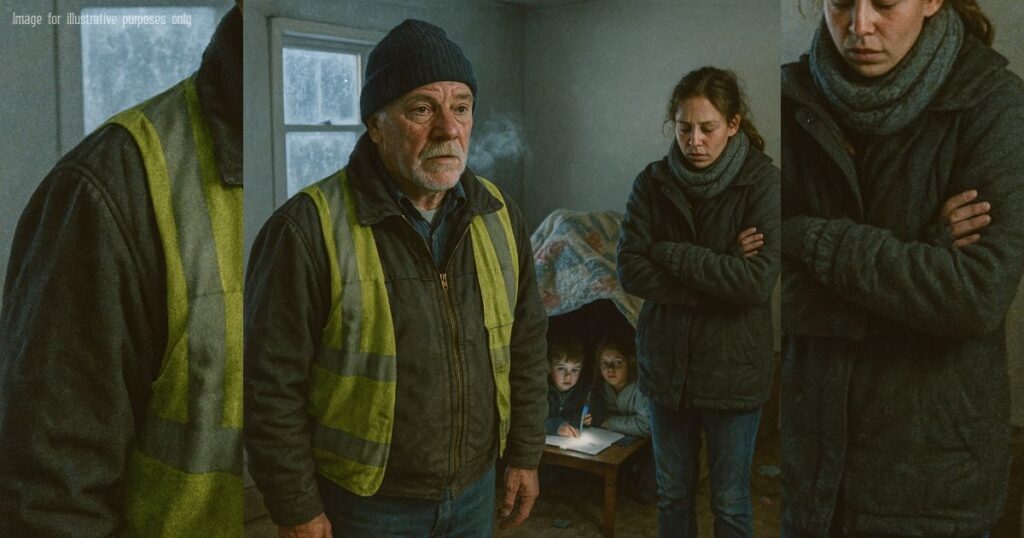
I told them about the cracked wallpaper curling away from cold walls. I told them about old men whose hands shake so hard they can’t sign the clipboard. I told them about kids thinking it’s a fun ‘campout’ in the living room because their parents are too proud to call it an emergency.
“I hear your fear,” I said, turning to the widow. “Nobody here wants your medicine money. That’s why the fund is voluntary. Give if you can. Don’t if you can’t. Your worth doesn’t depend on writing a check.”
Then I turned to the folks worried about “deserving” and “undeserving.”
“You are allowed to be frustrated,” I said. “You’re allowed to wonder if someone is taking advantage. But here’s the thing: the cold doesn’t care. It doesn’t check credit scores. It doesn’t ask about life choices. It just takes.”
I let that hang there for a second.
“We can spend hours trying to separate the ‘good poor’ from the ‘bad poor,’ or we can decide that no one in this town should risk their life because they ran out of fuel in January. You don’t have to agree with my methods. You don’t have to like every person who gets help. But you do have to decide what kind of community you want to live in.”
Some folks nodded. Some crossed their arms.
That’s fine. The point wasn’t to win an argument. The point was to keep people alive long enough to have one.
Here’s the part that might bother you, and maybe it should.
I still bend the rules sometimes.
Not the inventory ones—those days are over. We have systems now, approvals, logs. But I bend my own rules. The private ones.
I used to think help had to be perfectly fair to be valid. Now I think help just has to be real.
If I see an elderly neighbor’s porch light off three nights in a row, I knock. If a kid I deliver to is wearing flip-flops in the snow, I drop a pair of boots by the door next week “by mistake.” If a customer overpays by ten bucks and tells me to “put it toward someone who needs it,” I write their name on a sticky note and make damn sure their generosity doesn’t get lost in a computer.
Does everyone approve of how I do it?
Absolutely not.
But when the wind howls and the temperature drops and the sky goes that steel-gray color that means trouble, I remember something simple.
The internet argues in the comments.
The cold doesn’t read them.
So argue. Debate. Type five paragraphs about personal responsibility if you need to. Tell me in all caps how you’d run things differently. There’s room for that conversation. Maybe we even need it.
Just promise me one thing.
When the next cold snap hits your town, don’t let your opinions be the only thing you send out into the world. Send a casserole. Send a blanket. Send a few dollars to a fund you trust. Send a text that says, “Hey, you okay over there?”
The story people are fighting about online is not really about me.
It’s about what we owe each other when the world gets bitter and the thermostat drops.
You don’t have to steal fuel to be a hero. In fact, please don’t. My heart can’t take any more meetings.
But you can be the quiet reason someone’s furnace kicks on tonight.
You can be the argument for compassion that speaks louder than any comment.
And when some future kid draws a picture of a warm house and a red truck and a crooked old man with a blue hat, maybe the caption under it won’t be “Mr. Hank brings the summer.”
Maybe it’ll just say, “We didn’t freeze. Somebody cared.”
Thank you so much for reading this story!
I’d really love to hear your comments and thoughts about this story — your feedback is truly valuable and helps us a lot.
Please leave a comment and share this Facebook post to support the author. Every reaction and review makes a big difference!
This story is a work of fiction created for entertainment and inspirational purposes. While it may draw on real-world themes, all characters, names, and events are imagined. Any resemblance to actual people or situations is purely coincidenta