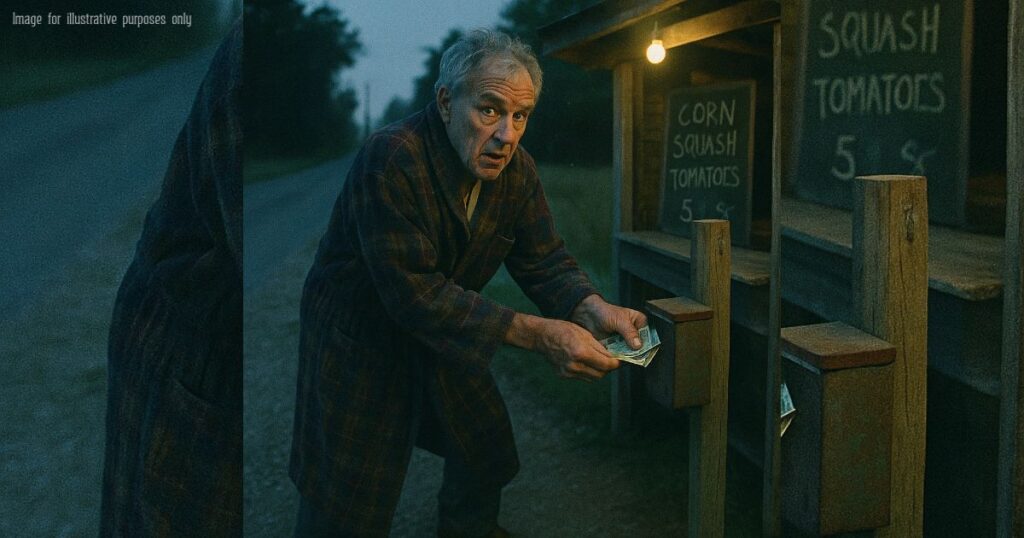
I am technically committing a financial crime every morning at 4:15 AM.
While the rest of the county is sleeping, I creep out of my back door in my bathrobe. I walk down the gravel driveway to my farm stand, look left and right to make sure the road is empty, and I stuff my own crumpled twenty-dollar bills into the metal lockbox.
I’m laundering my own pension money just so my neighbors won’t realize they’re stealing from me.
My name is Walt. I’m 74 years old. I grow Silver Queen corn, butternut squash, and tomatoes that actually taste like tomatoes—not that red styrofoam you buy at the chain grocery stores for $4 a pound. My stand is just a wooden shed off Route 6, built by my dad back when “organic” wasn’t a marketing term; it was just called “farming.”
For fifty years, this stand ran on the Honor System.
There are no cameras. No QR codes. No clerks. Just a rusted metal slot box nailed to an oak post. You pick your produce, you check the price on the chalkboard, and you slide the cash in.
My dad used to tell me, “Walt, a lock keeps an honest man honest. But the Honor Box? That tells you the soul of a town.”
And for decades, the math always worked. Sometimes, I’d even find an extra nickel or dime.
But this year is different.
You watch the news. You know what’s happening. The distribution center three towns over shut down. Gas prices spiked. A cart of groceries now costs what a car payment used to.
Suddenly, the math at my stand stopped making sense.
I’d put out thirty pounds of potatoes and racks of sweet corn. By noon, the shelves would be bare. But when I unlocked the box in the evening, there’d be three dollars and a button.
At first, I was furious. I’m on a fixed income. Social Security only stretches so far. I sat on my porch with my coffee, watching the road like a hawk. I wanted to catch the thief. I wanted to scream at them about “American values” and “hard work.”
Then, last Tuesday, I saw him.
It was Danny.
Danny is the local mechanic. He’s a good kid—mid-30s, two little girls. He fixed my transmission last winter and let me pay him in installments.
He pulled his rusted pickup over. He didn’t look like a criminal masterminding a heist. He looked tired. That bone-deep exhaustion you see in people who work 60 hours a week and still can’t make rent.
He looked around nervously. Shoulders hunched, head down. He grabbed a heavy bag of potatoes and a carton of eggs. He stood there for a long time, his hand hovering over the metal box. I saw him wipe his eyes with his greasy sleeve.
Then he got in his truck and drove away. He didn’t pay a cent.
But watching him, my anger evaporated, replaced by something heavy in my chest.
Danny wasn’t stealing because he was a bad person. He was stealing because he was hungry.
And worse—he was ashamed.
If the box was empty when he got there, rattling with nothing but air, he’d feel like a beggar taking the last crumb. He’d feel like a charity case. In this part of the country, for men like Danny, pride is the only coat they have left to wear against the cold.
So, I started my new routine.
Every morning before the sun comes up, I take cash from my “rainy day” jar. I put a ten, a few fives, and a handful of quarters into the Honor Box.
I do it so when Danny, or the widow Mrs. Gable, or the young couple down the street come by, they can hear the jingle of coins.
They can see money in the slot. They can pretend they are just “making change” for a twenty. They can tell themselves that business is booming for old Walt, so taking a few ears of corn won’t hurt.
It allows them to take what they need while keeping the one thing they can’t afford to lose: their dignity.
I’ve lost about $500 this month. I’m eating a lot of oatmeal and skipped refilling my blood pressure prescription to make up for it.
Yesterday, the first real freeze of the year hit. The ground was hard as iron. I walked out to the stand to board it up for the season. My joints ached. I felt old. Not body-old, but soul-old.
I thought about selling the land. Maybe the world has just gotten too hard for a dirt farmer who believes in honor.
I unlocked the box, expecting it to be empty.
It was stuffed.
I couldn’t believe it. I pulled out a wad of paper. But it wasn’t cash.
It was IOUs. Dozens of them. Scrawled on the backs of electric bills, fast-food napkins, and torn notebook paper.
“Good for $20 – Danny. I start the new shift Monday.”
“For the squash and the kindness. – Sarah.”
“I’ll come patch your barn roof in the spring, Walt. No charge. – Mike.”
And at the very bottom, wrapped in a rubber band, was exactly $500 in bills—the exact amount I had “seeded” into the box over the last month.
Attached was a note. It wasn’t signed by one person. It was signed, ” The Neighborhood.”
The note read:
“Walt, we saw you putting your own money in the box every morning at 4 AM. We know you were trying to save our pride. But we can’t let you go hungry just to feed us. We passed a hat around at the VFW hall last night. We might be broke, Walt, but we aren’t broken. Keep the change.”
I stood there in the freezing wind, clutching those scraps of paper, and I cried.
We talk a lot about how this country has changed. We argue on the internet. We talk about how people don’t look out for each other anymore.
But out here, when the screens are off and the road is quiet, the soil is still good.
The Honor System isn’t dead. It just looks a little different when times are tough.
If you have extra, share it. If you need help, ask for it. But never, ever underestimate the power of preserving someone’s dignity.
Sometimes, the most valuable thing you can put in the box isn’t a dollar. It’s grace.
———
The week after my neighbors stuffed that honor box with IOUs and grace, the whole world decided to have an opinion about my little farm stand.
Apparently, what happens at 4:15 AM on a gravel driveway off Route 6 doesn’t stay there anymore.
It started with a picture.
Click the button below to read the next part of the story.⏬⏬