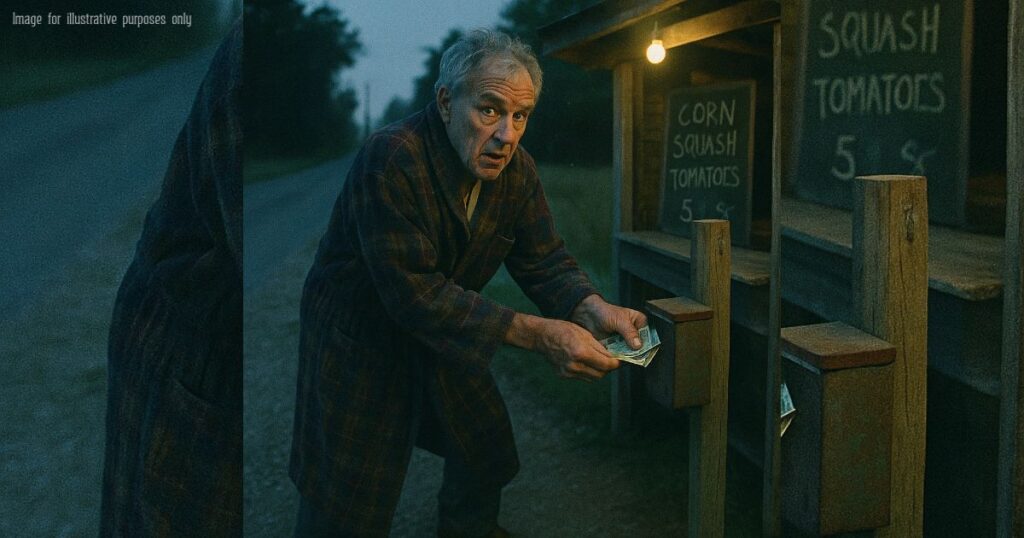
The week after my neighbors stuffed that honor box with IOUs and grace, the whole world decided to have an opinion about my little farm stand.
Apparently, what happens at 4:15 AM on a gravel driveway off Route 6 doesn’t stay there anymore.
It started with a picture.
I didn’t even know it had been taken. Somebody—one of the teenagers, I think—snapped a photo of the notes and that envelope signed “The Neighborhood.” They blurred out the signatures, wrote a little caption about “the old farmer who seeds his own honor box so people can eat,” and posted it online.
By Sunday, my granddaughter showed up, phone in hand, eyes wide.
“Grandpa, you’re… kind of viral,” she said.
Now, at 74, the only word “viral” I ever liked was in the sentence “Your test came back negative.” But she sat me at the kitchen table and scrolled through hundreds—no, thousands—of comments.
Some people called it “the most beautiful thing they’d seen all week.”
Some people called it “enabling theft.”
A few people said I should be “arrested for encouraging people not to pay.”
And then came the ones that hit me hardest:
“If you can’t afford food, that’s on you. Get another job.”
“Why is a man skipping his medication for strangers? That’s not noble, that’s irresponsible.”
“If he dies of a stroke, will the neighbors clap about ‘community’ at the funeral?”
Everyone had an opinion about my blood pressure pills.
By Tuesday, a white sedan with county plates pulled into the dusty lot by the stand. A woman stepped out with a clipboard and a polite-but-stern face. Her jacket had a patch with the name of some department I can never remember, the kind that worries about permits and regulations.
“Mr. Carter?” she asked.
“Depends who’s asking,” I said, wiping my hands on my jeans.
She didn’t laugh. “We received some… concerns about your operation here. People online are saying you might be giving away food, taking unreported payments, and potentially putting yourself, and others, at risk.”
“That’s a lot of sins for a shed and a chalkboard,” I said.
She walked around the stand like it was a crime scene. She took pictures of the box, the prices, the old hand-painted sign that says HONOR SYSTEM SINCE 1973. Then she turned back to me.
“Are you giving away produce for free?” she asked.
“Sometimes I’m getting paid in roofing repairs, or babysitting, or the promise that someone will plow my drive when my back gives out,” I said. “Sometimes in cash. Sometimes in nothing but a ‘thank you’ that sounds like it took a lot for a person to say.”
She sighed. “The rules are written for money, Mr. Carter. They’re not written for… whatever it is you’re doing.”
That’s the thing about rules. They can count dollars. They have a harder time measuring grace.
“I’m not running a business the way a supermarket does,” I told her. “I’m running a lifeline for people I’ve known since they were shorter than these tomato vines.”
She looked tired—my kind of tired, just in nicer shoes. “I understand you want to help. But when you put your own money in that box, it creates confusion. It looks like income. It looks like something it’s not. And if people are ‘taking without paying,’ that could create liability issues.”
There it was. That word the internet loves: liability.
“So what do you want me to do?” I asked.
“Be clear,” she said. “Either it’s a pay-for-produce stand, or it’s a free pantry. The in-between is where the trouble starts.”
After she left, I stood there a long time with my hand on the metal box.
Be clear.
That afternoon, Danny drove up in his pickup. He didn’t grab a bag. He didn’t even turn off the engine at first. He just sat there, staring at the field, until the truck rumbled quiet and he climbed out.
His beard looked a little longer, and there were purple moons under his eyes.
“I saw the post,” he said, finally. “My sister sent it to me. Said, ‘Is this your old farmer?’”
I swallowed. “You mad at me?”
He shook his head. “No. I’m mad at me. People in the comments—some of them are talking about ‘lazy people’ who just take. I know they don’t know me, but it still feels like they’re talking about me. Like I’m a story instead of a person.”
“You’re not a story to me,” I said. “You’re the guy who kept my old truck running when everybody else told me to junk it.”
He kicked a rock with his boot. “I took food when I couldn’t pay. That’s on me.”
“You left a note,” I reminded him. “You came back. You’re standing here. That’s on you, too.”
He looked at the box. “If this is making trouble for you, maybe you should just… stop. Close up. People say if you can’t afford something, you shouldn’t take it.”
I leaned on the post my father had sunk into this ground half a century ago.
“Let me tell you something,” I said. “My dad grew up in a time when neighbors left milk on each other’s steps and nobody called it ‘stealing.’ They called it survival. The difference now is that everybody has a camera and a comment section.”
Danny gave a short, bitter laugh. “Yeah. And people who’ve never been hungry can write paragraphs about ‘personal responsibility.’”
There it was: the real conflict. Not me versus the county, not the stand versus the rules.
Click the button below to read the next part of the story.⏬⏬