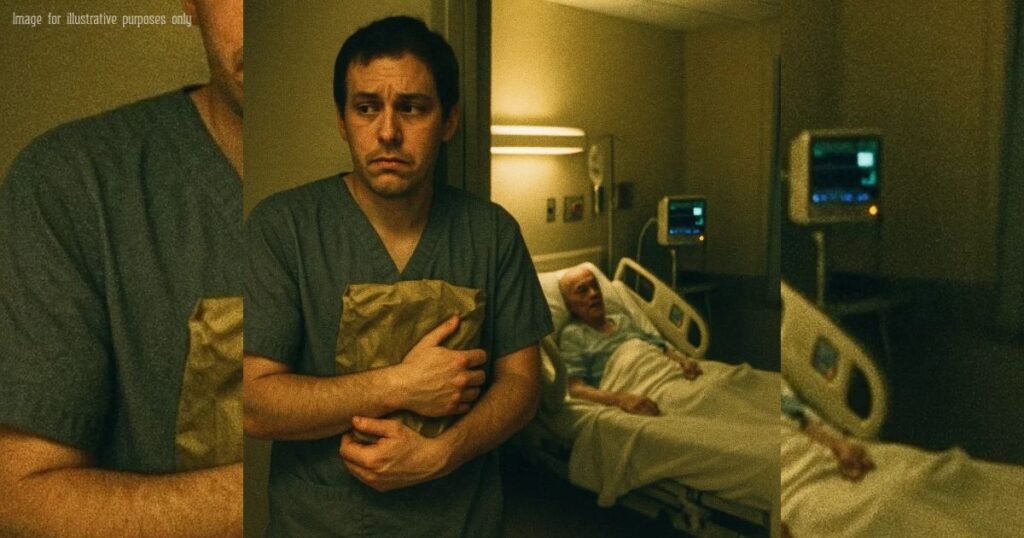
On the night I got written up for smuggling a greasy paper bag into the dementia unit, my boss said, “contraband.”
I just looked at the man in the bed and thought, If this doesn’t work, Mr. Lewis is going to die hungry.
Mr. Lewis hadn’t eaten real food in four days.
On his chart he was a problem list: seventy-nine, advanced Alzheimer’s, “refuses care,” “combative.”
In the bed, he was a retired mechanic who’d spent decades under car hoods so his kids could have easier lives.
The kitchen kept sending the same tray: soft vegetables, bland meat, pale pudding, everything beige and sealed in plastic.
Every time I raised the spoon, he turned his head away, batted my hand, and muttered, “I’m not a baby.”
The doctor talked gently about feeding tubes and “letting nature take its course,” which sounded like giving up slowly.
That Tuesday on night shift, the break room TV shouted about elections and health-care budgets while staff scrolled their phones.
In Mr. Lewis’s room, only the monitor lights glowed, and he talked softly in his sleep.
“Oil change at nine… lunch at twelve… don’t forget the sandwich, Linda…” he whispered, eyes closed, still somewhere else in time.
When he finally settled, I opened the small plastic box his daughter had left in the closet.
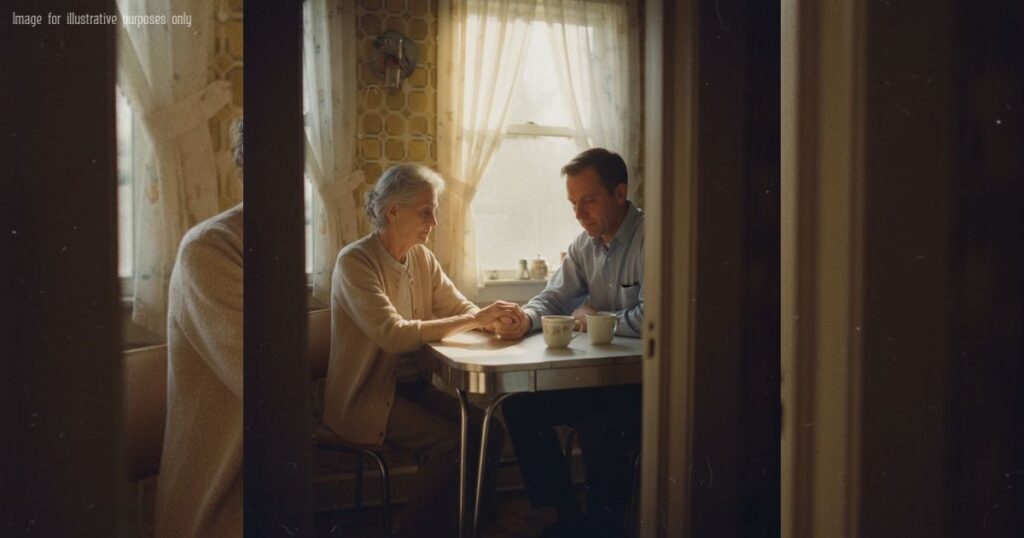
Inside were scraps of his life: a cracked key chain, a church bulletin, a photo of a smiling woman at a kitchen table.
At the bottom was a small stack of folded receipts, yellowed and soft at the edges.
On one, in loopy handwriting, it said, “Don’t skip lunch. Fried bologna, extra mustard. – L.”
I sat there with that thin paper and realized our mistake.
We were forcing him into our schedule, our food, our rules, while his mind lived in another world.
Men like him don’t let strangers spoon mush into their mouths; they open their own lunch box.
At seven in the morning I clocked out, but I didn’t go home.
I drove to a thrift store by the highway and walked the dusty aisles until something red caught my eye.
A dented metal lunch box with a black handle sat under a pile of tools, like it had been waiting.
On the way back to the facility, I stopped at a tiny diner that always smells like coffee and bacon.
I ordered fried bologna on white bread with mustard, nothing “healthy,” just the sandwich promised on that old receipt.
Back at work, I wrapped it in real wax paper, the kind that crinkles and keeps the smell locked in.
I poured hot black coffee into a scratched metal thermos from the back of a cabinet.
Then I copied the message as carefully as I could: “Don’t skip lunch. – Linda.”
At noon, the food cart rattled down the hallway with its beige plastic trays, and I let it pass.
I walked into Mr. Lewis’s room, turned off the TV, and set the red lunch box on his table.
The sharp clank of metal on wood made him flinch; slowly, his eyes focused on the box.
“Lunch break, Lewis,” I said, like I was standing in the doorway of his old garage.
“Linda sent this. Says you’ll need your strength.”
His hand shook as he opened the latch, lifted the lid, and peeled back the wax paper.
The smell of fried meat and mustard pushed the chemical hospital smell out of the air.
He stared at the note, tracing each letter with his thumb as if he could feel her through the ink.
Then he raised the sandwich and took a bite.
Mustard dripped on the blanket, crumbs scattered, but he chewed, swallowed, and took another bite, stronger this time.
His shoulders straightened, and his feet edged toward the side of the bed as if heavy work boots were still on them.
For a few minutes he wasn’t a “difficult patient”; he was a tired man on his lunch break.
That evening his daughter walked in and saw the empty lunch box on the table.
She picked it up with both hands and whispered, “Mom packed his lunch in this for years.”
“Even when money was tight, even when they were mad, she never let him leave without food,” she said, wiping her eyes.
“She always told me, ‘If he leaves the house with a full lunch, he knows I’m with him.’”
For the next two weeks, I kept “breaking protocol” and packing his lunch.
Some days I brought that same sandwich; some days his daughter brought cold pizza, their old Friday-night reward after long weeks.
We always used the red lunch box, and there was always a note with her name.
Mr. Lewis’s lab numbers climbed, but more important, the anger melted from his face.
He slept through the night, cursed less, and one afternoon he looked straight at his daughter and said, clear as day, “Hey, kiddo.”
My supervisor quietly dropped the write-up and joked, “Just don’t document this as ‘bologna therapy,’ but keep doing whatever you’re doing.”
In this country we argue loudly about health care, money, and politics, on every channel and every corner.
Those things matter, but sitting beside that old mechanic taught me something you won’t find on any form.
People are more than their diagnosis, and hunger isn’t only in the stomach.
The people in those beds once fixed cars, cleaned offices, wore uniforms, taught classes, raised kids, paid taxes, and held this place together.
Their memories may twist and tangle, their words may slip away, but the love that carried them through the years runs deeper than disease.
When we care for them now, we’re not just feeding a failing body; we’re honoring the whole lifetime still living inside.
And sometimes the thing that reaches them isn’t a miracle drug or a new machine.
Sometimes it’s just the right sandwich, wrapped the way it always was, carried in by someone who still sees the human being inside the patient.
—
I thought the story ended with a sandwich and a smile, but part two really started the night someone reported the red lunch box.
Three weeks later I came in for night shift and saw a note taped to the computer at the nurses’ station: “Please see charge nurse about non compliant food items in room 214.” Room 214 was Mr. Lewis.
Tasha, the evening charge nurse, held up her phone before I could ask. On the screen was a photo of the lunch box on his table, lid open, half a bologna sandwich inside, mustard on his gown.
Click the button below to read the next part of the story.⏬⏬