Part 2
Monday morning I woke up before my alarm because I kept seeing that poster in my head.
KINDNESS MATTERS.
Big letters. Bright stars. Like it was a promise.
I stood in my kitchen in the blue light of the microwave clock, staring at two foil-wrapped wedges of pepperoni pizza cooling on a paper plate. I’d bought them the night before like a man buying insurance—because something in me didn’t trust the system to do the obvious thing when a child was hungry.
Leo shuffled in wearing dinosaur pajamas, hair sticking up like he’d been electrocuted by sleep.
“Is today pizza day?” he asked, rubbing his eyes.
“Every day is pizza day if your dad’s making bad decisions,” I said, trying to smile.
He grinned, then got serious like seven-year-olds do when they’re holding something too big for their pockets.
“Dad… are they gonna throw it away again?”
That question landed in my chest like a nail.
“I don’t know,” I admitted. “But we’re not doing this like we’re sneaking contraband. We’re doing it like it’s normal.”
I slid the pizza into his lunch bag next to an apple and a little juice box. I also tucked in a folded note on plain paper—no fancy letterhead, no attitude. Just words.
Hi. Leo is bringing extra pizza today. It’s sealed, it’s simple, and it’s meant to share if a classmate doesn’t have lunch. If that’s not allowed, please send it back home instead of discarding it. Thank you.
I signed my name. I wrote my phone number. I tried to make it impossible for a grown-up to choose a trash can without feeling it.
On the drive to school, Leo stared out the window like he was watching a movie he already knew the ending to.
At drop-off, I walked him to the doors. Parents were doing the usual morning choreography—coffee cups, backpacks, quick kisses, quick guilt. Teachers stood by the entrance smiling like they hadn’t been awake since 2009.
Leo squeezed my hand.
“You remember what I said?” I asked.
He nodded. “Be kind.”
“And be honest.”
He nodded again, then stepped forward.
I watched him go inside, small and brave and unaware that he was about to test the character of people twice his size.
I got back in my truck and drove to the jobsite, but my mind wasn’t on drywall. It was on a second-grader and a foil-wrapped piece of pepperoni like it was evidence in a courtroom.
An hour later, my phone buzzed in my pocket.
Unknown number.
I answered with a dusty thumb.
“Mr. Russo?” a woman’s voice said, tight and official. “This is the front office. We need you to come in.”
My stomach dropped the way it had on Friday, but worse, because now I knew what “come in” really meant.
“What happened?” I asked.
There was a pause. Like she was choosing her words so they wouldn’t be used against her later.
“There was… an incident involving outside food.”
Outside food.
Like pizza had hopped a fence.
“I’ll be there,” I said.
I arrived with drywall dust on my jeans again because apparently that was going to be my uniform for these meetings.
In the hallway outside the administrative office, I saw the lunch monitor.
She was sitting on a plastic chair, holding a clipboard like it was a shield. She looked older than she had on Friday. Or maybe I just hadn’t wanted to see her as a person then.
She met my eyes and then looked away.
“Mr. Russo,” she said, not unkindly. “I didn’t want this.”
“Then why is it happening?” I asked.
Her jaw tightened. “Because my job is to follow the procedures.”
That word again.
Procedures.
The cousin of “policy.” The sibling of “liability.” The family tree of everything that makes people stop being human when it’s inconvenient.
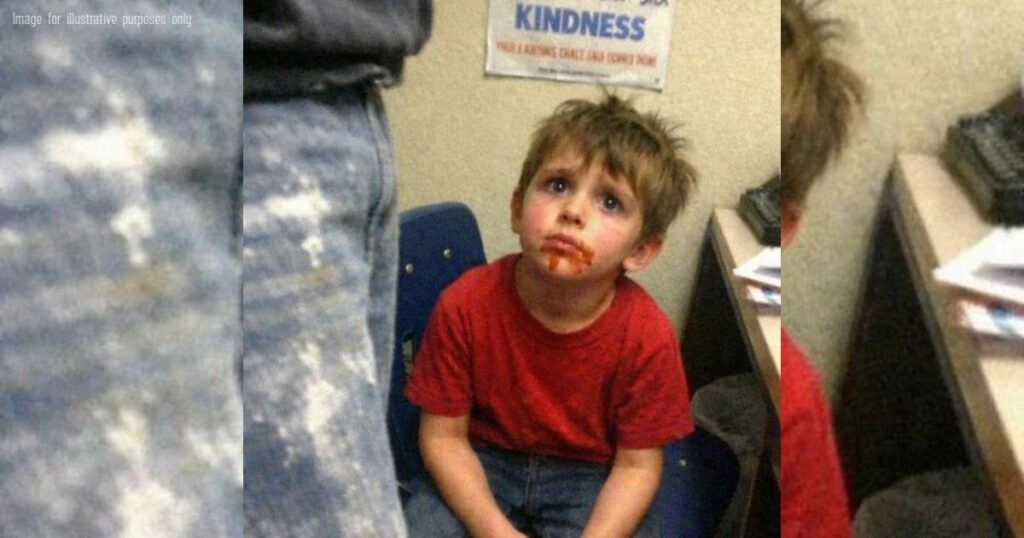
In Vice Principal Miller’s office, Leo sat in the Cool Down Chair again. Same spot. Same folded hands. Different expression.
This time he looked angry.
Not tantrum angry.
Moral angry.
The kind of anger you hope your kid never loses, because once it’s gone, something else moves in.
The vice principal stood by her desk like she’d rehearsed for this.
“Mr. Russo,” she began, “we received your note. We understand your intentions, but we cannot allow food brought from home to be distributed to other students.”
“You can allow it to be thrown away though,” I said.
Her lips pressed together. “We did not throw it away.”
Leo’s eyes snapped to her.
“Yes you did,” he said, loud enough that it echoed off the laminated motivational posters.
The vice principal blinked, caught off guard by a seven-year-old calling her bluff like he’d been paying taxes for thirty years.
Leo’s voice shook, but he didn’t back down.
“They took it from me,” he said. “They said I can’t give it. I said send it back to my dad. They said no. They put it in the bin.”
He turned to me, furious in the way only a child can be—pure, clean, with no pride in it.
“Dad, I did what you said. I was honest.”
I looked at the vice principal.
“I wrote on the note: send it back. Why wasn’t it sent back?”
She glanced at the lunch monitor, who wasn’t in the room, and then at a folder on her desk like the folder could speak for her.
“It was handled according to sanitation protocol,” she said.
“So you threw it away,” I replied.
She exhaled slowly. “Mr. Russo, please understand. If we allow food-sharing, and a child gets sick, or there’s an allergic reaction, or a parent claims—”
“Sam doesn’t have an allergy,” I said.
“I know,” she said quickly. “But we can’t treat one student differently from another. We have to assume. That’s the safest approach.”
Leo muttered, “The safest approach is letting kids be hungry.”
I felt something twist in my chest. Pride and heartbreak at the same time.
I sat down across from her, the way you sit when you’re trying not to stand up and say something that becomes a headline.
“I’m not asking you to ignore allergies,” I said, keeping my voice low. “I’m asking why the rule is built in a way that turns kindness into a violation.”
She opened her hands, palms up, like she wanted to show me she had nothing personal in them.
“Because we’re responsible for everyone,” she said. “Because the school is not a family. It’s an institution.”
That was the most honest thing she’d said.
An institution.
And institutions don’t have hearts. They have policies. They have forms. They have fear.
Leo looked at the big poster behind her desk again.
“I thought the big poster was the boss,” he said, quieter this time.
The vice principal’s face softened for half a second. Then it hardened again.
“Leo will receive a lunch detention,” she said. “And we need you to stop sending extra food intended for other students.”
A lunch detention.
Punished during the very time he’d tried to help.
I stared at her, the way you stare at a door you just realized is locked from the inside.
“You’re detaining him at lunch,” I said slowly, “because he tried to make sure another kid had lunch.”
Her cheeks reddened. “It’s because he disrupted protocol and refused to comply with staff direction.”
There it was.
Compliance.
The word we dress up as virtue when what we mean is obedience.
Leo’s fists clenched in his lap.
“So if I see someone crying,” he said, “I’m supposed to just… eat?”
The vice principal looked like she might cry too, but she didn’t.
Because adults learn early: don’t show feelings in a room with paperwork.
I stood up.
“Okay,” I said. “Then let’s talk about the real problem.”
She blinked. “Excuse me?”
“The real problem isn’t Leo,” I said. “The real problem is that kids are being denied a hot meal, and then the food gets thrown away anyway. That’s not safety. That’s… something else.”
Her posture stiffened. “We provide an alternate meal.”
“The Cheese Sandwich of Shame,” I said before I could stop myself.
Her face flinched. Not because I was wrong, but because I’d named it.
Leo looked at me like I’d just said a bad word.
I took a breath and forced my voice back into something usable.
“How often does this happen?” I asked. “How many kids are ‘in the red’ right now?”
“We can’t share that information,” she said quickly.
“Of course you can’t,” I replied. “Because if people knew, they’d have opinions.”
Her eyes narrowed. “Mr. Russo, are you trying to start something?”
I thought about that question.
Because the truth was, something had already started. Friday started it. A grown woman throwing away a child’s pizza started it. A seven-year-old asking which mattered more—the poster or the rulebook—started it.
“I’m trying to stop something,” I said. “I’m trying to stop kids learning that rules matter more than people.”
She looked away, and for a second she seemed tired. Not evil. Not cruel.
Just exhausted.
“Do you know how many angry calls we get from parents?” she said quietly. “About allergies. About germs. About fairness. About ‘why should my kid’s money pay for someone else’s.’”
Ah.
There it was.
The argument that always shows up like it owns the room.
Fairness.
But not the fairness of children.
The fairness of adults counting points.
“I’m not asking you to pick a political side,” I said, careful, because I’d learned the fastest way to kill a conversation in America is to turn it into a team sport. “I’m asking you to pick a human side.”
That silence again.
That humming air conditioner.
Finally she said, “We have a school board meeting tomorrow.”
I stared at her.
She didn’t look at me when she said it. She looked at the poster.
“You can sign up to speak,” she added.
I didn’t know if she was warning me or inviting me.
Maybe both.
That night, after Leo went to bed, I sat at my kitchen table with my phone in my hand like it was something dangerous.
I wasn’t planning to post anything. I’m not that guy. I work with my hands. My world is nails and tape measures and paychecks that don’t stretch.
But the image of that pizza in the trash wouldn’t leave me alone.
So I wrote the story.
Not names. Not details that would turn into a witch hunt. Just the truth in plain language:
My son got in trouble for sharing his lunch with a hungry classmate. The food got thrown away. There’s a giant poster at the school that says KINDNESS MATTERS. My kid asked why the poster isn’t the boss.
I posted it in a local community group—one of those places where people argue about potholes and lost dogs and whether fireworks are a personality.
Then I put my phone down like I’d just lit a fuse.
Within ten minutes, it started buzzing.
Comments.
Shares.
Messages.
People calling my son a hero.
People calling him “disrespectful.”
People saying, “My kid needs to learn rules.”
People saying, “Your kid learned the right rule.”
One woman wrote, If you can’t afford lunch, don’t have kids.
Another person wrote, If you can afford kindness and still don’t give it, what’s your excuse?
And then the worst part:
Someone wrote, This is why schools are failing. Always catering to the lowest.
I stared at that one for a long time.
Click the button below to read the next part of the story.⏬⏬