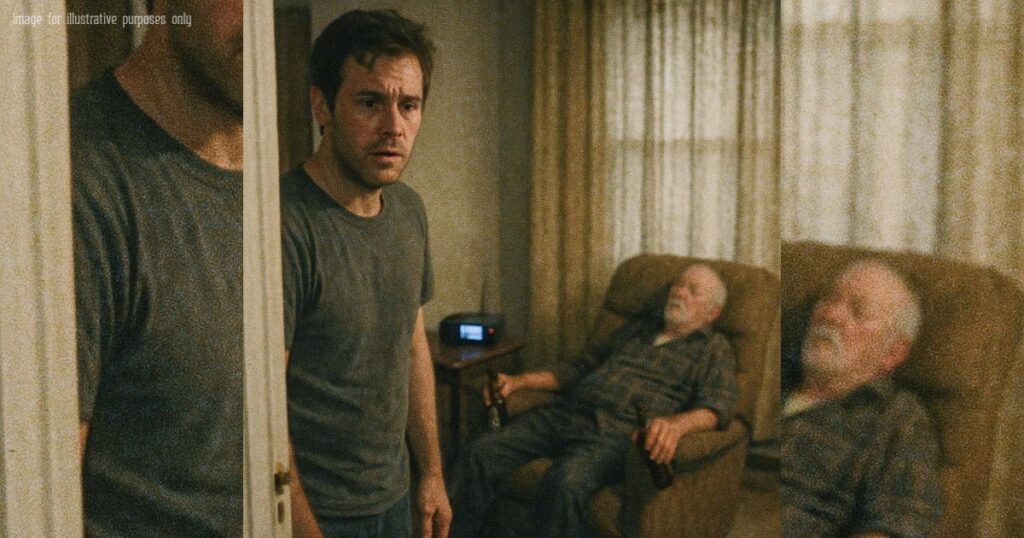
I found my father dead in his recliner, a lukewarm beer in his hand and that damn police scanner screaming static at full volume. I didn’t cry. I just reached over and finally turned it off.
For fifteen years, that noise was the soundtrack of my resentment.
Dad was a retired Fire Captain, a man made of soot, silence, and stubbornness. When Mom passed, he retreated into that chair in our rusted-out rust belt town, spending his days listening to dispatch codes from the county frequency.
I’m an architect in Chicago now. I build glass towers that touch the clouds. I live in a world of silence and precision. I hated coming home. I hated seeing him wasting away, obsessed with a job he left a decade ago, listening to sirens he would never chase again.
“He’s just living in the past, Dave,” I’d tell my wife after phone calls where he barely spoke a word. “He’s an old war horse who can’t accept the war is over.”
I was wrong. I was so arrogant, and I was so wrong.
Three days after the funeral, I was cleaning out the house. The place smelled like pine-sol and old flannel. I grabbed the scanner to toss it into the donation box. That’s when I saw the notebook underneath it.
It wasn’t a scrapbook. It was a log.
Nov 14, 2022 – 2300 Hours. 402 Oak Street. Mrs. Higgins. Furnace failure. Code 4.
Jan 03, 2023 – 0900 Hours. The Miller Boy. Bicycle rim. Code 4.
Oct 12, 2023 – 1400 Hours. Old Man Thompson. Storm debris/Driveway blocked. Code 4.
I frowned. “Code 4” in our county meant “Situation Under Control.” But why was he logging this?
I drove to 402 Oak Street. It was a small, peeling bungalow. Mrs. Higgins answered the door, leaning on a walker. When I told her who I was, her eyes welled up.
“Oh, Jack,” she whispered. “He was a saint.”
“Mrs. Higgins,” I asked, confused. “Did my father… know you?”
“Honey, two years ago, my furnace died in the middle of a blizzard,” she said. “I dialed 911 because I was freezing, but they said it wasn’t a medical emergency and the fire department couldn’t fix heaters. Ten minutes later, your dad showed up. He had his toolbox. He spent four hours in my basement. Got it running. He told me the Department sent him as a ‘special service’ so I wouldn’t feel like a charity case.”
My chest tightened. I drove to the next address. Then the next.
The story was always the same. Dad wasn’t sitting in that chair reliving his glory days. He was monitoring the radio for the calls that slipped through the cracks. The minor emergencies. The things too small for the police, too technical for a social worker, but devastating for a poor family.
A tree down in a driveway? The city takes three days. Dad took a chainsaw and was there in twenty minutes.
A kid’s bike crushed by a hit-and-run? Dad welded it back together in his garage and left it on their porch.
He listened to the static to hear the people the world had stopped listening to.
The funeral was yesterday. I expected a standard “Firefighter’s Farewell”—a few guys in dress blues, the bagpipes, the folded flag.
What I didn’t expect was the standing room only.
The church was packed. Not just with uniformed men, but with people I’d never seen. A young mechanic with a sleeve of tattoos. A single mother holding a baby. An elderly veteran in a wheelchair.
They didn’t know “Captain Miller.” They knew the guy in the flannel shirt who showed up when no one else would.
During the service, the Fire Chief rang the silver bell three times. The signal for the “Last Alarm”—the end of the final shift.
But as the sound faded, I realized something. Dad didn’t just put out fires. He built structures, just like me. But while I built skyscrapers that people looked at, he built safety nets that people could lean on.
I went back to the empty house tonight. I sat in his recliner.
I picked up the logbook one last time. A sticky note fell out of the back. It was in Dad’s chicken-scratch handwriting, addressed to me. He must have written it when he felt his heart starting to give out.
“Dave. If you’re reading this, don’t sell the tools yet. Mrs. Gable down on 5th Street—her porch steps are loose. I heard the dispatch about a delivery guy tripping there last week. I didn’t get to it. You were always good with a hammer.”
I looked at the silence of the room. Then, I looked at the old Uniden scanner.
I reached over and turned it on.
The static hissed to life. A voice cut through the noise: “Dispatch to all units, minor flooding reported on Elm…”
I stood up. I took off my expensive watch and rolled up my sleeves. I grabbed his toolbox.
“Copy that, Pop,” I whispered. “I’m on it.”
The Message:
We often measure a legacy by the wealth we leave behind or the monuments built in our name. But the true measure of a man isn’t how tall he stands; it’s how often he bends down to help someone else up. The world doesn’t need more heroes who want to be seen. It needs more neighbors who are willing to listen.
—
The first night after I turned my father’s scanner back on, I learned something ugly: everyone loves a silent hero—until his kid refuses to stay silent.
I didn’t sleep that night.
I sat in Dad’s recliner with the Uniden balanced on my knee, the green digits burning into my eyes like a clock I couldn’t turn back. The house creaked the way old houses do, expanding and shrinking with the cold. Somewhere in the kitchen the fridge hummed, struggling against age. The logbook lay open on the coffee table, one page ending with his last shaky entry, the sticky note to me still tucked inside.
“Mrs. Gable. Loose steps. You were always good with a hammer.”
Click the button below to read the next part of the story.⏬⏬