The first night after I turned my father’s scanner back on, I learned something ugly: everyone loves a silent hero—until his kid refuses to stay silent.
I didn’t sleep that night.
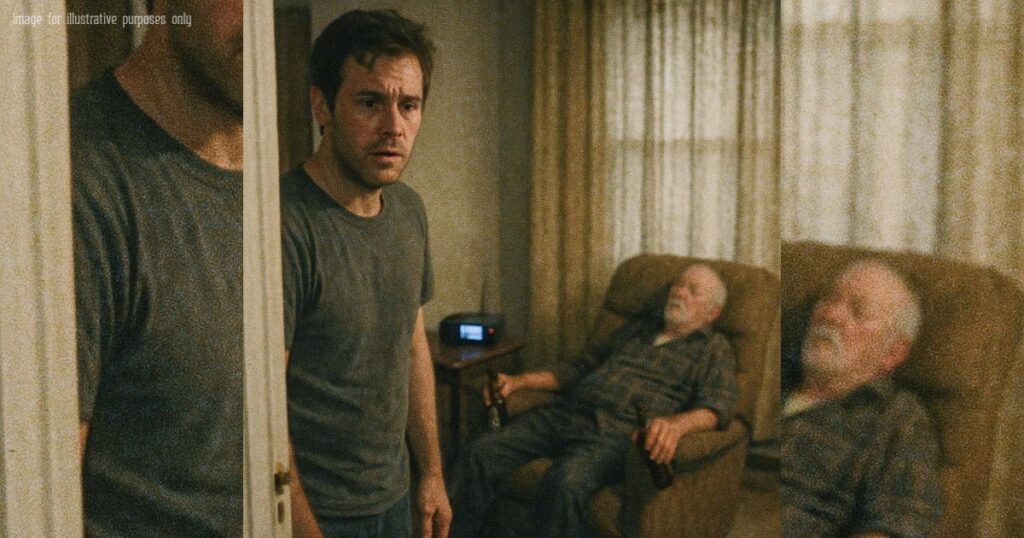
I sat in Dad’s recliner with the Uniden balanced on my knee, the green digits burning into my eyes like a clock I couldn’t turn back. The house creaked the way old houses do, expanding and shrinking with the cold. Somewhere in the kitchen the fridge hummed, struggling against age. The logbook lay open on the coffee table, one page ending with his last shaky entry, the sticky note to me still tucked inside.
“Mrs. Gable. Loose steps. You were always good with a hammer.”
“Yeah, Pop,” I muttered to the empty room. “We’ll see.”
The scanner crackled to life.
“Dispatch, minor flooding reported, basement, Elm and 3rd. Caller reports water up to ankles. No immediate danger. Advise to contact landlord.”
The usual pause.
“Copy. No units available at this time. Logging as informational.”
I stared at the radio. Fifteen years of resentment had trained me to hear that phrase—“No units available”—as an excuse. Now, with Dad gone, it felt like a sentence.
I didn’t remember deciding. One moment I was in the chair. The next, I was pulling on Dad’s old work boots by the door, my architect’s coat layered over his faded station hoodie. His toolbox clanged when I lifted it; the weight surprised me.
Elm and 3rd was only eight minutes away.
The house was a narrow rental with peeling paint and a sagging porch. Floodwater glimmered in the weak streetlight along the curb, turning leaves into floating islands. I could hear voices inside—children, high and anxious.
I knocked.
A tired-looking woman in a T-shirt and flannel pajama pants cracked open the door. Her hair was twisted into a messy bun that had given up the fight hours ago.
“Ma’am?” I said, suddenly realizing how insane this was. “Uh—my name is Dave. My father… used to listen to the scanner. I, um, heard the call.”
Her eyes widened.
“Are you with the department?” she asked, glancing at the hoodie. It still had the faded patch on the sleeve.
I hesitated. “No, ma’am. I’m just… a neighbor. My dad used to help when he could. I’ve got a pump and some tools. I can take a look? No charge. You can tell me to leave. I’ll go.”
Behind her, a little boy peeked out, feet bare, SpongeBob pajamas soaked around the ankles. The air that rushed out from the hallway smelled like wet cardboard and laundry detergent.
The woman’s shoulders dropped. She stepped aside.
“Come in,” she said quietly. “The landlord keeps saying he’ll send someone ‘next week.’ But the rain never waits.”
The basement was worse than I expected. Water shimmered over concrete, swallowing paint cans and Christmas decorations stacked in plastic bins. An old washer and dryer stood like nervous witnesses in the corner.
I waded in, teeth clenching as cold water seeped into Dad’s boots. It was ridiculous—I own tailored suits and Italian shoes in Chicago, and here I was, ankle-deep in somebody else’s basement, holding my dead father’s rusty toolbox like it was a compass.
The little boy watched from the top step, hugging the banister.
“Are you a firefighter like my grandpa?” he asked.
I froze.
“I’m… an architect,” I said. “I build buildings. But my dad? He used to keep them standing when everything went wrong.”
I found the sump pump buried behind storage bins. It was dead, the float switch jammed. I jiggled it loose, checked the outlet, traced the extension cord to an overloaded power strip on a shelf. The kind that would make any inspector faint.
“Do you have another outlet?” I called.
“No,” the woman replied. “That’s it. The landlord says it’s ‘within code.’ Whatever that means.”
I stared at the strip. My inner building-safety brain screamed. I could hear Dad’s voice in my head, low and steady—Solve the biggest problem first. Then argue about the rules.
I unplugged a few things, reset the breaker, cleaned the filter. The pump coughed, sputtered, then roared to life. Water began to whirl toward the drain in a frantic spiral.
The woman exhaled so hard it sounded like she’d been holding her breath for a year.
“Thank you,” she whispered. “I was scared it’d ruin everything. The kids’ clothes… their school stuff…”
I nodded, uncomfortable.
“Look,” I said. “You should still call the landlord. This isn’t a real fix. Just… buys you time. And if the water gets higher, you call 911 again. Don’t wait for… guys like me. I’m not a replacement for actual crews. I’m just trying to do what my dad did.”
She looked at me for a long moment.
“My grandpa used to say the same thing,” she said. “He’d always show up with duct tape and a stubborn attitude. The city always came. Just… later.”
The little boy padded down a few steps, staring at the swirling water.
“I’m gonna be a helper too,” he announced. “Like you. Like your dad.”
I didn’t know what to say to that.
By the time I got back to Dad’s house, my feet were frozen, my jeans streaked with mud. The scanner was still chattering, oblivious to my hero complex.
I dried off, poured myself a coffee that tasted like burned memories, and did something that felt almost ceremonial.
I opened a fresh page in the logbook.
Feb 02, 2025 – 0115 Hours. Elm & 3rd. Basement flooding. Code 4.
My hand shook as I wrote. Dad’s sharp block letters had become my sloppy script. Same notebook. Different man.
My phone buzzed on the table.
It was a text from Amy.
How are you holding up? Kids say hi. When are you coming home?
Good question.
I typed, erased, typed again.
House is a mess. Lots to sort. Need a few more days. Tell them I love them.
I didn’t mention the scanner. Or Elm Street. Or the fact that some deep, rusted part of me felt more awake than I had in years.
Two days later, everything blew up.
It started with another “small” call. A carbon monoxide alarm chirping in a two-family duplex on the edge of town. The dispatcher logged it, advised to “crack a window and contact the landlord or a technician.”
No units were sent. They were slammed with a multi-car accident on the freeway.
The scanner spat out the call, then moved on. But I couldn’t.
“CO alarms aren’t suggestions,” Dad’s voice muttered in my head. He’d drilled it into us as kids. The invisible dangers were always the worst.
So I went.
I brought a portable detector from Dad’s closet of leftover gear and the toolbox, because that’s what I knew how to carry now—wood, metal, guilt.
A young couple and their baby met me at the door, eyes wide, cheeks red from the cold seeping in through open windows. Upstairs, in the other unit, a middle-aged guy in a ripped tank top kept insisting it was “just a bad battery” and that everyone needed to “calm down.”
“My alarm’s been doing that for months,” he said, waving a dismissive hand. “You can’t believe everything these things say. They just want you to buy new ones.”
My detector beeped the moment I crossed the threshold.
Click the button below to read the next part of the story.⏬⏬