Everyone thought my grandfather was being a grinch for sitting alone outside in the freezing snow on Christmas Eve. They were wrong. He wasn’t hiding from the joy; he was guarding it.
The year was 1998. I was twelve years old.
Inside our suburban Ohio home, the scene was perfect. The fireplace was crackling, the smell of honey-glazed ham filled the hallway, and Dean Martin was singing about a “Marshmallow World” on the stereo. My cousins were fighting over the Nintendo 64. My aunts were laughing over wine in the kitchen.
It was loud. It was chaotic. It was warm.
But Grandpa’s leather armchair—the one right next to the fire—was empty.
“Where’s Grandpa?” I asked my dad.
Dad sighed, rubbing his temples. “He’s on the porch, Leo. Just leave him be. He gets like this sometimes. It’s an old man thing.”
But I couldn’t leave him be. I grabbed my coat and a spare wool blanket from the sofa and slipped out the sliding glass door.
The silence hit me harder than the cold.
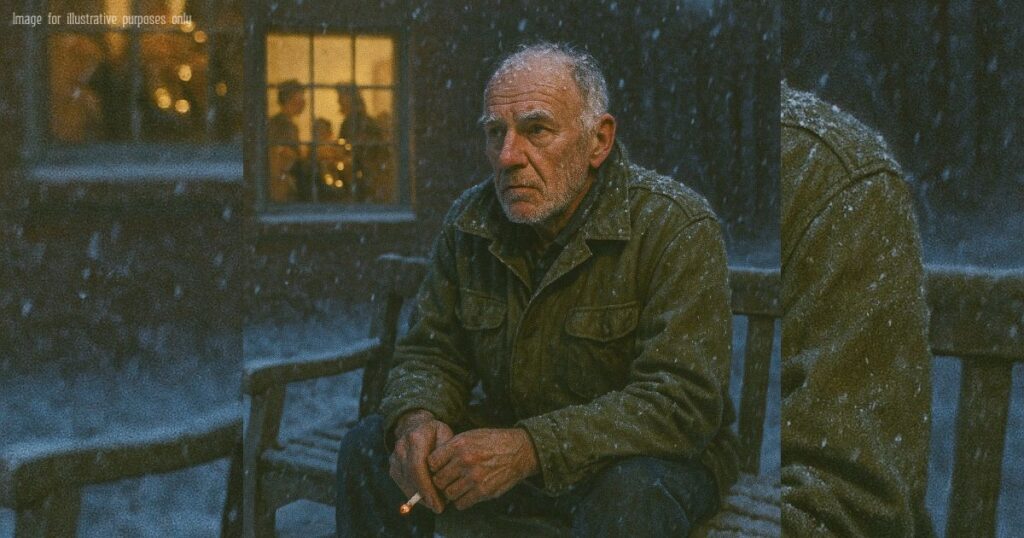
The wind was howling, cutting through my flannel pajamas. And there he was.
Grandpa Frank.
Sitting on a hard wooden bench in the dark. He wasn’t wearing a heavy coat, just his old, faded green field jacket—the one with the patches removed. The glow of a single cigarette illuminated his face. His eyes weren’t closed. They were wide open, scanning the tree line where the backyard met the woods.
He didn’t turn when the door clicked shut.
“Grandpa?” I whispered, my teeth chattering immediately. “It’s ten degrees out here. Come inside. Mom’s cutting the pie.”
He took a long drag, the smoke mixing with the winter steam of his breath.
“Go back inside, Leo. It’s warm in there.”
“That’s why you should come in,” I argued, stepping closer and draping the wool blanket over his stiff shoulders. He didn’t shrug it off, but he didn’t lean into it either.
“Why are you out here?” I asked, sitting next to him. “Everyone is having fun. You’re missing it.”
Grandpa stubbed out the cigarette on the sole of his boot. He stayed silent for a long time. When he finally spoke, his voice sounded like gravel grinding together.
“It’s too quiet, Leo.”
“What?”
“Inside,” he pointed a trembling finger toward the glowing window where my family was laughing. “It’s loud in there. Music. Talking. Eating. Everyone is distracted. Everyone is safe.”
He turned to me, and for the first time, I saw that his eyes were glassy. Not from the cold wind, but from a memory I couldn’t see.
“Christmas Eve, 1950. The Reservoir,” he whispered. “It was colder than this. So cold that the oil in our rifles turned to jelly. We were surrounded. We knew if we closed our eyes, we might freeze, or the enemy might breach the line.”
He paused, rubbing his knuckles—hands that were scarred and tough as leather.
“My buddy, Mitchell… he saw I was shaking. He told me to take five. Said, ‘Frank, close your eyes. Imagine you’re home. I’ll take the watch. I won’t let anything touch you.’ So I did. I slept for maybe an hour. I dreamt of my mother’s kitchen.”
Grandpa’s voice cracked.
“When I woke up, the snow had covered us. I shook Mitchell to wake him up for his turn.”
He looked back at the tree line.
“He didn’t wake up, Leo. He gave me his warmth. He gave me his watch. He died so I could have that one hour of peace.”
I sat there, frozen, the breath caught in my throat.
“Every year,” Grandpa continued softly, “when the house gets warm, and the food is hot, and everyone is laughing… I get scared. I feel like if I relax, if I let my guard down, the cold will come back. Someone has to stay awake, Leo. Someone has to sit in the cold and watch the perimeter so the people inside can sleep without fear.”
He wasn’t a grinch. He wasn’t anti-social.
He was still on duty. Fifty years later, he was still keeping the watch for Mitchell. He was paying back a debt that could never be settled.
I looked at the window again. I saw my dad laughing. I saw my mom happy. I realized for the first time that their joy wasn’t free. It was paid for by men like Grandpa, sitting in the dark, staring down the demons so the rest of us didn’t have to.
I didn’t try to pull him inside anymore.
Instead, I pulled my coat tighter.
“Okay, Grandpa,” I said, settling back against the hard wood of the bench.
“What are you doing, kid?”
“My shift,” I said. “I’ll take the watch for ten minutes. You go inside and get a slice of pie. Mitchell would want you to taste the pie, Grandpa.”
He looked at me. Really looked at me. The hardness in his face softened, just a fraction. He reached out and squeezed my shoulder. His hand was heavy and warm.
“Ten minutes, soldier,” he said.
“Ten minutes,” I promised.
He stood up, groaning as his old knees popped, and walked toward the warmth of the house. But before he went in, he stopped and looked back at me. He gave me a nod. A nod of respect.
The Lesson
We often look at the older generation—our veterans, our grandparents—and wonder why they are hardened, why they are silent, or why they can’t seem to “just relax” during the holidays.
We forget that for us, peace is a birthright.
For them, peace was a purchase. And the receipt was stamped with the names of their friends.
This holiday season, look for the empty chairs. Look for the men and women standing a little too far from the party, watching the door, watching the street.
They aren’t rejecting your joy. They are protecting it.
If you see a veteran this Christmas, don’t just say “Thank you for your service.”
Sit with them.
Listen to them.
And maybe, just for a moment, offer to take the watch so they can finally rest.
To all those who stood in the cold so we could live in the warmth: We remember.
—
Twenty-five years after I took the watch for ten minutes, I broke the promise I made on that bench.
If you read about my grandfather Frank sitting alone in the snow that Christmas Eve in 1998, this is what happened next—long after the snow melted, long after his boots stopped leaving prints in our backyard.
Click the button below to read the next part of the story.⏬⏬