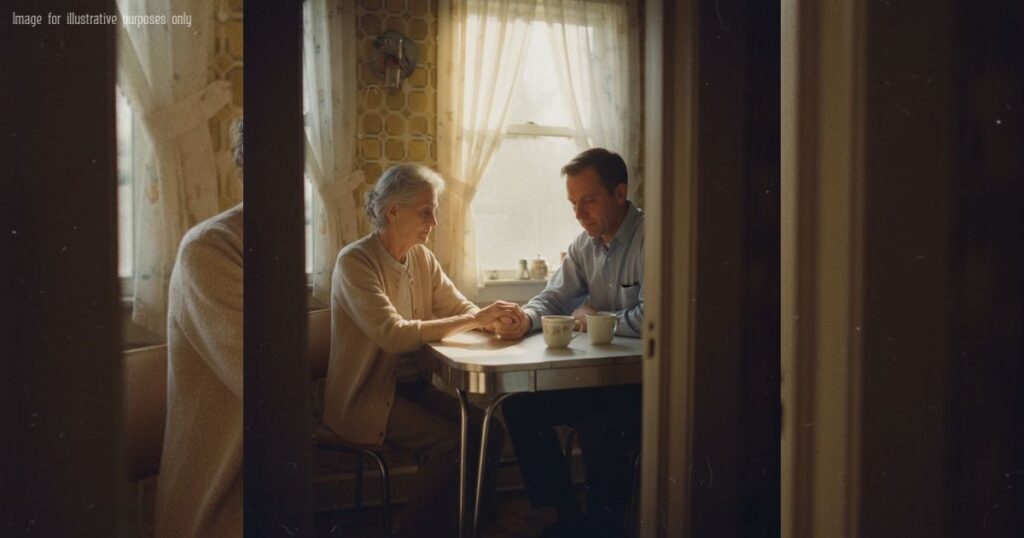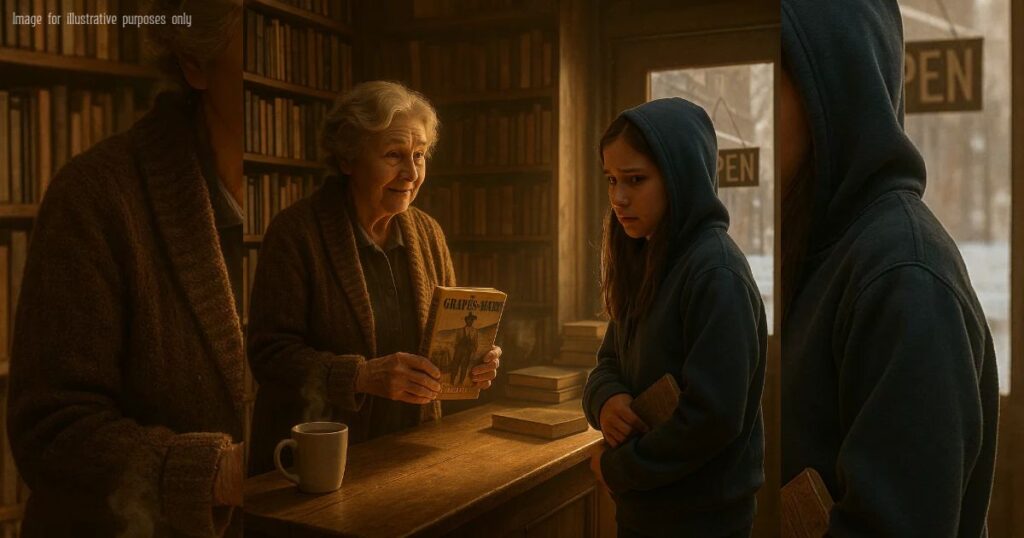
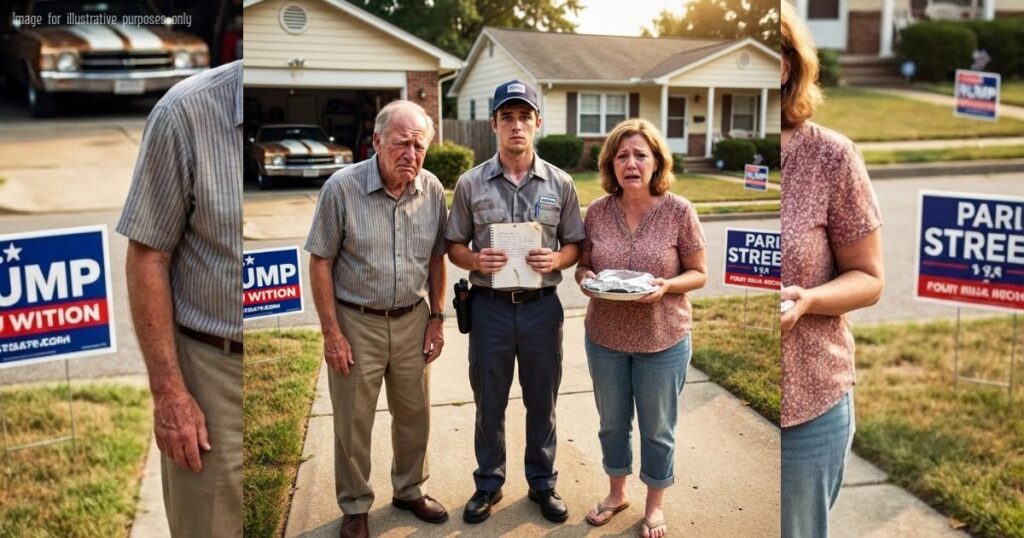
The tracking dot on the Dispatch screen stopped blinking at 2:14 PM. Management thought it was an unauthorized break. It was actually a heart stopping in the middle of Oak Creek Drive.
His name was Arthur. Everyone called him “Old Artie.”
I was the one sent to replace him. I’m twenty-four, fit, and efficient. I don’t limp. I wear noise-canceling earbuds to drown out the barking dogs and the distant highway hum. I treat the route like a video game: scan, drop, photo, run. My numbers are perfect. My “Time Per Stop” is thirty seconds faster than Artie’s ever was.
According to the corporate algorithm, I am a superior employee.
But three days into the route, I realized the neighborhood was broken.
Oak Creek Drive is one of those streets that looks nice from a drone but feels like a cold war on the ground. You know the type. House 402 has a yard full of political signs in bold red. House 404, right next door, has signs in deep blue. They have fences that seem a little too high. They have doorbell cameras that swivel to watch you as you walk by.
Nobody is outside. The porches are empty. The only sound is the whir of air conditioners and the robotic voice of a GPS saying, “You have arrived.”
On my fourth day, I found the notebook.
It was shoved in the back of the glove compartment of the delivery truck, wedged behind a stack of tire pressure logs. It was a cheap, spiral-bound thing, stained with coffee rings and smelling faintly of peppermint and old paper.
I thought it was a list of gate codes. It wasn’t.
It was a manual on how to be human.
Artie hadn’t just been delivering utility bills and catalogs. He had been conducting a silent diplomacy mission in a war zone.
I opened to the page marked Oak Creek Drive.
House 402 (Mr. Miller): Bark is worse than his bite. He yells about “the government” because his wife died last year and the silence in the house scares him. Do not just drop the mail. Compliment his restored Chevelle in the driveway. It’s the only thing he’s proud of.
House 404 (Ms. Hayes): She works from home. Anxious. If you knock too loud, she won’t answer. Wave at the camera. Leave the package behind the planter so the porch pirates don’t see it. She’s raising two kids alone.
House 410: The dog’s name is Buster. He looks mean, but he just wants a biscuit. If you feed him, the owner will finally trust you enough to say hello.
I sat in the idling truck, sweat sticking my uniform to the seat. I looked at my scanner. It was screaming at me to move. Behind Schedule, it blinked.
I looked at House 402. Mr. Miller was standing on his porch, glaring at me with his arms crossed. A “No Trespassing” sign was nailed to the pillar next to his head.
My earbuds were playing a podcast about productivity hacks. I took them out.
I walked up the driveway. I didn’t run.
“Afternoon,” I said.
Mr. Miller grunted. “You’re late. The old guy was never late. Where is he?”
He didn’t know. Nobody knew. In our system, when a worker drops, they are just replaced by a new ID number.
“Artie passed away last Tuesday, sir,” I said softly.
Mr. Miller’s face changed. The anger, which was really just a shield, crumbled. He looked suddenly small. He looked at the empty space where Artie’s truck used to park.
“Oh,” he whispered. “He… he promised to bring me a catalog for car parts today.”
“I don’t have the catalog,” I said, remembering the notebook. “But that Chevelle in the garage? It’s a ’67, right? It’s a beauty.”
Mr. Miller blinked. He stepped off the porch. For the first time, he didn’t look at me like an intruder. He looked at me like a person. “It’s a ’68,” he corrected, a faint smile touching his lips. “Artie liked the chrome trim. He always asked about the transmission.”
As we stood there talking, the front door of House 404 opened.
Ms. Hayes stepped out. She usually waited until the truck was gone to retrieve her mail. But she had heard us. She was holding a small, foil-wrapped plate.
“Did I hear…” she hesitated, standing safely on her side of the property line. “Did you say Artie died?”
Mr. Miller looked at her. Usually, they only communicated through aggressive lawn maintenance and noise complaints.
“Heart attack,” Mr. Miller said, his voice raspy.
Ms. Hayes looked down at the foil plate. “I made cookies,” she said quietly. “It’s his birthday tomorrow. He told me last week he didn’t have any family left to celebrate with.”
There was a silence on the street. It wasn’t the empty, digital silence of the suburbs. It was a heavy, human silence.
“I didn’t know that,” Mr. Miller said. He looked at the woman he had spent five years hating because of the color of a yard sign. “I didn’t know he was alone.”
“He wasn’t alone,” I said, holding up the battered notebook. “He had you guys. He worried about your transmission, sir. And ma’am, he made sure your packages were hidden because he knew you couldn’t afford to replace them.”
I saw the realization hit them. For years, Artie had been the invisible thread stitching this neighborhood together. He absorbed their stress, listened to their rants, and carried their secrets. He crossed the lines that they refused to cross.
Ms. Hayes stepped over the property line. She walked onto Mr. Miller’s driveway.
“I’m Sarah,” she said, extending the plate of cookies. “I think… I think we should eat these. For Artie.”
Mr. Miller hesitated. He looked at his “No Trespassing” sign, then at the woman offering him kindness. He took the plate. “I’m Bill,” he said. “I have some coffee inside. If you want.”
I finished my route that day an hour late. The corporate dashboard flagged me for “Inefficiency.” My supervisor sent a text asking why I was stationary for so long.
I didn’t reply.
I drove past House 402 one last time. The red signs and the blue signs were still there, sticking out of the grass. But on the porch, two people were sitting in rocking chairs, drinking coffee out of mismatched mugs. They were talking.
Artie died on the pavement, but he didn’t leave a void. He left a bridge.
We live in a world that is obsessed with speed. We want same-day delivery, instant downloads, and 15-second videos. We judge our neighbors by their profile pictures and their politics. We think we are connected because we have Wi-Fi, but we are starving for contact.
Artie wasn’t “inefficient.” He was doing the work that machines can’t do. He was slowing down enough to see the people standing right in front of him.
Don’t wait for the funeral to learn your neighbor’s name.
The algorithm doesn’t care if you’re happy. It only cares if you’re fast. But life isn’t about how fast you run the route. It’s about who you stop for along the way.
Slow down. Look up. Say hello.
— –
PART 2 — The Stop That Broke the Algorithm
If you’re reading this and you missed Part 1: a delivery driver named Arthur—“Old Artie”—died mid-route on Oak Creek Drive, and the only thing he left behind wasn’t money or a legacy post online.
It was a beat-up notebook.
A manual on how to treat strangers like neighbors in a street that had turned into a quiet civil war.
And I was the replacement the algorithm chose.
Click the button below to read the next part of the story.⏬⏬