PART 2 — The Stop That Broke the Algorithm
If you’re reading this and you missed Part 1: a delivery driver named Arthur—“Old Artie”—died mid-route on Oak Creek Drive, and the only thing he left behind wasn’t money or a legacy post online.
It was a beat-up notebook.
A manual on how to treat strangers like neighbors in a street that had turned into a quiet civil war.
And I was the replacement the algorithm chose.
The next morning, my supervisor called me into the “Performance Pod,” which is what management calls a glass room with a tablet bolted to the wall.
Her name was Kara. Late thirties. Tight bun. Coffee that smelled burnt. She didn’t look evil. She looked tired in a way that doesn’t get fixed by sleep.
She didn’t ask how my route was going.
She turned the tablet toward me like a judge sliding evidence across a bench.
A line graph spiked like a heart monitor.
Stationary Time: Oak Creek Drive.
Duration: 00:57:12.
Cause: Unknown.
“We got a flag,” she said.
Her voice was calm, like she was explaining weather.
“We didn’t get a flag,” I corrected before I could stop myself. “A man died. I told Mr. Miller.”
Kara blinked once. Not surprise—more like a brief pause while her brain searched for a button that didn’t exist.
“I’m sorry,” she said automatically. “That’s… unfortunate.”
Then she tapped the screen again.
“Do you know what this looks like in the system?” she asked. “It looks like an unauthorized break.”
“It wasn’t a break.”
“It was a break,” she said, still calm. “By definition. You were stationary.”
I stared at the graph. The coldness of it didn’t come from cruelty. It came from distance.
A line didn’t know the difference between grief and laziness.
Kara swiped to another screen.
Time Per Stop: my average had climbed.
Thirty seconds turned into forty-five. Forty-five turned into sixty.
The system didn’t call it talking to a widower.
It called it route degradation.
“You’re new,” she said. “So I’m going to give you a clean warning. We do not linger. We do not socialize. We do not enter any home. We do not accept food. Liability.”
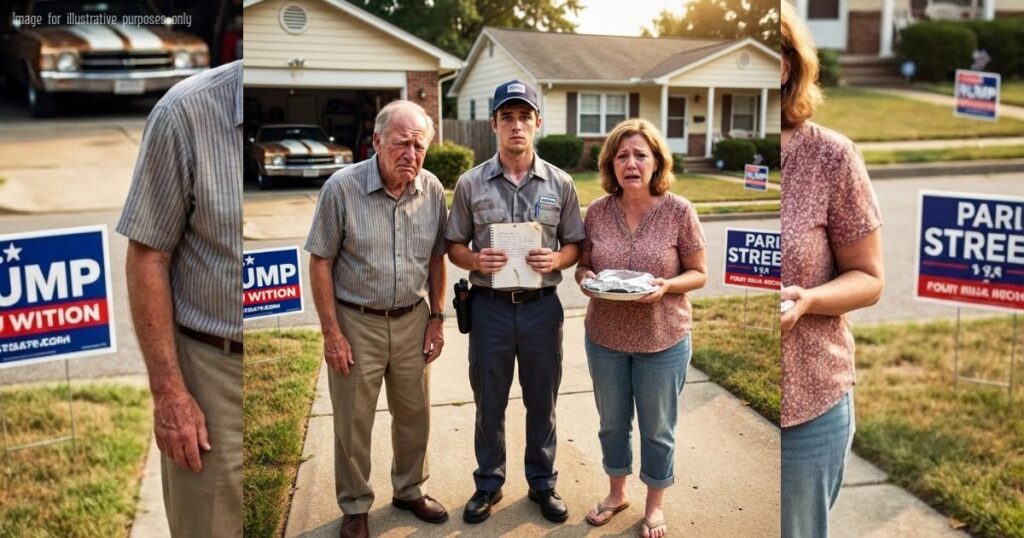
“She baked cookies for Artie,” I said.
Kara’s mouth tightened.
“And I’m sure they were delicious,” she said. “But our policy is clear.”
I could feel the notebook in my bag like a brick.
Artie had written down names like they mattered.
The company wrote down minutes.
Kara leaned forward. “I need you to understand what happened last week,” she said. “The moment you do anything outside the script, you become the story. And stories come with risk.”
“Artie became a story,” I said. “He died and got replaced by a new ID number.”
Kara flinched at that. A real flinch.
For a second, she looked like she wanted to say something honest.
Then her eyes slid back to the screen.
“I’m not your enemy,” she said quietly. “But the system doesn’t care that you’re trying to be… nice. The system cares about consistency.”
I wanted to ask her if she knew Artie.
If she’d ever said his name out loud.
But the room was glass, and behind the glass people walked fast with their heads down, like they were inside a clock.
Kara stood up. “One more thing,” she said. “Oak Creek Drive has a high complaint rate. Cameras. Neighborhood apps. Everybody thinks everything is theft or trespassing.”
She tapped the tablet and a line of text appeared.
NEW GUIDELINE: “NO-CONTACT DELIVERY” — OAK CREEK ROUTE.
“You wave,” she said. “You drop. You go.”
That was it.
A rule to fix a neighborhood.
A rule written by someone who’d never sat on a porch with a widower holding a plate of cookies meant for a dead man’s birthday.
On the drive back to the route, I tried to do what I used to do: drown it out.
Earbuds in.
Podcast on.
Some guy telling me how to optimize my mornings, as if life is just a spreadsheet you haven’t formatted correctly.
But at a stoplight, I saw myself in the rearview mirror.
Twenty-four. Smooth skin. Clean uniform. A face that had never had to fight for anything besides a better GPA.
And behind my eyes, something had changed.
Because once you see how lonely a nice neighborhood can be, you can’t unsee it.
Oak Creek Drive greeted me the way it always did: curtains like eyelids, doorbell cameras like tiny black pupils, signs like warnings.
The red ones.
The blue ones.
The ones that screamed KEEP OUT in polite fonts.
House 402 was quiet.
House 404 had a new wreath.
And House 410—Artie’s note said Buster—had a dog pressed against the fence like he’d been waiting for me specifically.
Buster wasn’t a cute dog.
Buster was a scarred block of muscle with a notched ear and a stare that made people cross the street.
Artie wrote: He wants a biscuit. If you feed him, the owner will finally trust you enough to say hello.
I stood at the curb with a package in my hand and Kara’s words in my head.
No-contact.
Wave. Drop. Go.
Buster let out a low, disappointed sound, like he could sense the rulebook hovering over me.
I looked at the camera mounted above the porch light.
I lifted my hand. A small wave.
Then I did something that wasn’t in the script.
I reached into my pocket and pulled out a plain biscuit I’d bought that morning at a generic grocery store.
Nothing fancy. Nothing special.
Just a small circle of trust.
Buster’s eyes softened.
He took it like I’d handed him a secret.
Behind the screen door, someone shifted.
A woman’s voice called, “Buster?”
The door opened a crack.
A tired face appeared. Late fifties. Grease under her nails like she worked with her hands. Not a porch person. A survival person.
She saw me. Saw the biscuit crumbs. Saw Buster wagging like he’d forgotten how.
Her gaze flicked to the camera, then back to me.
“You shouldn’t feed other people’s dogs,” she said.
It wasn’t angry.
It was wary.
Artie’s handwriting suddenly felt like a hand on my shoulder.
“I’m sorry,” I said. “Artie told me he likes biscuits.”
Her eyebrows pulled together. “Artie told you that?”
Click the button below to read the next part of the story.⏬⏬