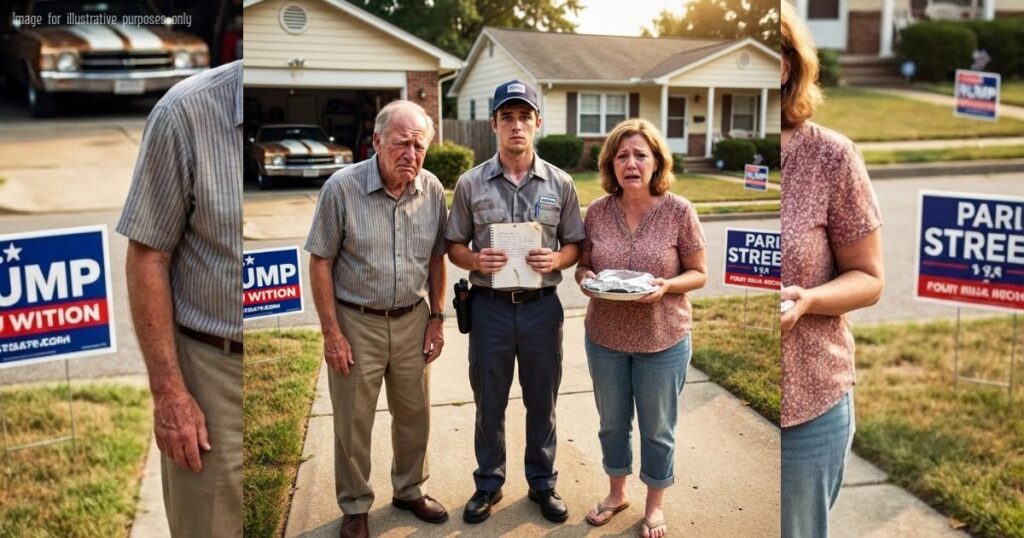
“He wrote it down,” I said, and for a second I almost pulled the notebook out like proof of human decency.
But I remembered Kara’s screen.
Liability.
So I just shrugged, small.
“He was… good at noticing things,” I said.
The woman stared at me for a long moment.
Then she said, softer, “He was the only person who called me by my first name.”
I swallowed. “What is it?”
She hesitated like the answer mattered.
“Lena,” she said.
“Hi, Lena,” I said. “I’m—”
“My mail carrier,” she cut in, but there was a flicker of something else in her eyes. Something like relief she didn’t want to admit.
Buster leaned against the fence, satisfied, as if he’d accomplished his mission.
I scanned the package.
I took the photo.
I started to walk away.
Then Lena said, almost like she hated the words as they left her mouth, “Artie—he… he told me he was scared of dying where nobody would find him.”
I stopped.
The street felt suddenly smaller.
Like Oak Creek Drive had ears.
I turned back. “Did he say that?” I asked.
She nodded. “He joked about it. But it wasn’t a joke. He said sometimes he felt like the neighborhood didn’t see him. Like he could fall and the system would just… reroute around him.”
I felt something hot behind my eyes.
I forced my voice steady. “He was seen,” I said.
Lena looked past me, down the street.
“Then why did he die alone?” she asked.
That question hung there like smoke.
And it was the kind of question people love to argue about online, because nobody has to answer it with their actual life.
By lunchtime, I had already been flagged twice.
Not by Kara—by the neighborhood.
A notification popped up on the company device:
CUSTOMER REPORT: “Driver lingering at 410.”
CUSTOMER REPORT: “Driver interacting with resident.”
Interacting.
Like I was a virus.
I kept moving, but my chest felt tight.
House 402 had Bill on the porch again. Mr. Miller. The widower with the “No Trespassing” sign and the old muscle car he loved like a memory.
Sarah from 404 was there too, holding a travel mug.
They nodded at me like we were part of something now.
Not friends, exactly.
But not enemies.
Bill lifted his mug in a small salute.
Sarah smiled, tired but real.
And across the street, a different curtain twitched.
A different camera adjusted.
Someone watching the watchers.
Two days later, the neighborhood group chat exploded.
Not because of politics.
Not because of a sign.
Because packages started going missing.
It began small. A padded envelope. A toy. A box of pantry items.
Then it grew.
“Porch pirates” is what people call it, like it’s a funny nickname for someone stealing from your front steps.
But it isn’t funny when you’re a single mom replacing groceries with hope.
It isn’t funny when an elderly man is waiting on medication.
The comments—those invisible, weaponized little sentences—spread like gasoline.
“It’s always someone from outside.”
“It’s probably one of the drivers.”
“I caught a guy in a hoodie.”
“I saw a car I didn’t recognize.”
“This neighborhood is going downhill.”
That last one is the kind of phrase that looks harmless until you realize what people usually mean by it.
I pulled up to House 404 and Sarah met me at the property line like she’d been waiting.
Her eyes were red, not crying—angry.
“They’re saying it’s the drivers,” she said.
“They?” I asked.
She held up her phone like it was evidence. “The group. The chat. The neighborhood app. Everybody’s suddenly a detective.”
I didn’t look at the phone. I didn’t need to.
I knew how this story goes.
Something goes wrong, and people don’t want solutions.
They want suspects.
“I hide your packages like Artie did,” I said. “You know that.”
“I know,” Sarah said, voice tight. “But half the street doesn’t. They don’t know you. They don’t know your name. They don’t even know Bill’s name until someone dies.”
She exhaled like she was trying not to scream.
“And now there’s this guy—House 408—posting clips from his door camera like he’s running a trial.”
House 408.
Artie’s notebook had a note there too.
408: Mr. Greer. Thinks the world is stealing from him. Sees danger everywhere. Speak calmly. Never argue. He wants control.
I felt my stomach drop.
Because the moment someone posts video, the algorithm doesn’t just track packages.
It tracks people.
That afternoon, Kara texted me a single line:
CALL ME. NOW.
When I got back to the depot, she was already in the glass room, tablet lit up.
She didn’t make me sit.
She played the clip.
It was me on Lena’s walkway at 410.
It was grainy. No sound. Just my body turning slightly toward the door.
A pause.
A hand gesture that could have been anything.
The caption underneath—typed by someone who didn’t know my name—said:
“DRIVER LURKING. WATCH YOUR PACKAGES.”
Kara’s face was pale.
“They posted it?” I asked.
“It’s already being shared,” she said. “And before you say it—yes, it’s unfair. But unfair goes viral faster than truth.”
I stared at the paused image of myself on the screen.
In the video, I looked guilty.
Because the camera decided I was.
Kara lowered her voice. “This is exactly what I warned you about,” she said. “No-contact. No lingering. No side conversations. You are not paid to build community.”
I heard Artie’s voice in my head, even though I’d never heard it in real life.
If you feed the dog, the owner will finally trust you enough to say hello.
Trust.
The thing that made a neighborhood feel like a place instead of a prison.
Kara exhaled. “One more incident,” she said, “and you’re done.”
“Done,” I repeated.
She nodded. “Terminated.”
She said it like the weather again.
Like a forecast.
And maybe to her, it was.
Because in the system, people were interchangeable.
But on Oak Creek Drive, Artie’s absence still sat in the air like a missing tooth.
You felt it every time you tried to chew through the day.
That night, I couldn’t sleep.
I kept thinking about the clip.
About strangers in comment sections deciding who I was from eight seconds of silent footage.
About how easy it is to be judged when nobody knows your name.
So I did something I’d never done before.
I wrote.
Not a complaint. Not a rant.
A letter.
I didn’t post it under the company name. I didn’t name the company at all. I didn’t name the neighborhood app. I didn’t attack anyone.
I just told the truth as carefully as I could.
I wrote about Artie.
I wrote about Bill and Sarah sitting on a porch with mismatched mugs.
Click the button below to read the next part of the story.⏬⏬