I wrote about a scarred dog named Buster who wanted a biscuit more than he wanted to be feared.
I wrote one sentence that felt like a match striking:
“If your system collapses because someone takes sixty seconds to say hello, the system isn’t efficient—it’s fragile.”
Then I stopped.
Because I could already hear the arguments forming.
“Do your job.”
“Mind your business.”
“This is why packages are late.”
“We’re not responsible for your feelings.”
“Drivers aren’t social workers.”
“We need connection.”
“We need privacy.”
“We need both.”
Controversy isn’t always screaming.
Sometimes it’s two truths that don’t fit in the same sentence.
The next day, something happened that Artie’s notebook didn’t prepare me for.
House 402’s door was open.
Bill’s “No Trespassing” sign was still there, but the door was open anyway, like the house had forgotten its own rules.
I walked up slowly.
“Bill?” I called.
No answer.
Then I heard it—a low, strained sound.
Not pain exactly.
Fear.
I stepped to the threshold and stopped. Kara’s policy flashed in my head.
No entry.
No liability.
But a man’s voice was inside, and it sounded like it was breaking.
“Bill?” I said again, louder.
From the living room, he answered, thin: “Here.”
I didn’t go in.
I stayed at the doorway, hands visible, like I was approaching a skittish animal.
Bill was on the couch, hunched, one hand on his chest, the other gripping a framed photo so tightly his knuckles were white.
His face wasn’t the red anger he wore like armor.
It was raw.
“I’m fine,” he said, automatically.
People say that even when they’re drowning.
“What’s going on?” I asked.
He swallowed hard. “It’s… stupid,” he whispered.
“It’s not stupid if it’s making you breathe like that,” I said.
He laughed once, bitter. “My wife’s birthday was today,” he said. “Artie used to remind me. He’d say, ‘Don’t be a tough guy all day, Bill. Go buy the flowers.’”
His eyes were wet and furious at himself for it.
“And now,” he said, voice cracking, “there’s nobody to remind me. And I forgot. And I hate myself for forgetting.”
I stood there at the threshold, not crossing the line, not leaving either.
The package in my hand suddenly felt ridiculous.
A cardboard box while a human being fell apart.
“You didn’t forget her,” I said. “You’re remembering her so hard it hurts.”
Bill stared at me like he didn’t know what to do with that.
And then, from behind me, a voice said quietly, “Bill?”
Sarah.
She’d come over.
She walked up the driveway, crossing property lines the way she had the day of the cookies, like she was learning a new kind of bravery.
Bill didn’t answer at first.
Then he whispered, “I don’t want to be alone today.”
Sarah nodded once. “Then don’t be,” she said.
The simplicity of it knocked the air out of the moment.
No speeches.
No politics.
Just a human offering.
From the doorway, I glanced at the street.
Curtains twitched.
Cameras watched.
But something else watched too.
Something older than surveillance.
Something like conscience.
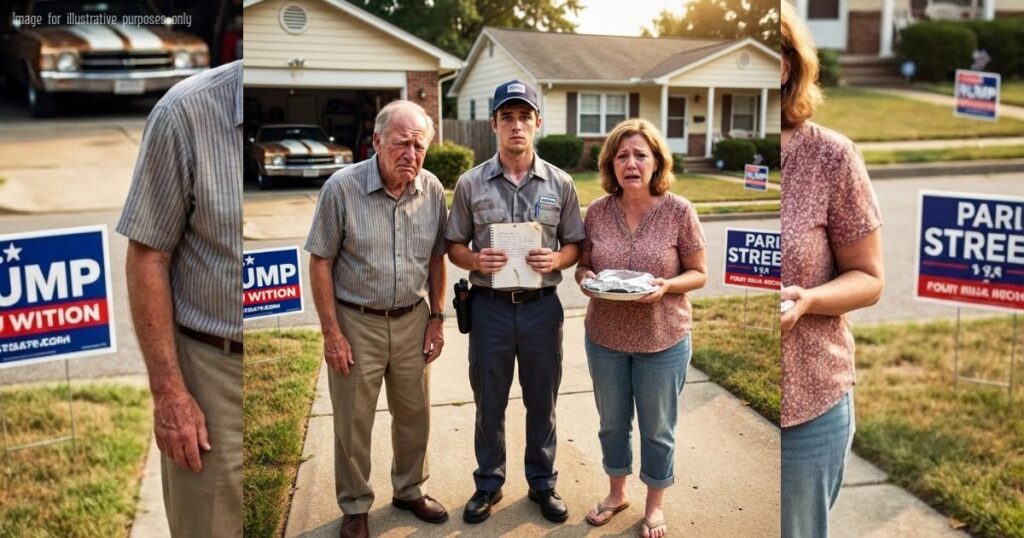
Two days later, Oak Creek Drive held a memorial for Artie.
Not a formal funeral. Nobody knew where his body had gone, not really. The company had handled it like paperwork.
But the neighborhood—the one that pretended it didn’t need anyone—organized anyway.
They set up folding chairs in Bill’s driveway.
They put out a table with coffee and cookies and a cheap bouquet someone had bought last-minute at a generic store.
Lena from 410 came with Buster on a leash, the dog solemn like he understood.
Sarah brought her kids. They held handmade cards.
Even people I’d never seen outside their houses came out and hovered at the edges, unsure if grief required a password.
And then something happened that turned the memorial into a fire.
Mr. Greer from 408 showed up.
He stood by his hedge like he was attending a trial, not a tribute.
He held up his phone.
I could see the red recording dot.
“Are you filming?” Sarah asked, her voice sharp.
Greer didn’t lower the phone. “People deserve to know what’s going on,” he said.
“What’s going on is we’re honoring a dead man,” Bill snapped, the old anger coming back to protect the softer parts.
Greer shrugged. “It’s public,” he said. “This is my property line. And I’m not comfortable with strangers gathering.”
Lena’s jaw clenched. “Artie wasn’t a stranger,” she said. “He knew your dog’s name. He knew your wife’s allergy. He knew your security system glitches at night.”
Greer’s face tightened. “That’s exactly the problem,” he said. “He knew too much.”
A ripple moved through the crowd.
There it was.
The conflict that defines so much of America right now, but nobody wants to say it out loud:
Do we want to be known?
Or do we want to be safe?
Sometimes people act like you can’t have both.
I felt Kara’s rulebook in my pocket like a shackle.
Click the button below to read the next part of the story.⏬⏬