No-contact.
No lingering.
No side conversations.
But Artie had lingered.
Artie had known.
Artie had built a bridge in a place that was terrified of crossing anything.
Sarah stepped forward. “You think a man delivering packages was your threat?” she asked, voice shaking with anger. “Not the person stealing off our porches? Not the fact that we don’t even recognize each other’s cars anymore? Your threat is… someone saying hello?”
Greer’s phone stayed up. “This is exactly what I mean,” he said. “It turns into drama. People bring their issues into my neighborhood.”
Bill laughed—hard, ugly. “Your neighborhood?” he said. “You didn’t build this street. You just moved in and installed cameras like you’re guarding a vault.”
Greer’s eyes flashed. “At least I’m not sitting on my porch judging people by the color of a sign,” he shot back.
The crowd sucked in air.
That line landed like a slap.
Because it wasn’t entirely wrong.
And that’s what makes people furious.
Truth that hurts is gasoline.
I saw phones rise.
The memorial was turning into content.
And content turns into comments.
And comments turn into war.
Before it could get worse, Sarah’s youngest kid—maybe eight—stepped forward holding a card.
His voice was small but clear.
“My mom says Artie was nice,” he read, stumbling over the words. “He hid our boxes. He waved at me. I didn’t know old people could be funny until he told me jokes.”
Silence fell.
Not the empty suburban silence.
The human kind.
The kind that makes you remember you’re not an avatar.
Greer’s phone lowered a fraction.
Bill swallowed hard, looking like he’d been punched somewhere deeper than pride.
Lena squeezed Buster’s leash.
And I realized something terrifying:
It wasn’t Artie who made the bridge.
It was the choice to step onto it.
After the memorial, as people folded chairs and wiped cookie crumbs off paper plates, Kara’s text popped up on my device again.
WHERE ARE YOU.
I didn’t answer.
I watched Bill help Sarah carry the coffee pot inside.
I watched Lena kneel beside Buster and press her forehead to his.
I watched Greer stand by his hedge, uncertain now, like he’d walked into a story he didn’t know how to exit.
And I thought about Artie dying alone on the pavement while the system rerouted around him.
Then I thought about something even worse:
How many people are alive right now, in nice houses, on quiet streets, dying slowly in silence while the algorithm calls it normal.
Not dramatic enough for news.
Not profitable enough to fix.
Just… efficient loneliness.
I pulled Artie’s notebook from my bag and flipped to the last page.
I hadn’t looked that far yet.
On the last page, in shaky handwriting, he’d written one sentence.
“If I go first, tell them they were never enemies. They were just strangers who got scared.”
My throat tightened.
Artie didn’t leave a legacy.
He left instructions.
And suddenly, the “controversial” part wasn’t red vs. blue or signs vs. cameras.
It was this:
We’ve built a country where being a good neighbor feels suspicious.
Where slowing down feels like rebellion.
Where saying hello can get you reported.
Where a man can be labeled “inefficient” for preventing a street from turning into a bunker.
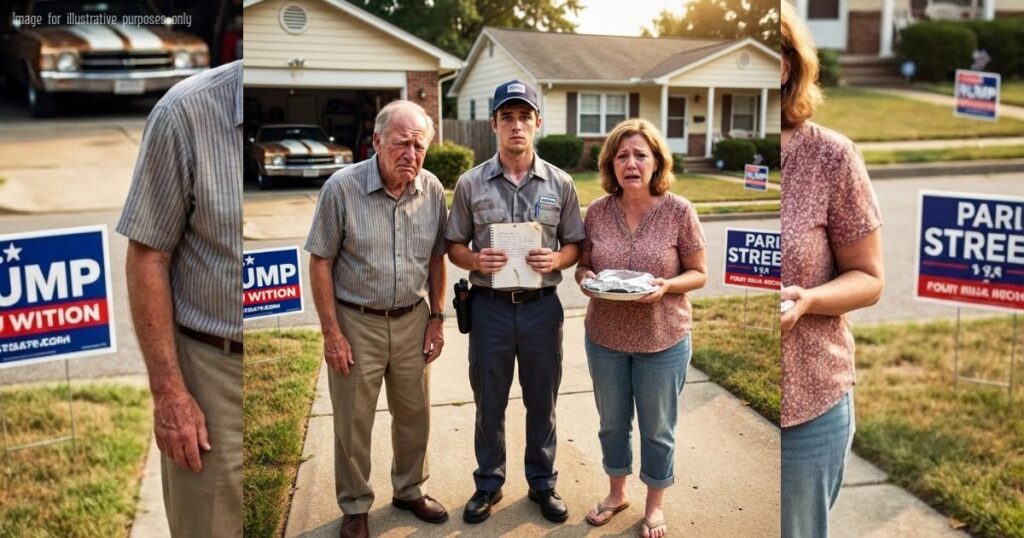
I looked up at Oak Creek Drive—at the fences, the cameras, the signs, the closed doors.
Then I made my decision.
I opened the company device.
I didn’t write a rant.
I wrote one line into the route notes—something no one in management had asked for, and everything in Artie’s notebook demanded:
“Stop. Look up. Learn one name today.”
Then I hit save.
I didn’t know if it would get me fired.
I didn’t know if anyone would ever see it.
But I knew this:
The algorithm can track a package to your porch.
It can’t track what happens when you finally open your door.
And if that makes people argue in the comments—good.
Let them argue.
Because the real danger isn’t disagreement.
The real danger is a street full of houses where nobody knows who would notice if they disappeared.
At the end of the day, I drove past House 402.
Bill was on the porch.
Sarah was there too.
This time, Greer from 408 stood on his own walkway, phone in his hand, not recording—just holding it, unsure.
He looked at them.
They looked back.
For a second, nobody moved.
Then Bill lifted his mug, small and stubborn.
Not a surrender.
Not an apology.
Just a signal.
A human one.
Greer hesitated.
And then—barely—he nodded.
A tiny bridge.
Not enough to go viral.
Not flashy.
But real.
And real is the only thing that lasts longer than the comment section.
Because if you can’t spare sixty seconds to be human… what exactly are you optimizing your life for?
Thank you so much for reading this story!
I’d really love to hear your comments and thoughts about this story — your feedback is truly valuable and helps us a lot.
Please leave a comment and share this Facebook post to support the author. Every reaction and review makes a big difference!
This story is a work of fiction created for entertainment and inspirational purposes. While it may draw on real-world themes, all characters, names, and events are imagined. Any resemblance to actual people or situations is purely coincidenta