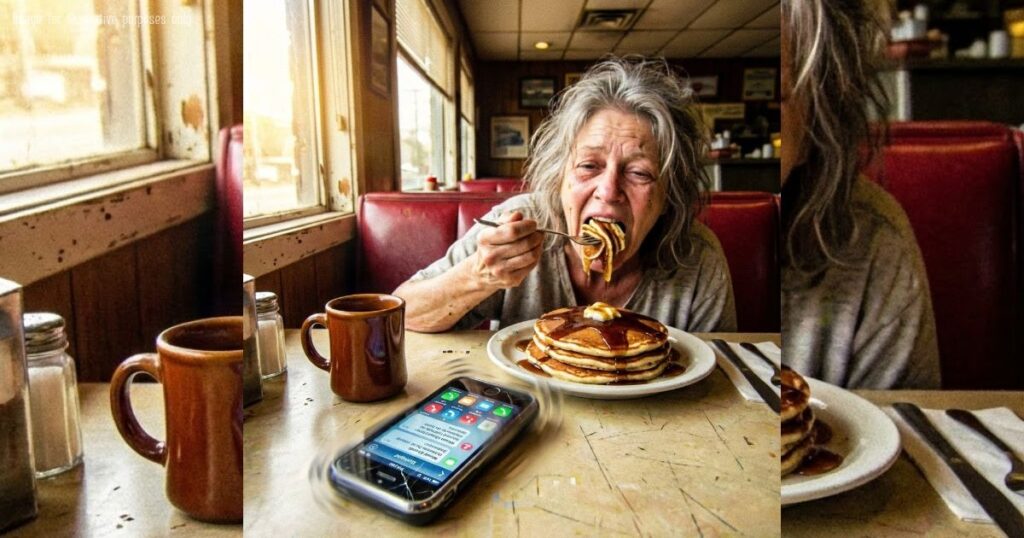
By the time I finally pick up my phone, my pancakes are cold and my daughter is hot with anger.
If you read Part 1, you already know: I’m the “boring” grandma who makes lunches, does school pick-up and got quietly replaced at a birthday party by a shiny tablet and a twice-a-year “Fun Grandma.” This morning, for the first time in seven years, I simply didn’t show up.
“Mom, what is going on?” Sarah explodes the second I answer. No hello. “The kids are freaking out. Leo cried when you didn’t pull into the driveway. I have a meeting in ten minutes. You can’t just disappear like this!”
Once upon a time, that sentence would have sent me lunging for my car keys, apologizing before I even knew what I was apologizing for.
Today, I stir my coffee.
“I didn’t disappear,” I say. “I’m at a diner. I’m having breakfast.”
There’s a beat of silence.
“You’re… what?”
“Having breakfast,” I repeat. “By myself. On purpose.”
She lets out a harsh little laugh. “Are you serious right now? Mom, we rely on you. Mark has a presentation, the kids need rides, you can’t just decide you’re on strike.”
“I’m not on strike,” I answer. “I’m retired. I just forgot to tell everyone.”
“That’s not funny,” she snaps. “You know our life doesn’t work without you.”
That’s the problem, I think. Their whole life is built on the assumption that I will bend before anything else does.
“You have two parents,” I say gently. “And two grandmothers. One of them flies in with big gifts. One of them has been running a full-time, unpaid childcare and housekeeping service. I’m that one. Or I was.”
“It’s not that simple,” she says. “Everything is expensive. Childcare waitlists are months long. If I say no at work, I look irresponsible. If I say no at home, I’m a bad mom. I thought we were on the same team.”
“We are,” I say. “But teammates don’t let each other play on a broken ankle.”
She is breathing hard on the other end. I picture my usual spot in her kitchen, empty. My coffee mug still in the cabinet, untouched.
“You told me you’d always be there,” she says, softer now. “When I had Sarah, you said, ‘You’ll never be alone.’”
“I said I would love you and your children,” I reply. “I never said I would replace you.”
There’s another pause. When she speaks again, there’s a new edge in her voice.
“And what about that post?” she says. “Don’t act like you don’t know. ‘Written by A Tired Nana.’ It showed up on my feed with tens of thousands of shares. I didn’t need a name to know it was us.”
My stomach flips.
Last night, sitting in the dark driveway, I poured my hurt into words and hit “post” in a caregiving group. No names, no town, a few details changed. Then I shared it to my own page, set to “friends only,” and told myself almost no one reads to the end anyway.
Apparently, the internet did.
“I wasn’t trying to punish you,” I say. “I was trying not to disappear.”
“Well, congratulations,” she says. “You’re very visible now. People are calling me selfish. People are calling you dramatic. Strangers are telling us how to run our family. Is that what you wanted?”
The truth is, I didn’t think that far ahead. I was just a heartbroken grandmother begging to be seen.
“No,” I say. “It’s not what I wanted. But maybe we both needed to see how this looks from the outside.”
“Great,” she mutters. “Now the whole world is our outside.”
“There are a lot of opinions,” I say quietly. “Some people think I’ve finally set a healthy boundary. Some think I’m abandoning you. Some say you’re taking advantage of me. Some say the real problem is a country that runs on invisible care work.”
“Yeah, well, they don’t have to get three kids out the door,” she fires back. In the background, I hear Leo’s small voice: “Where’s Nana? Did she get lost?”
My throat tightens.
“I’m not mad at the kids,” I say quickly. “Tell them that. But I can’t keep living like a piece of furniture that only matters when it’s missing.”
“Do you think I don’t feel guilty already?” she blurts out. “Do you know what it’s like to wake up every day and feel like you’re failing at work and failing at home? You were the only place I didn’t feel judged, Mom. Now it feels like you joined in.”
Her words hit harder than the online comments.
“I’m not judging you,” I say. “I’m refusing to vanish for you.”
She is quiet for a long moment.
“So what now?” she asks. “Because I literally cannot do this alone.”
“That’s exactly the point,” I say. “You’re not supposed to. No one person is supposed to hold up an entire family. Not one mom. Not one grandma. Not even one very tan Fun Grandma with a suitcase full of surprises.”
She lets out an unwilling little laugh.
“Are you saying you’re never helping again?” she asks.
“I’m saying I won’t be the default,” I reply. “I’ll still go to games. I’ll still make soup when someone has the flu. But I will not be your built-in childcare plan, your backup plan, your only plan. I get to have a life, too. I get to finally see the Grand Canyon before my knees give out.”
She repeats the words slowly, like they’re foreign. “The Grand Canyon.”
“I was going to go last summer,” I remind her. “I canceled because you asked me to keep the kids out of camp to save money. I told myself it was fine. Then I did the same thing the year before that. My retirement became everyone else’s emergency fund.”
“Why didn’t you just tell me?” she whispers. “Before it got this bad. Before it went viral.”
“Because every time I tried, you looked so tired that I swallowed it,” I admit. “Because I come from a generation that thinks ‘I’m fine’ is easier than ‘I’m drowning.’ Because I didn’t know how to say ‘no’ without feeling like I was abandoning you.”
There it is: generations of women taught to disappear for the people they love.
“I don’t know what to say,” she finally murmurs.
“Maybe this isn’t about saying the right thing,” I say softly. “Maybe it’s about doing the hard thing.”
“What’s the hard thing?” she asks.
“Changing the script,” I answer. “Admitting this arrangement isn’t sustainable. Letting someone other than me drop a ball and see that the world doesn’t actually end.”
She lets out a shaky breath.
“So are you coming over?” she asks. “The kids think you’re mad at them.”
“I’m not coming this morning,” I say. “You and Mark will figure it out. Call another parent. Ask a neighbor. Be late. Let something give that isn’t me.”
She is silent for so long I think she’s hung up.
“That feels cruel,” she finally whispers.
“It feels new,” I say. “There’s a difference.”
We end the call without a neat resolution. No big speech. No instant forgiveness. Just two women sitting in the middle of a broken system, finally admitting it’s broken.
Here’s the part people in the comments are already fighting about:
I did not rush in to rescue my own child.