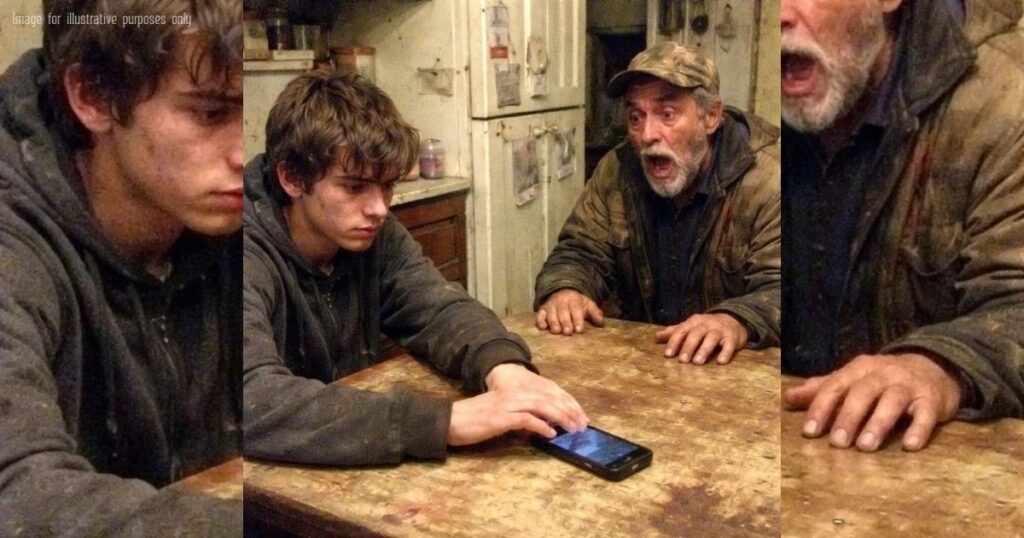
He said, “Maybe. But not because I did something wrong.”
The blazer man blinked, like he wasn’t used to teenagers speaking in complete sentences.
Leo continued, voice steady. “I didn’t ask to be posted. I didn’t ask to be turned into a debate. I just… I just wanted something real. And I found it. In the garage.”
The principal tilted her head. “Leo, we understand you’re seeking healthier outlets. But the attention online can be intense. Sometimes stepping away is best.”
Leo looked her in the eye.
“Stepping away is what you told my grandpa to do,” he said. “You told him it wasn’t your jurisdiction.”
Silence fell like a wrench hitting concrete.
The blazer man cleared his throat. “We can’t control what happens on private platforms.”
“No,” I said, “but you can control what happens on your property. You can control whether kids learn that humiliation is entertainment.”
The principal’s cheeks flushed. “We are implementing a device policy review.”
I almost laughed. Policies. Reviews. More paperless notes.
Leo shifted beside me. I could feel him deciding something.
Then he said, “Can I say something?”
They nodded, surprised again.
Leo’s voice wasn’t loud. But it was solid.
“I get why people are mad,” he said. “Some people think my grandpa was trying to embarrass me. But you know what embarrassed me? Sitting on that bench while people filmed me like I was… like I wasn’t human. That’s what made me want to disappear.”
The principal’s eyes softened a little—real this time.
Leo kept going. “In the garage, I didn’t disappear. I messed up. I stalled. I scraped my hand. I fixed it. That’s not humiliation. That’s learning.”
He swallowed, and for a second he was fourteen again.
“And everyone online is arguing about my life,” he said. “They’re arguing about ‘tough love’ and ‘toxic’ and whatever. But none of them were there when those guys recorded me. None of them asked if I was okay. They just…” He made a small helpless gesture. “They just picked a side.”
That hit me like a cold gust. The kid had just described America in one sentence without ever saying the word.
The blazer man finally spoke, cautious. “Leo, what would you like us to do?”
Leo glanced at me, then back at them.
“I want you to stop pretending you’re powerless,” he said. “I want you to treat filming someone’s worst moment like what it is. Not ‘kids being kids.’ Not ‘outside jurisdiction.’ I want consequences.”
The principal took a breath. “We’ll investigate.”
Leo nodded once. “And I want something else.”
“What’s that?” she asked.
Leo’s eyes flicked toward my grease-stained hands.
“I want a place for kids to do something real,” he said. “Not just talk about feelings. Not just stare at screens. Like… a shop. A garage club. Something.”
The principal looked at the blazer man, and I watched two adults calculate the cost of caring.
Liability. Jurisdiction. Policies.
Leo waited them out.
Finally, the principal said, “We do have an unused maintenance bay behind the auditorium. It’s… currently storage.”
My pulse jumped.
The blazer man frowned. “We’d need waivers. Supervision. Insurance.”
“Of course you would,” I muttered.
Leo leaned forward, fearless now. “So do it.”
When we walked out of that office, Leo exhaled like he’d been holding his breath for months.
In the parking lot, he looked at me.
“I think I made it worse,” he said.
I shook my head. “You made it honest.”
He stared at the school building, eyes narrowed. “They’re still going to talk about us.”
“Let them,” I said, hearing his own words echo back. “But listen—talk is cheap. Always has been. The difference now is it follows you home.”
Leo’s jaw tightened. “I hate it.”
“I know.” I put a hand on his shoulder. “Here’s the part nobody tells you: you can’t stop people from talking. But you can decide what their talk builds inside you.”
He looked at my hand like it weighed something.
“You think I’m made of steel now,” he said quietly.
I almost smiled.
“No,” I said. “I think you’re learning when to be steel.”
He blinked.
“And when?” he asked.
I nodded toward the school doors.
“When you speak the truth anyway,” I said. “And when you don’t turn into what hurt you.”
Leo’s eyes flicked down, then back up. “What do you mean?”
I could’ve lied. I didn’t.
“I saw it,” I admitted. “Yesterday. When a kid bumped you in the hallway and you looked like you wanted to shove him through a locker.”
Leo’s cheeks reddened. “I didn’t.”
“No,” I said. “You didn’t. But you wanted to.”
He swallowed hard. “Yeah.”
“There’s your next gear,” I told him. “Power without cruelty. Strength without becoming a predator. That’s the part that separates a man from a bully.”
Leo stared at the ground for a long moment.
Then he said, “Do you think the bullies will get punished?”
“I don’t know,” I said honestly. “The system moves slow. Like cold molasses.”
Leo’s shoulders slumped.
“But,” I added, “you already got something they don’t have.”
He looked up.
“A life that exists offline,” I said. “A skill. A place to stand. When the internet gets bored and moves on—and it will—you’ll still know how to build.”
Leo’s lips twitched. “And they’ll still just… record.”
I nodded. “Recording is easy.”
He glanced at the school again, and for the first time I saw something in his face that looked like purpose, not just survival.
“What if we actually start that club?” he asked. “For real.”
I felt my chest tighten—because the idea was beautiful, and because I could already hear the arguments it would spark.
A garage club at a school in 2026?
Half the town would call it salvation. The other half would call it dangerous. Outdated. “Problematic.” Whatever word people use when they’re afraid of anything they can’t control.
But controversy isn’t always poison. Sometimes it’s a signal that you hit a nerve that needed waking up.
I looked at my grandson—grease still under his nails, voice steady in his throat.
“Yeah,” I said. “For real.”
Leo nodded once, like a bolt finally turning loose.
And as we walked toward my rusted pickup, I realized the first lesson hadn’t been the wrench.
The first lesson had been this:
In a world that turns children into content, the most rebellious thing you can do is help them become human again.
Thank you so much for reading this story!
I’d really love to hear your comments and thoughts about this story — your feedback is truly valuable and helps us a lot.
Please leave a comment and share this Facebook post to support the author. Every reaction and review makes a big difference!
This story is a work of fiction created for entertainment and inspirational purposes. While it may draw on real-world themes, all characters, names, and events are imagined. Any resemblance to actual people or situations is purely coincidenta